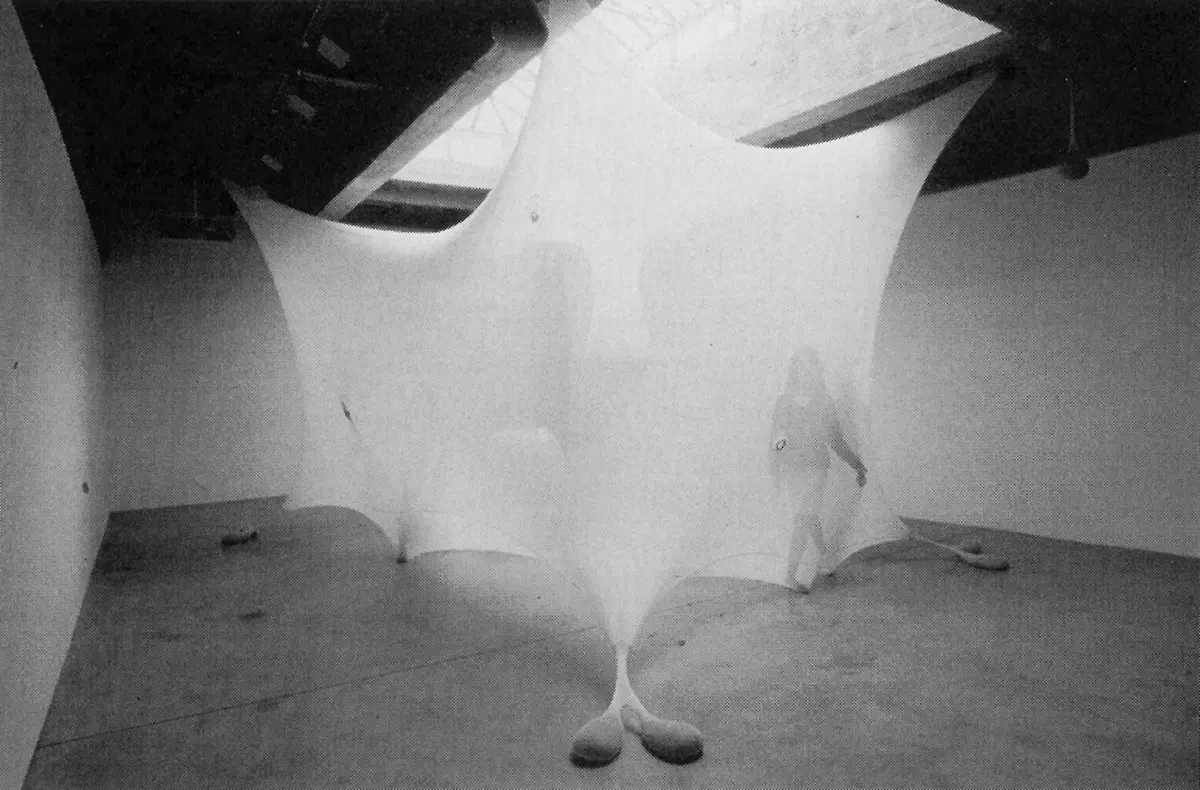
Everything, beginning with the title of this show, seems to indicate Ernesto Neto's intention to establish a sense of continuity between the works presented at the Bonakdar Jancou Gallery. Before entering the exhibition area properly, the visitor was able to read the general title of the exhibition on one of the outside walls: Navedenga and the Ovaloids. Navedenga is the title of the major work in the show, a volumetric rectangle encased in Lycra tulle, a kind often occupied the main room. According to the press release issued for the show, the title of this work comes from the two words "ship" and "denga," the latter being an allusion to female sexuality and fertility. The Ovaloids are individual pieces, in the form of large Lycra sacks filled with little balls of tergopol and pierced with openings that extend like tubes or hoses made of the same material through the entire fabric of the works. The show could be interpreted first of all as the set for a science fiction film from the 1970s. The Ovaloids seem to be inhabitants from some distant planet in the sinuous galaxy of pop and the “ship” their vessel of synesthesia transportation. They are clearly likable creatures, as the visitors were able to see when they took off their shoes and entered the floating capsule of the ship, or when they pushed themselves gently into the slippery interior of the Ovaloids. The pleasantly ludic atmosphere of the works was so convincing that it even managed to distract the spectator’s attention from the specific formal precision of the pieces, which combined the sensuality of Niemeyer’s architecture with the experimental lightness of the installations which Hélio Oiticica carried out at the end of the 1960s, such as Edén. With regard to what might be termed the genealogy of these works, mention might be made of the role played in Neto’s imagination by the group experiences of Lygia Clark—especially those that were carried out by the Brazilian artist towards the end of the 1970s under the collective title of Biological Architecture.
But, between the one and the other, more than thirty years have passed, and Neto’s work, unlike that of Clark and other artists from her generation, is not defined in terms of an iconoclastic search for emancipation, but rather as a practice designed to encourage the spectator to recuperate the sense of intimacy of intersubjective and non-mediatized space.
The question of the interaction between the work and the spectator has been a constant feature in Neto’s production from the time of his early sculptures with polyamide stockings and munitions at the end of the 1980s called the Weights. Both the Colonies (groups of Weights) and the Polyps —which resemble long protuberances made with little balls of tergopol and polyamide stocking— were works supposedly intended to be handled by the spectator. The sensuality evident in the works certainly encouraged the visitor to touch them but their formal precision gave them an unequivocal autonomy that discouraged any kind of external interference. Towards the middle of the decade, Neto did a series of works in which he replaced lead munitions with spices. These works were intended to activate simultaneously the senses of smell and sight, with their penetrating essences and their brilliant earth colors. However, because of their extremely fragile nature, any possibility of direct handling of the works by the spectator was thwarted. Only with the Ships, a group of works carried out for the first time a year ago did Neto finally manage to create a sculpture whose formal precision was not an obstacle to its interactive potential. The Ships were conceived as capsules that could be inhabited and were undeniably intended to be penetrated by the spectator. The transparent fabric with which they are constructed allows a curious visual communication to be established between the spectators outside the vessel and those who venture inside.
In recent months, Neto has gradually made more complex both the surface and the interior of the Ships, giving a kind of irregularity to the surface by including perforations, indentations, and folds which function as poles of attraction, like a kind of topological amusement park.
It is possible that this is one of the reasons why Neto had to conceive this show as an unusual whole, made up of the Ship and its ovaloid excrescences. Both enhance the potential of the other, like the fragments of some fantastic stage set, and the work as a whole manages to temporarily suspend our sense of reality. This suspension is necessary, since it encourages the spectator to establish a ludic relationship with the works, and between the works. Without this ludic space the pieces would be simply autonomous and static sculptures and their interactive potential would remain hidden. In the 1960s, interactivity was seen as a strategy for combating the increasing reification of the work and aesthetic experience in the contemporary world. Thirty years later, with more modest objectives, Neto’s work is an attempt to reactivate this strategy with the sole intention of creating a space of contact of a purely sensorial kind between the work and its public.
CARLOS BASUALDO