Few artists in Chicago have the inquisitive creativity of the Brazilian artist Eduardo Kac, who has moved from working with holography to computer programs, from installations to performance events. In one case, Kac surgically inserted into his thigh, in full view of the public, a computer microchip, which recorded him in an electronic farming database used for locating stray animals. Kac has also invented an electronic robot (which he calls an Ornithorhynchus or platypus), which can be remotely controlled by various users through the Internet.
Kac’s different experiments in poetry, holography, computerization, and robotics not only reflect his creative curiosity, but the clear, focused, and rigorous interests of a sensitive intelligence that is attracted by the seduction of the new, but which does not forget the essence of literary and visual poetics.
Though Kac has spent many years in Chicago (first as a student and then as a teacher at the Art Institute of Chicago), most of his exhibition projects have been carried out in other cities. After a brief absence from Chicago, Kac has now returned with fresh energy and an interest in showing his work there. The result was the exhibition recently presented at the Aldo Castillo Gallery, titled Language Works, and curated by Julia Friedman.
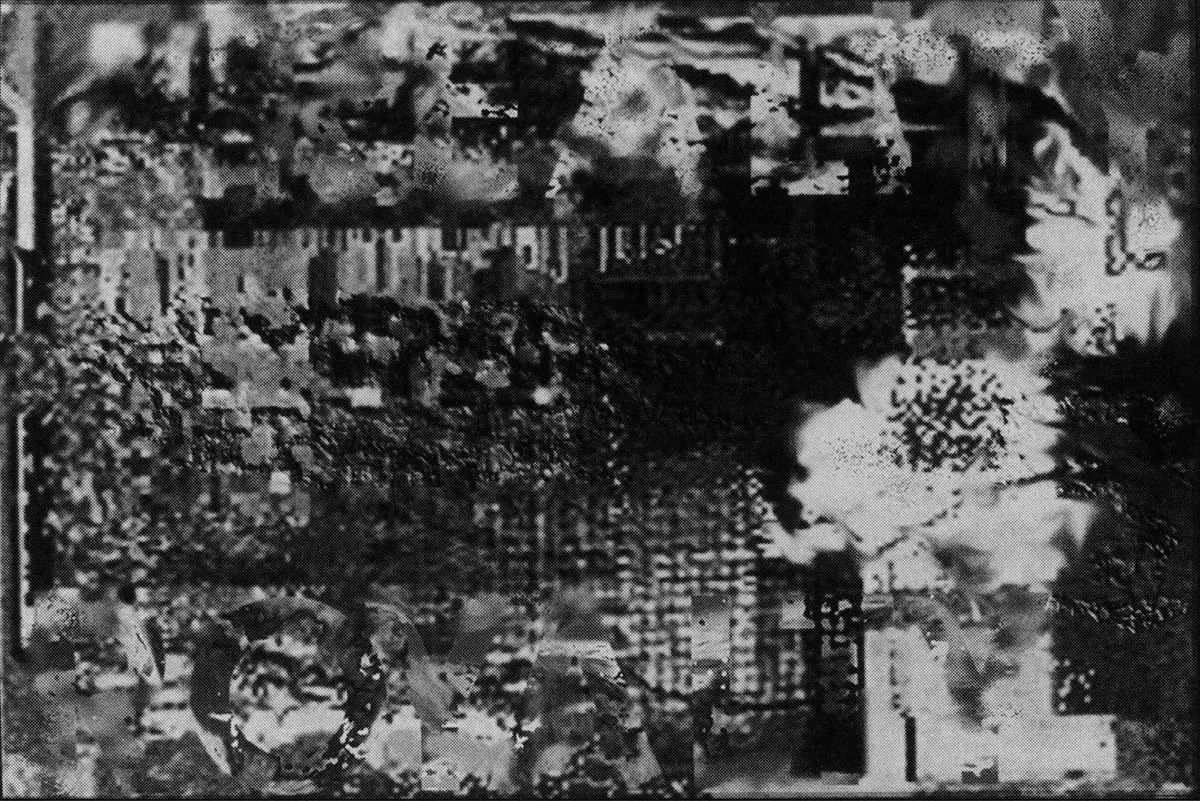
In this exhibition, the visitor was shown a sample of Kac's constant fascination with a series of themes, including the way language functions, and the frontiers between the visual and the textual, the technological and the literary. From very early on Kac has explored language through holography, a medium that allows him to present a specific image in a three-dimensional form that seems to be moving. Using this medium, Kac worked for ten years on the development of what he called Oholopoetry. poems that can be read in different ways depending on the direction or the position in which the spectator looks at them. Without a doubt, one of the fundamental influences on Kac’s work has been the legacy of Brazilian and international concrete poetry. Subsequently. as seen in Language Works, Kac explored other kinds of interactivity through computer programs. In this exhibit, the visitor was able to enter a program through which he could read a poem in many different ways, depending on the decisions made by clicking on the screen. Creating a poem in this way with many reading options (a well-established literary tradition in Latin America: see for example Rayuela, by Julio Cortázar, or Blanco, by Octavio Paz) makes the reader more active and a creator of meaning.
The works in the show had complex conceptual origins. For example, another work, entitled UPC, consists of a video projected onto the wall with diagonal letters crossing the screen to form phrases such as Nothing above to Left or right nothing below. Kac has a great familiarity with semiotic theory and provides significant explanations of his experiments. It is difficult to imagine, however, that any spectator would notice the connections between this work and the fact that, as the artist points out, his work adopts a nihilist position, suggesting that the rigid dichotomies of the past, such as the political left or right or the “above" (heaven) and “below" (hell) of religion, are being overcome by economic forces (UPC, incidentally, is the acronym for universal product code.)
Seen in this way, the ultimate strength of Kac’s work does not necessarily lie in the conceptual structure on which it is based or the source of the artist’s inspiration (but not the starting point for the spectator), but rather the impact of the intrinsic poetic dimension. There is no need to be a specialist in semiotics to understand that there is a language, both visual and literary, in these cold pieces of apparatus known as computers. For a moment we can forget that we are in front of an electronic screen, and momentarily feel the illusion of poetic space. In the final analysis, the objective is not to explain, but to present an infrastructure that generates a multiplicity of experiences and interpretations. Wittgenstein believed that language was only useful in allowing us to realize how inefficient it was in describing the world: “I am only describing language, I am not explaining anything." In Kac's case, too, language is not definitive, but neither is it useless: its usefulness lies in its ability to be many different things as we use it to navigate through the seductive labyrinth of his works.
PABLO HELGUERA