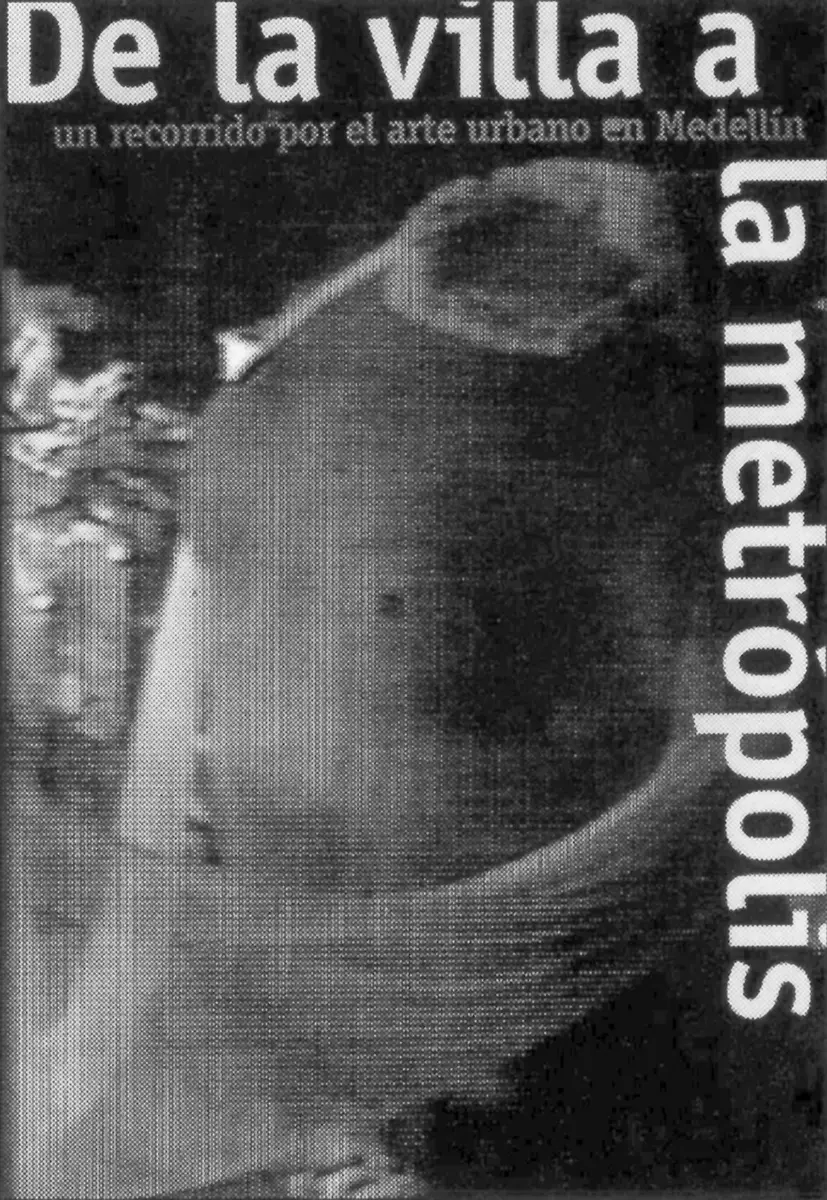
This book published by the Secretariat of Education and Culture of Medellin, under the directorship of Jaime Xibillé, with the collaboration of several writers and university teachers, unfortunately, does not reach its objectives. Although the prologue sets forth the objectives of the book and there are brief descriptions of the contents of seven of the eight articles, the publication in general is diffuse, confused, and often obscure. Despite the importance and interest of the subject —the city of Medellin-most of the writers prefers to engage in theory— of a mostly airy kind, to boot rather than undertake a rigorous investigation of historical facts. Above all, there is no systematic study of the urban art of the capital of Antioquia. Since the specific references to the works reproduced are very few, the reader has the impression that the illustrations are merely decorative appendages, lacking any real importance. Since some of the authors write about the city in very distant terms, including comparisons and digressions of a rather petulant kind, we begin to wonder whether these writers have ever walked through the city or ever really looked at the many artistic works of the city, or if they have done so, then their eyes must have become blurred. Maybe by their many cosmopolitan experiences?
The 144 pages of the book contain a number of —sometimes quite good— photographs which in most cases do not accompany the texts. For example, in the part where Xibille says that Arenas Betancur's Monument to the Race is "imposing and sublime," there is a full page showing the Pieta by Bernardo Vieco, a work to be found in the Cementerio de San Pedro. This lack of coordination does not however mar the article by Alberto Uribe, the most straightforward in the book, though it falls short of the mark concerning the subject of urban art in the 1970s (to a large extent because the writer himself was one of its protagonists); or the article by Edgar Bolívar dealing in particular with certain works from the International Art Festival of 1997 or that of Jairo Montoya and Jaime Xibillé, The birth of an urban symbol, one page in length, on Botero’s sculpture titled The Bird, which was destroyed by a bomb in St. Antonio Park a few days before its inauguration. At the end of the note the writers say that the "symbolic universe now evoked by the sculpture makes it an authentic tattoo of memories that cannot be excluded from it: the holes produced by the explosion, the deformations resulting from the shock waves, and the resulting changes of meaning not only in the biological memories but in those constructed by the various registers of the mass communication media." Since it would be inofficious to comment on texts of this kind, let me add only two indisposed, by Santiago Restrepo, is absolutely lamentable, not only in its scant selection of public works, from the torso of Girardot, by Cano (1910) to the Tetrahedron by Alberto Uribe (1988), in a city which according to the book has 850 urban works. The author's comments are either too obvious (in the case of Christ the Pastor by Constantino Carvajal, the note that it is a "religious work") or incredibly trivial (in the case of Ramírez Villamizar's Wall opening up, the remark that its monumentality and central opening encourage us to play with metaphors: zip, incision, abdomen. Other comments are extremely narrow or distorted, as in the case of those dealing with the enormous production of Pedro Nel Gómez: Meanwhile (during the Bachué "current") the master began to paint by the meter the surfaces of public and private buildings. 2) What credibility can the article by Jorge Echavarria have when he systematically quotes Lyotard, with references to thousands of things that have nothing to do with Medellin, such as Richard Serra's Tilted Arc and the inflatable sculptures by Carlos Blanco, etc. After a brief review of the urban art of Medellin, Echavarria puts the final touch to his summary by noting that "there is virtually no doubt about Lacan's diagnosis (Lacan was never in Medellin, but he did state in one of his seminars that making visible and revealing to the gaze is sometimes the best way to hide something and conjure it away): is the public art of our city increasingly less visible in its untranscending proliferation?" One indeed wonders whether Dr. Echavarria has had the time to discover the latest sculptures in Medellin.
GERMÁN RUBIANO CABALLERO