The gallery which presented this exhibition of work by Carlos Torres is located in old Montmartre, and its discreet location seemed to suit the intimate nature of Torres' work. Although the André Roussard Gallery is the oldest gallery, it still carries out perhaps for that reason-important activity in the field of publishing (books, prints, lithographs, and posters). But today, despite its 2,000 artists (including Nicolas Schöffer, Valerio Adami, and Corneille), the former mythical village which existed here at the turn of the century, with the famous and renovated Bateau-Lavoir of Picasso (now the residence of artists of all nationalities), has been abandoned by the city’s contemporary art galleries.
The figurative phase of neo- Mexicanism in the 1980s did not contaminate the work of Carlos Torres. A Mexican painter who settled in France in 1974, Torres has maintained a coherent aesthetic direction. His projects, which are both conceptual and pictorial, establish a link of sorts with the kinetic artists but also distance him from them because of the specificity of the creative dialectic between abstraction and figuration. Torres managed to assimilate the teachings of Torres-García (the compartmentalization of the surface) and the Madí artists in questioning the limits of the frame and the perception of the work. From the 1950s, these painters wanted to open up new paths to real and virtual movement, creating a mobile and transformable art that, a few years later, would continue to be investigated by kinetic artists. In 1949, Arden Quin perforated the surface of the picture, and the wall entered into the perception of the work. At the same time, Rod Rothfuss interrogated the frame and its limits through cubist composition. To these explorations which Torres assimilated and reinterpreted in a spirit of freedom that had nothing to do with any school-like dependency, mention should also be made, regarding the idea of fissures and laceration, of the influence of Lucio Fontana, in the creation of an “unbalancing of intensities" which reveals a cosmogonic and mythical image of the universe (Severo Sarduy).
The works presented in this exhibition (seventeen mixed media works from 1996-1998) reflect the radical differences between this painter and his predecessors: his move towards a warm kind of painting the purpose of which is to strike back at the void (virtual or real, hole, wall or flat white or black surface) by questioning it iconographically.
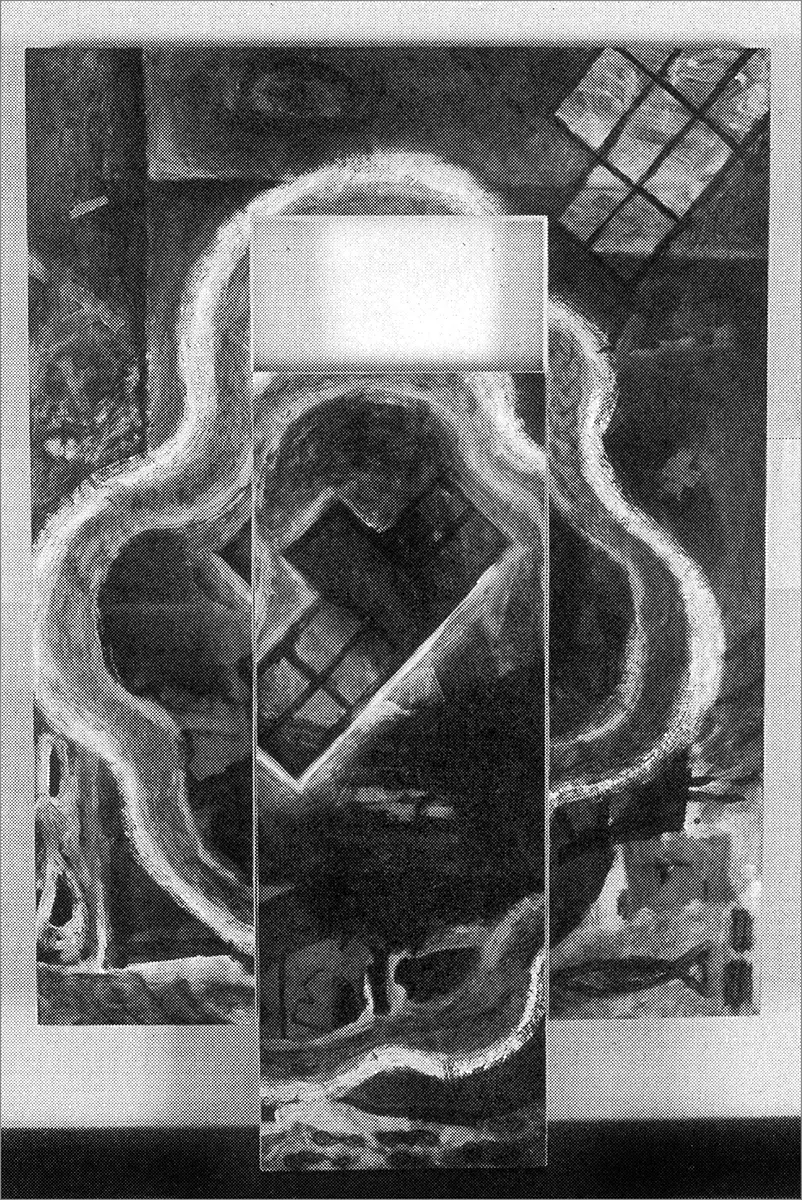
This presence of painting confirms Torres’ permanent reliance on an expressiveness that recalls the “sensitive geometries” of the Southern Cone. Carlos Torres is, without doubt, a real colorist and continues to be a “landscape” artist who cuts out, reconstructs, and organizes a new geometry of nature. His gestural vocabulary, both in form and linework, is more or less a kind of sensual “calligraphy.” This contrast between conceptual and sensitive elements is based on the molded forms and the color lit from inside; the space is structured by the presence of black color which creates the contrasts and transparencies of stained glass.
The artist defines his basic concept as that of a spectator. The psychoanalytical, philosophical, and aesthetic levels of his work are the result of this premise, as well as of the interplay between what is hidden (prohibited) and what is seen (allowed). However, this voyeurism does not have any explicit sexual overtones. It is instead the result of the intrinsic and twofold potential of creation regarding the unknown and the known, what can be seen and what can be imagined. When Torres plays in his triptychs with black panels contrasting with pictorial density (an interplay between graphic elements and textures resulting from the subtle interaction between pastels, acrylics, and inks), a window is opened up onto an adventure, the adventure of aesthetic discourse. This game of contrasts and opposites becomes a questioning of the precarious nature of the process of a work conceived in two times.
The technique of cutting or laceration could have taken him towards a kind of purification, as in the case of the Madí artists. However, with Torres, there remains the closeness of the vital power of color which he handles as if it were light to create genuine chiaroscuro tones. Beyond the whites and blacks, he works with transparencies, densities, and vibrations to humanize his pictorial discourse. The fragmented, ripped image acquires a new space: it is recontextualized and enters another dimension within this halo in a succession of degraded surfaces in blacks, grays, and whites. It is the very fine work on these shades which generates a virtual depth. To call the attention of the spectator is to introduce the latter into a world of fluctuation, into the moving yet the permanent dimension of art. Here, thanks to the integration of signals and signs, the representation is able to question its own limits as well as its own destiny.
CHRISTINE FRÉROT