It's been thirteen years since Gallery Lilián Rodríguez opened, and has done some exchange exhibitions with her native Argentina in order to promote Latin American art in Montreal.
Young Romero (1963) has a Master’s degree in Fine arts and is finishing her Doctorate in Art History. She also spent one year studying in Paris at L’Ecole du Louvre. Romero’s work is decorative, colorful, and balanced and is rich in Mexican iconography. Her work is conceptual and avant-garde, concerned with political issues, environmental, and religious themes expressed through a postmodern fusion of Mexican colonization imagery. She works in series with different concepts, so her visual language changes constantly...
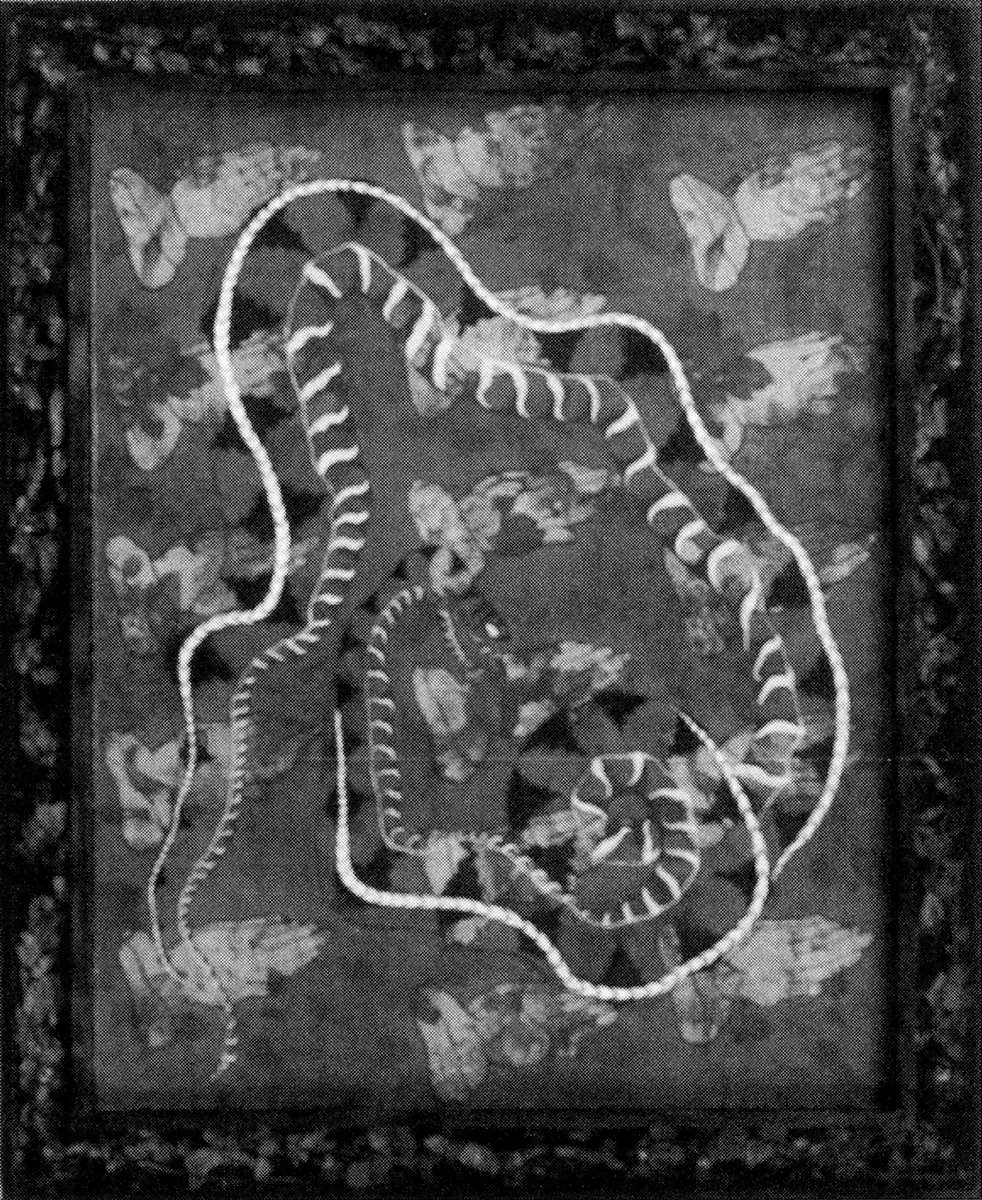
Romero’s paintings are ‘constructions' in which she glues the painted canvas to a piece of plywood. It is then mounted in a glass-covered thick wide frame, with a gap filled with organic elements such as dry roses, stems with thorns, or bird feathers. Her intent is to break the tradition of the frame as a compliment. Romero instead wants the frame to be part of the work, something that gives physical and visual solidity to the painting. In past series she has glued painted canvas to car hoods, fenders, and doors, thus creating ‘sculptural paintings.' Romero also has done paintings of Mexican colonial imagery blended with well-known Pop art images of Warhol, Wesselmann, and Lichtenstein.
This exhibition is titled Huellas de un Edén “a reference to the flower images of popular Baroque Mexican paintings that appeared in the saints’ robes or curtains that make an allusion to paradise.”1 At first glance, some of the works give the appearance of colonial flower paintings, because of the heavy use of ochres and the fading hues in the background that make it seem as if time peeled the oil paint from the canvas. On a second look, they are avant-garde works because of the wide frames with dry roses. There is an ambiguity of feelings in her work.
Territories Paranoicos IV is a balanced image of flowers in bright and dark colors. The frame is gold-colored and the flowers evoke the thought of colonial paintings immediately. On closer inspection, we see that Romero has nailed seven small plastic snakes to the floral image. This symbol changes the reading completely, the “invasion of snakes gives a meaning of lost paradises, an opposition to goodness and also means one of the most terrible invasions we suffer.”
Paraisos Paranoicos V is another colonial flower painting but one that has a different feeling from the others. It looks like part of a mural, because of the use of gesso patches, heavy impasto, and heavy linear brush strokes. Is loosely painted and old looking as well. We can see the artist gets the desired intentions because they are conveyed to us through her work.
Romero's visual language changes drastically from one series to the next, and in this way, she keeps her oeuvre fresh and rewarding. The only thing that remains in her trade signature is the thick wide frame with dry roses. Her acceptance in the international market is becoming rapidly established. Her show marks a new beginning for Latin American art in Montreal. Next year, the Montreal Museum of Fine Arts will present Modern Mexican Art, 1900-1950, an exhibition that will surely give Latin American artists more visibility in Canada.
NOTE
1. Interview with the artist, October 1998.
AUGUSTO CHIMPEN