The end of the century brings with it a series of discourses on the demise of exhaustion of thought, the sense of disillusion, the lack of faith and ideologies, and, at the same time, a review of all that man has done, the excess of information and ideas. Asdrúbal Colmenárez is a Venezuelan artist who has lived in Paris for thirty years and in his most recent exhibition, he freely evokes the knowledge, aesthetics, concepts, and questionings which have marked our times.
Colmenárez exalts the conceptual dimension of the work of art, the precision of such concepts, and the apprenticeship of the history of art. Similarly, he is interested in the final result of art, its ethical transcendence, and the reflective essence that it should involve.
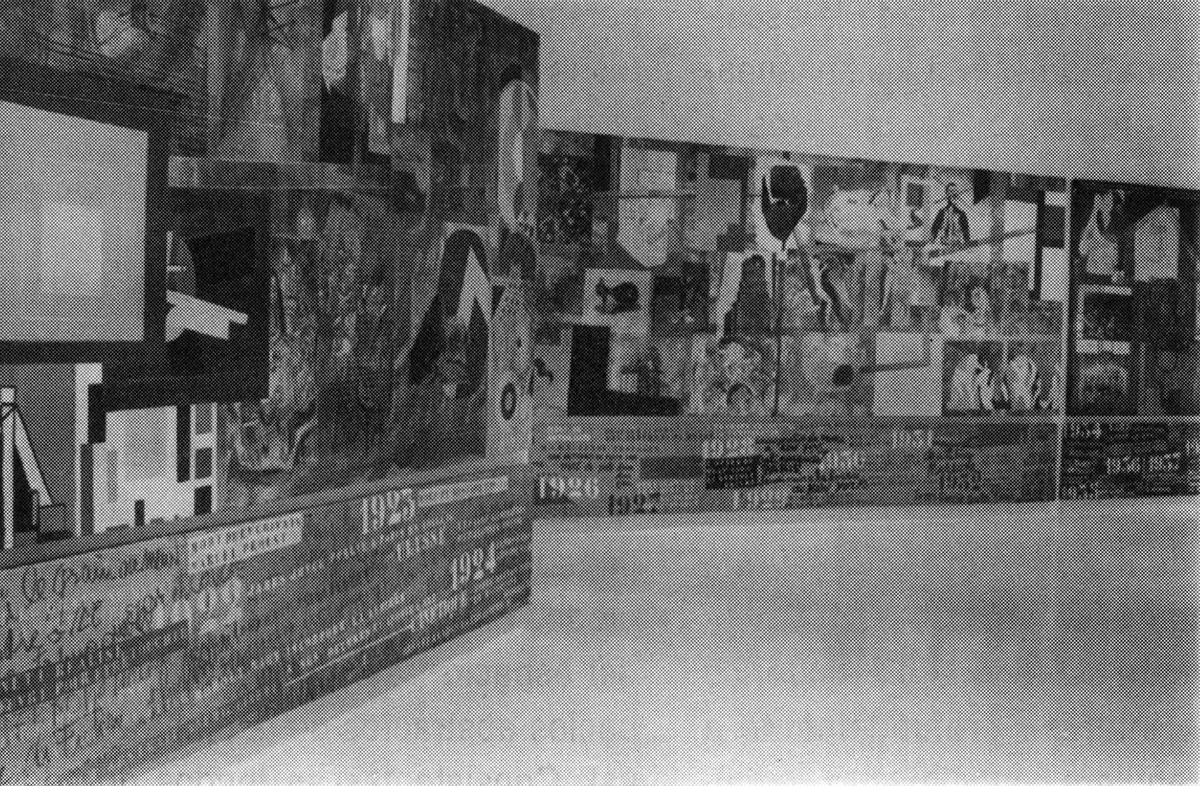
This exhibition was made up of several panels which depict the icons which have characterized our century —the most pronounced feature of which is the concept of the new. New postures, acts, and works. Originality, innovation, topicality. The new in Colmenárez's condensed image is reduced to ten mural canvases and 230 memorable works which reflect the notion of sensibility towards the artistic phenomenon and rework the meanings of interlocking chronological information.
Modernity has diminished the frontiers between the past and the present and made them contemporary. Thus Colmenárez brings together the historical avant-gardes from the Demoiselles d'Avignon to Penk, Clemente, Baselitz, Spoeri, Beuys, and Mapplethorpe, among others gathered together in his final picture. The sense of balance is a sign of the times. The gauging of sources and landmarks, the historical criterion, and the certification of the final outcomes in our times are matters which were pointed out by Robert Rauschenberg at the end of the 1950s, with the accumulation of citations as an expression of his same work. Further, in certain pieces by Fernand Léger or Joaquín Torres-García, the combination of factors served the purpose of creation itself and the formulation of its spaces. For his part, the painter Erro called on the history of art to celebrate some of the figures of the century, as in the work titled Pollock from 1966 (from the collection of the Georges Pompidou Center). In the 1980s, the attitude Basquiat implied a journey through art, while in the Venezuelan context, Carlos Zerpa, in his exhibitions titled India Nova (1987) and Heroes and Villains (1989), established intersections between the models of modernity. Now Colmenárez makes use of both the succession of paintings (and some sculptures) as well as referential dates and data.
The hallmark of art today, Jorge López Ayala has said, is its simulacrum. In a way rarely experienced before, there remains in the spectator a sense of reflection. These notions had already appeared in the work of Colmenárez in his Polysensorial Alphabet (1978), continuing to this current work, titled Transposition.
Finally, it is worth noting that in the selection by Colmenárez which refers to two hundred and thirty specific works from Western art, there are only five Latin American artists (Diego Rivera, Torres-García, Lam, Tamayo, and Soto) included. An opportunity has been missed for proposing a re-reading of the process from a non-Eurocentric point of view.
JUAN CARLOS PALENZUELA