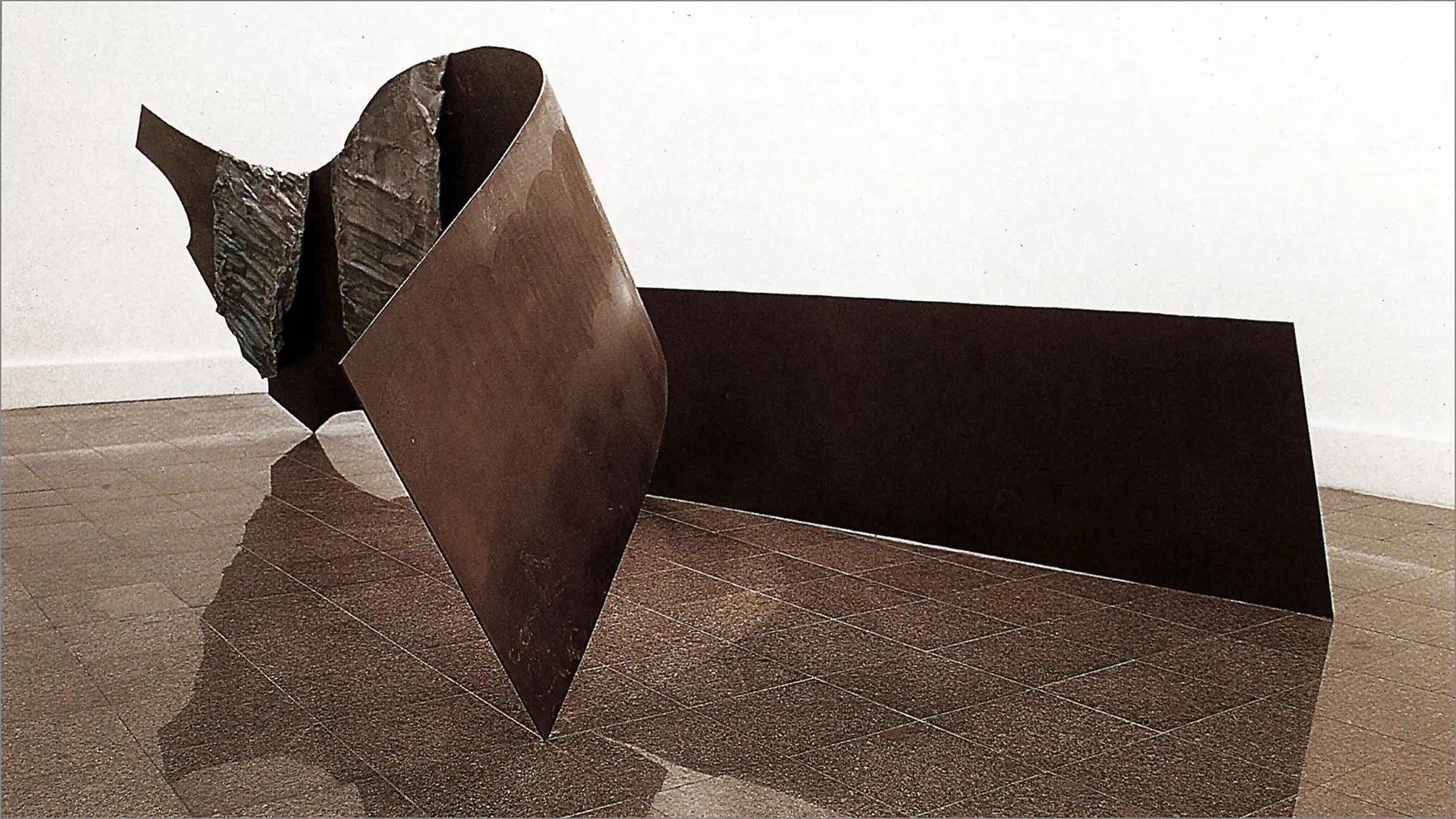
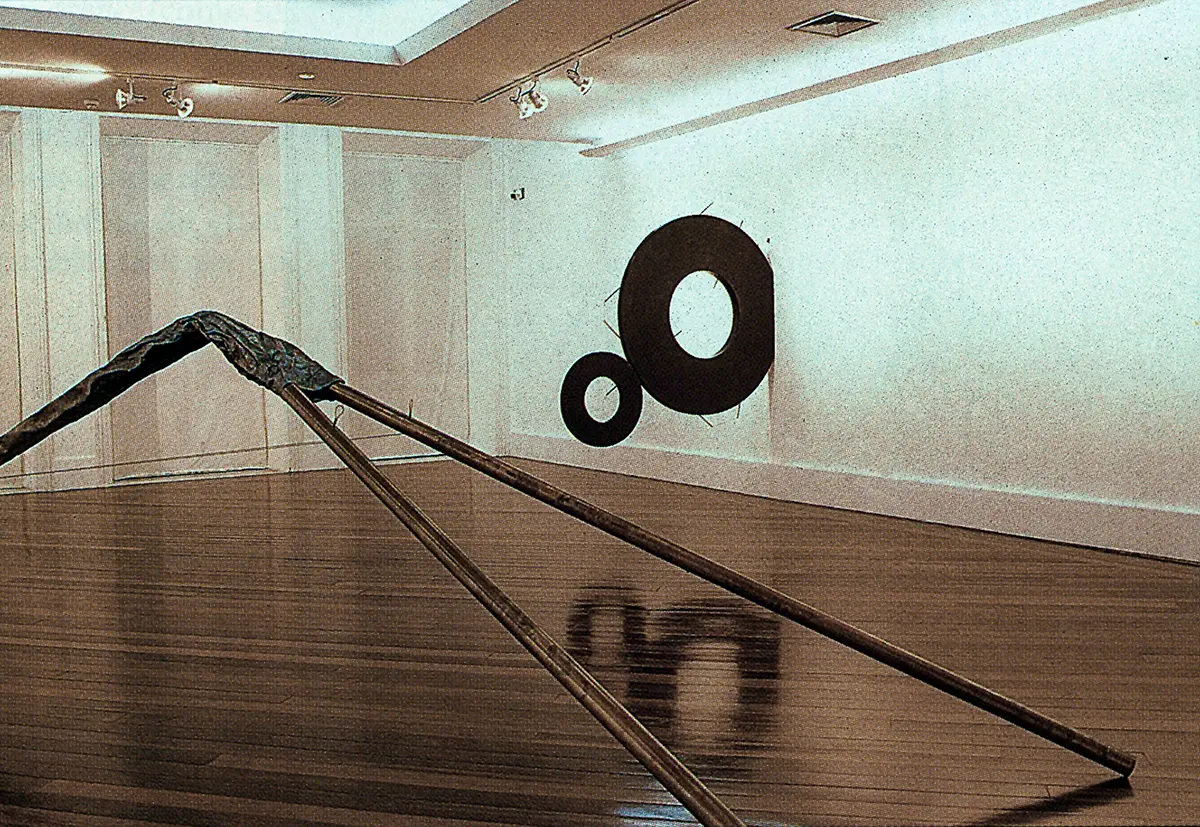
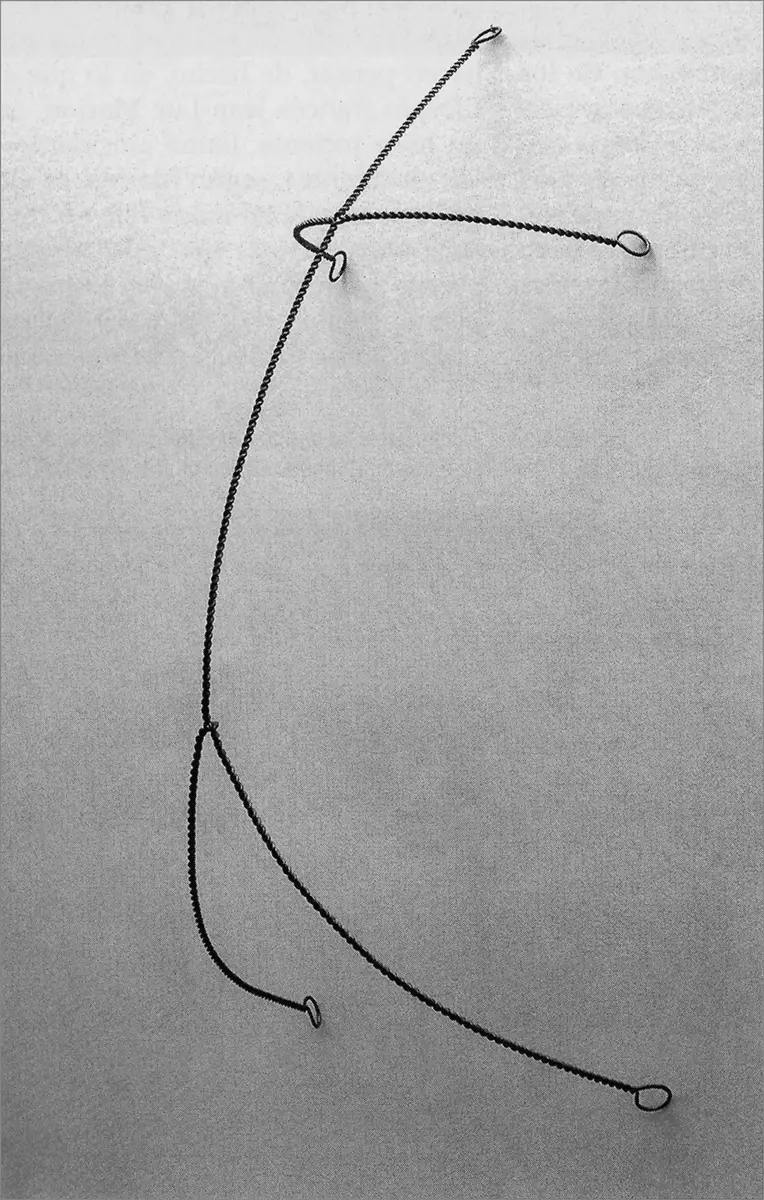
Years ago, at the family gatherings at Christmas or New Year's, long after midnight, some children and adults, small imprecise beings, fiddled with the wire structures that covered the corks on the champagne bottles. I was immediately reminded of some of the finest works in a recent José Resende show at the Hélio Oiticica Art Center and in the Paulo Fernandes Gallery in Rio de Janeiro. The same, almost pathetic, grace of those animals of no species suddenly seemed to be inhabited by an object made of four iron sections, linked by rings, and supported upon a block of hay, which opened the show at the Oiticica Center; or a long "Z" made of metallic tubes wrapped with thin sheets of lead and tied with thin cables, which closed the show. This impression seems to have been shared by the Brazilian critic Ronaldo Brito, who wrote the text for the show's catalog, and who praises "the way in which [Resende's works] appear in the world, quickly and fortuitously," in such a way that, in them, "the provisional is positively reevaluated."1 Indeed, it seemed to me from the very beginning that there is something provisional in these pieces, something that is merely for now, and they propose themselves more as possible states of a body than as definitive and, therefore, in some way, necessary profiles.
But, who is José Resende? He is doubtless one of the central artists of the generation of Brazilian artists who, born between the late '40s and early '50s, perpetuated certain essential developments from the late '60s (developments especially associated with the names Lygia Clark and Hélio Oiticica). These artists include, for example, Cildo Meireles, Waltercio Caldas, Jac Leirner, and Tunga. Resende himself was born in Sao Paulo in 1945. He graduated with a degree in architecture in the same city and has shown his work primarily in Sao Paulo and Rio de Janeiro since 1964. His work was recently shown at the Robert Miller Gallery in New York and in Kassel.
Curiously, Resende's work is easy to describe. The description, however, gives a rather poor idea of his rare way of affecting the viewer. Let us consider a piece from 1994 which is particularly emblematic of his work: an object whose title in English would be velvet, paraffin, copper, and steel cable. It is a composition made of these materials placed in an unstable equilibrium. The piece is a sort of velvet sleeve spread out on the floor. Paraffin has been poured over the ends of the sleeve. The composition is pierced by a curved steel bar whose tips are joined by a tense metallic cable. The fragility of the construction (of the precipice) is extreme; it is obviously elegant, but at the same time there is something vaguely obscene about it as if that elegance were to disappear from itself at the last moment; as if, upon presenting itself, instead of maintaining its composure, it were to lose it at the decisive moment.
It is quite suggestive that the majority of Resende's works have for their titles a list of materials used to make them, written in small letters— thus avoiding a title that refers to its contents or form, and avoiding the conventional use of "Untitled." Resende's titles are minimums of denomination, denominations in their minimal form. However, minimal as they are, these titles never cease to indicate something: as far as the labeled objects are concerned, the titles indicate material rather than motive or form. Few artists adjust themselves better than Resende to what Roland Barthes wrote with respect to Cy Twombly's paintings (in a text from 1979 titled "Wisdom of Art").
What is unique in Twombly's operation, according to Barthes, is that he "imposes material, not as something that is going to serve a purpose, but rather as an absolute material... that preexists the division of meaning." The power of the painter, says Barthes, is that "it makes material exist as material; even if one meaning rises from the canvas, the paintbrush and the color continue to be "things", obstinate substances from which nothing (no subsequent meaning) can undo the obstinacy of "being there"2. The title of this object is a discreet list of his materials, primarily because the program that Resende obeys as he works is that of presenting certain materials in their obstinacy.
However, this object, this scene, this unadorned theater not only finds its title in the materials with which it is made, but its title is also in small letters: I believe that this is an indication of Resende's desire to avoid the melodrama of materials characteristic of certain art forms of the '50s, '60s, and '70s. The materials in Resende's works are deliberately exposed, but as something common and uncultivated: the banal materials with which everyone negotiates daily life, presented in their banality, with nothing especially "original" or "alchemical" (nothing in them, for example, of the felt and grease of a Joseph Beuys). There is nothing telluric or cosmic in the work of this artist (who has been realizing what I would call an art of urbanity, albeit a perturbed urbanity).
Resende's most auspicious pieces show or "impose" certain materials (and, more precisely, the contact between certain materials), but they also possess forms: even suggestive forms. Like the imaginary universe of Lygia Clark, Resende's world is fundamentally animal: it is a universe of imaginary animals, of forms and attitudes that evoke imaginary animals that, nevertheless, have the virtue of perturbing the faculty of identification. In the face of those more —shall we say—, animal objects, we are not finished telling ourselves "that's an animal," when we begin to ask ourselves "what type?" These compositions make me think, in fact, of what the French philosopher Jean-Luc Marion calls, in a recent book, an "incident." According to Marion, an "incident" is "what arrives in such a way that it consists in nothing more than this first and final arrival, without preexisting in any way and without making itself visible before the incident." The "incident" consists entirely in the act of its own obstinate appearance, "with no background, no prevision or provision reduced to that act."3 An incident, such as Marion defines it, is something that appears without allowing the person for whom it appears to identify it fully: something that begins by escaping its viewer, as if we had it on the tip of our eyes (as we say when words that escape us are "on the tip of our tongue"), and which arrives, which comes to occur, to present itself, at the same moment in which its identity is lost.
Resende's most intense compositions (which are generally the most squalid) recall the work of Clark (especially the Clark of the Bichos [Animals, or Beasts]) or Richard Tuttle, much more than certain arte povera sculptors like Giovanni Anselmo, with whom he shares some important propensities concerning matter and form. The same spirit of Tuttle's miserable constructions is found, for example, in a solid pouring of plaster, pierced by wires, that hung in the Paulo Fernandes Gallery, or a fragment of fabric that enclosed another fragment of leather in the Hélio Oiticica Center, or, finally, a small arabesque pendant of twisted lead that seemed to have been improvised (a work of quick pincers and hammers that is the three-dimensional equivalent of a sketch) bearing the scant title plomo (lead).
Works like these make me think of a text in St. Augustine's Confessions (in which he deals with lost identities). The text is found in Book XII, and the context is a discussion on the notion of matter, which is, in the traditions referred to in the discussion, something that lacks form. St. Augustine explains the difficulty of imagining anything that completely lacks form, yet nevertheless exists. He writes: "For l could more readily imagine that what was deprived of all form simply did not exist than 1 could conceive of anything between form and nothing—something which was neither formed nor nothing, something that was unformed and nearly nothing" (XII, 6, 462). The stupor of not being able to propose to the imagination something that would be almost nothing can only be overcome —says the saint—, by concentrating on one phenomenon: the mutability of bodies. Only by concentrating on the change of bodies can we imagine, momentarily and unstably, something formless. And so l applied to the bodies themselves and looked more deeply into their mutability, by which they cease to be what they had been and begin to be what they were not. This transition from form to form 1 had been regarded as involving something like a formless condition, though not actual nothingness. But what is that mutability between two forms? asks St. Augustine. Answer: "Could it be said, 'Nothing was something,' and 'That which is, is not'? If this were possible, I would say that this was it."
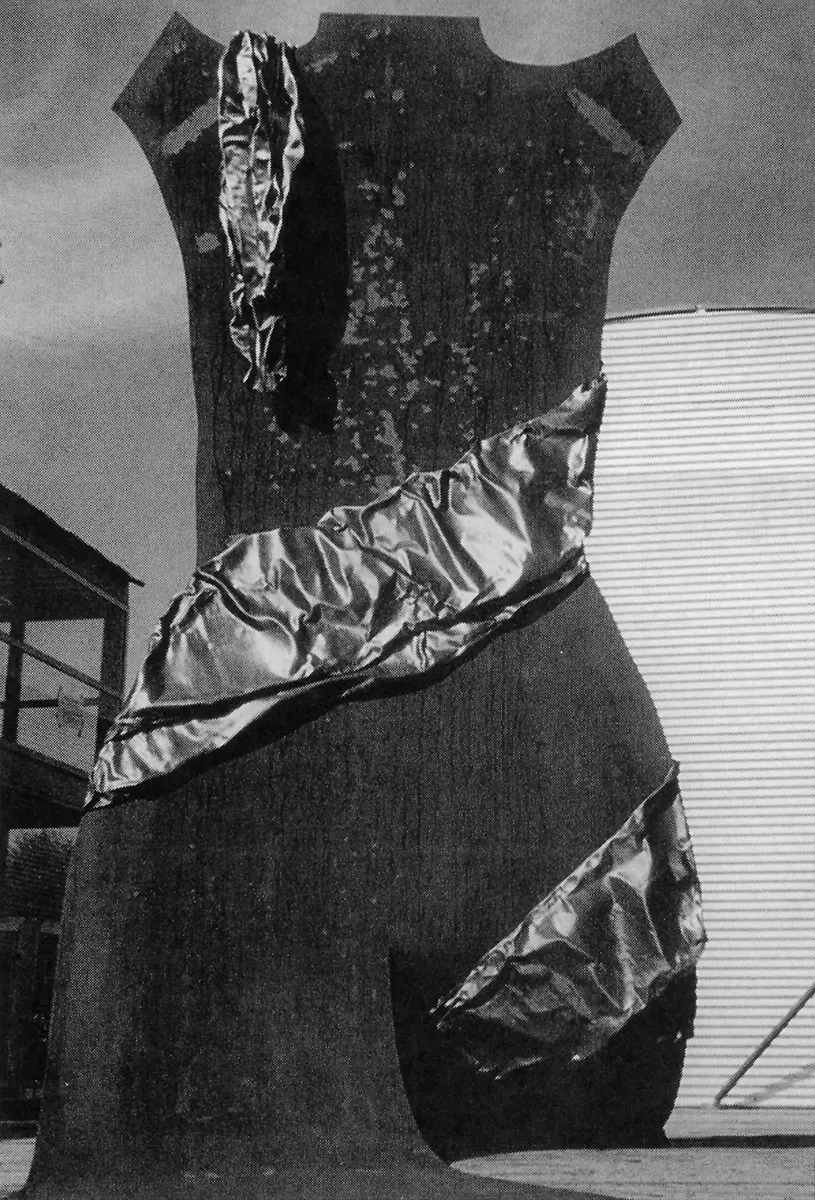
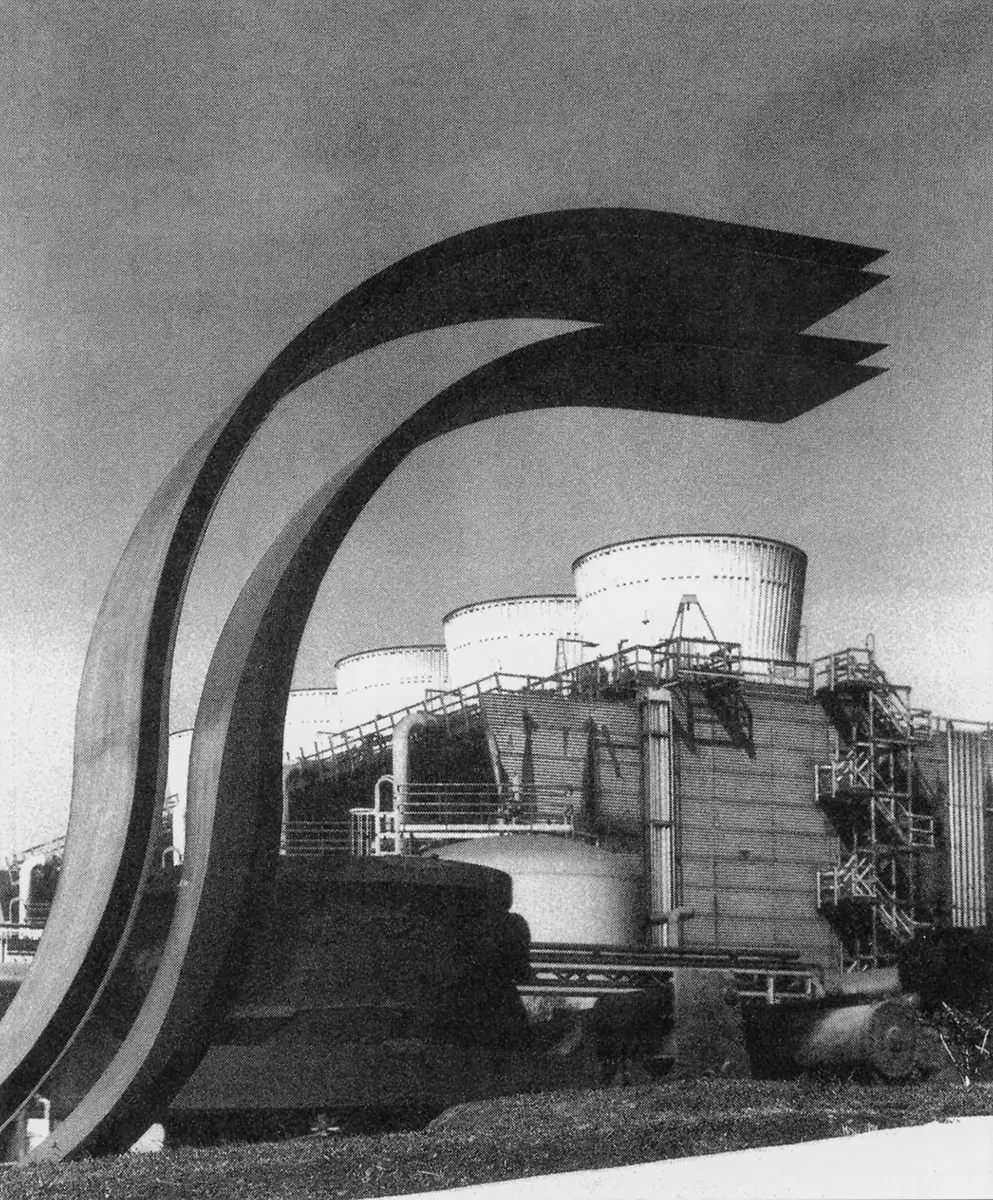
In my judgment, it would be the same to say that Resende fails at the exact moment his constructions acquire consistency, density, and the weight of the monument. This is the case with certain female silhouettes that he has realized in recent years which, unlike the great majority of the artist's work, have a big title (they are called Venus). It is also the case of a work from 1996 that recalls Giacometti. This composition is made of two large, curved steel sheets that evoke legs, installed in Rio de Janeiro's Largo de Carioca, bearing the title Pasante (Passerby). The Brazilian artist finds himself at the polar opposite on the spectrum of sculptors, of a Richard Serra, whose effect is inseparable from the sensation of an overcome resistance and, in sum, a sensation of force. The impression of ease in the realization of his pieces is essential in Resende's sculptures: the impression that they were completed in a minute, almost without thinking, with no effort. And the impression that they are works (not so many works as operations) of leisure which issue from him, and which are directed towards him.
Why has Resende received less international exposure than other recent Brazilian artists, and contemporaries of his who are at the same level? There is probably not an entirely good answer to that question. But it seems reasonable to think that one reason is that this work, unlike that of Cildo Meireles or Tunga, for example, is not made to impress, move, or enthuse, but rather has another purpose. But what other purpose? Our critical vocabulary is so permeated by the idea that art is a basically exciting activity that it is difficult to pinpoint that purpose.
The virtue of these works does not reside in their ability to excite, but rather elsewhere. They do not appear except in the measure in which they are given time. The time that we are able to give them is directly proportional to the energy (we could say to the weak energy) of their unfolding. For the naturalness, which is one of his immediate characteristics, gestures, and ways of appearing before us, is what these compositions lose in the measure in which we give them time. But, likewise, they are eminently able to give us time, a certain time, a certain quality of time: they give us a time not made taut, but rather one that expands. In a certain way, it is as if Resende's pieces disintegrated before the gaze and, in that insistence, that obstinacy of disintegrating, they distended the time they occupy (and, of course, their space).
It seems to me that these pieces are aimed more at moving, impressing, and dazzling than tentatively making an advance (as we speak of "advances" in the vocabulary of seduction), leaving the viewer with the impression of a light touch. Is that what Ronaldo Brito refers to when he speaks of these pieces as "problematic evidence" that "insist on remaining there, throbbing when they should be finished or undone"? I believe so. In reference to a string quartet by Paul Hindemith, the great Brazilian writer Clarice Lispector wrote that he "is before maturity," like a "root fallen asleep in its force" or a "smell that has no scent." This kind of entity (both reserved and insidious) constitutes the greatest pieces of this artist: bodies without profiles? accumulations without character? volumes without a body?
NOTES
1. Ronaldo Brito, “Em forma de mundo," José Resende (Rio de Janeiro: Centro de Arte Hélio Oiticica, 1998) 17.
2. Roland Barthes, Oeuvres completes, vol. 3 (Paris: Seuil, 1995) 1021.
3. Jean Luc-Marion, Etant donnd. Essai d'une phdnomenologie de la donation (Paris: Presses Universitaires de France, 1997) 213.
REYNALDO LADDAGA
Writer and essay producer based in New York. He teaches at New York University and has published extensively on literature and art in Latin America and the United States.