Alejandro Pintado (Mexico City, 1973) goes around the Federal District of Mexico City like a clandestine observer who keeps a wary distance from what is going on. His depictions of anonymous beings turning their backs on the spectator, or the faceless silhouettes which invite us to engage in a contrasting dialogue of presences and absences, are the distinctive features of Pintado's digital photographs.
The figures superimposed on manipulated photographs of various avenues of the city seem to be so close to us and yet so introspective that it is difficult to determine whether their relationship with the spectator is one of subtle and intentional ignorance, a farce, or simply an aesthetic game designed to give the paper the resonance of some latent proximity.
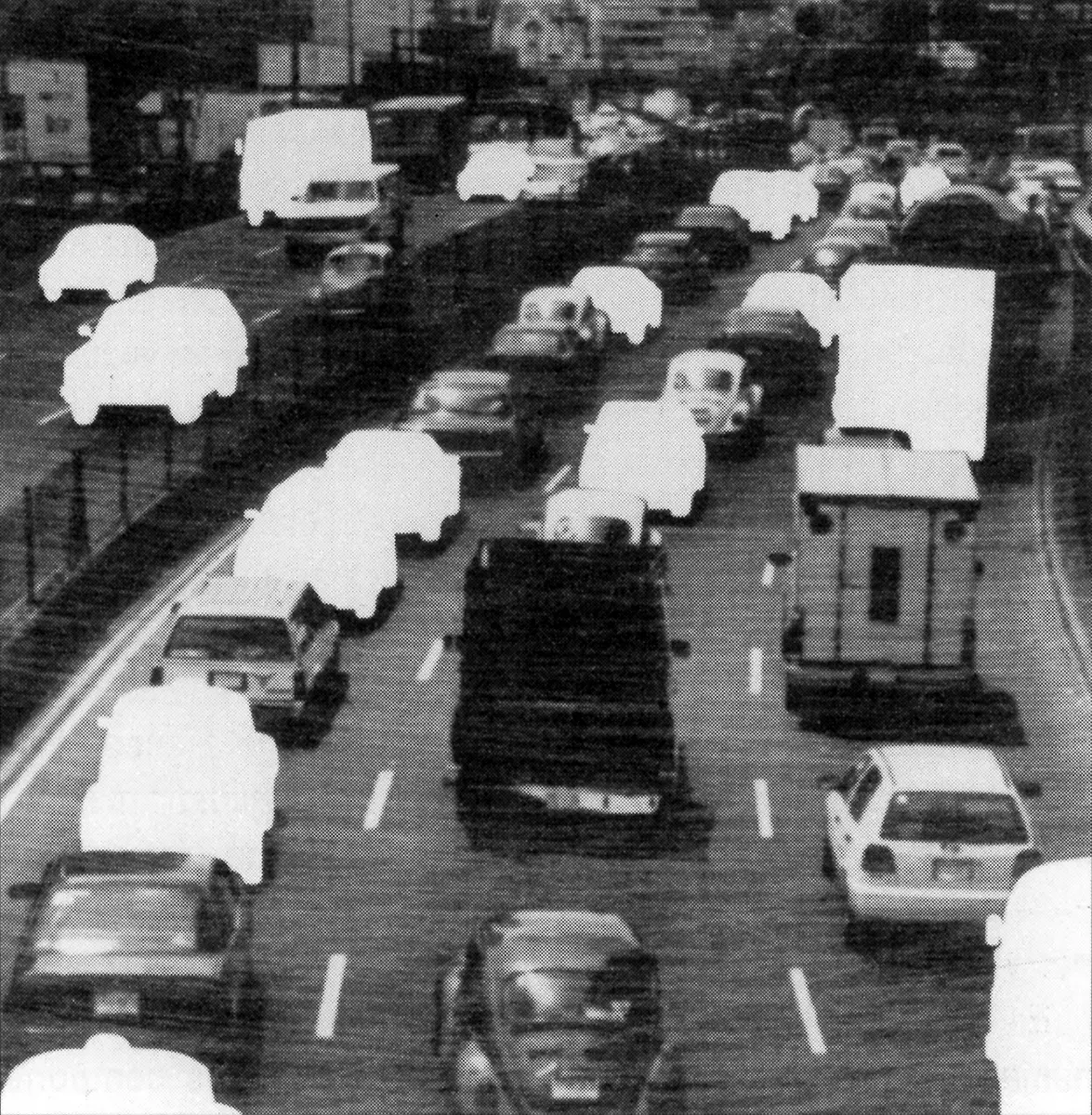
The electronic photomontages which Pintado sets on wood take us back to the situation of the contemporary world which the theorist Celeste Olalquiaga, following Roger Caillois, called "psychasthenia." This is a biological/sociological phenomenon in which a person and their surroundings fuse into a single identity. As Olalquiaga says, it is a state in which real space, whose coordinates are determined by the organism's own body, becomes part of the depicted or simulated space. A psychasthenic person is unable to distinguish the limits of their own body and abandons the sense of their own identity in favor of a space beyond themselves, becoming camouflaged into their surroundings (Megalopolis, 1993).
Advanced technology obliges us to reformulate the spatial-temporal paradigms established by our entertainment society. On the basis of this supposition, Alejandro Pintado wants to be sure that when we look at the "suspended particles," we go beyond the images in the foreground and penetrate into the world which he depicts in a shrouded background and thus become witnesses of those everyday circumstances which are placed before us like mirrors.
Computer-processed pictures of cars caught in traffic jams, of alienated beings wandering around the city space, imaginary maps, pedestrian direction signs, symbols that attempt, like magical compasses, to guide the spectator, images of fragmented silhouettes, bridges, streets, protective barriers, with everything in grey, black and an occasional red, are aspects that the artist shows with an unusual sense of distancing against striped backgrounds, heightening our sensation of not belonging.
Pintado uses these visual elements to rearticulate a conscious dialogue based on the dismemberment of the human body and the city: as our sense of individuality disappears in the immense metropolis, so the traces of it which remain are reconstructed. The artist presents the heterogeneous fragments of space in which we move: the repetition of icons enables him to exercise control over us as inhabitants being observed in the multifaceted landscape of the city.
Elements such as the superimposition of images and planes, the random combination of circumstances within the same space, the blurred contours which give the works a strong texture, as well as the apparent ability of the human beings to float over the city, are all characteristics which the artist incisively reveals in an eloquent discourse which makes us question our sense of lost identity, the frontiers which separate the body from its everyday surroundings, and the possible revalorization of everyday experience in the city which has robbed us of our image and tried to govern the perception of those who live in it.
LUZ MARÍA SEPÚLVEDA