Adrián Pujol and his portraits make up a story that needs to be told with pauses. More than one hundred of us posed for someone who, in creating the instant of birth, not with procrastination but with the patience of one who knows how to wait, made a face emerge by taking possession of a little piece of wood resting on the easel. In this process, there were two protagonists in the act of creation. One saw and acted (the artist) in front of the other, who remained expectant, and who allowed himself or herself to be seen (the model). A gaze within another gaze, a time within another time, the time of the temporal face which become timeless through the action of the painter. With the face turned here or there, or looking directly at the painter installed like a magus with his magic-making instruments, the model, as in any portrait, had to try and be himself, or perhaps to delude the person looking at him in order to capture something which lay beyond any pleasant or unpleasant features. As a participant in this experience, I believe that Adrián Pujol, an artist born in Palma de Majorca in I948, revealed little by little over a period of several hours, the existential interior of the self by using a totally plastic analytical method. Two situations exist for the artist: the delight in looking at the other and the delight in painting. His approach was not that of a simple chronicler of the facial features of a given person. He painted these faces as if he were recreating in modern terms the famous funeral portraits of El Fayoum. It was not a symbolic caprice that the show was titled Animania. Portraits.
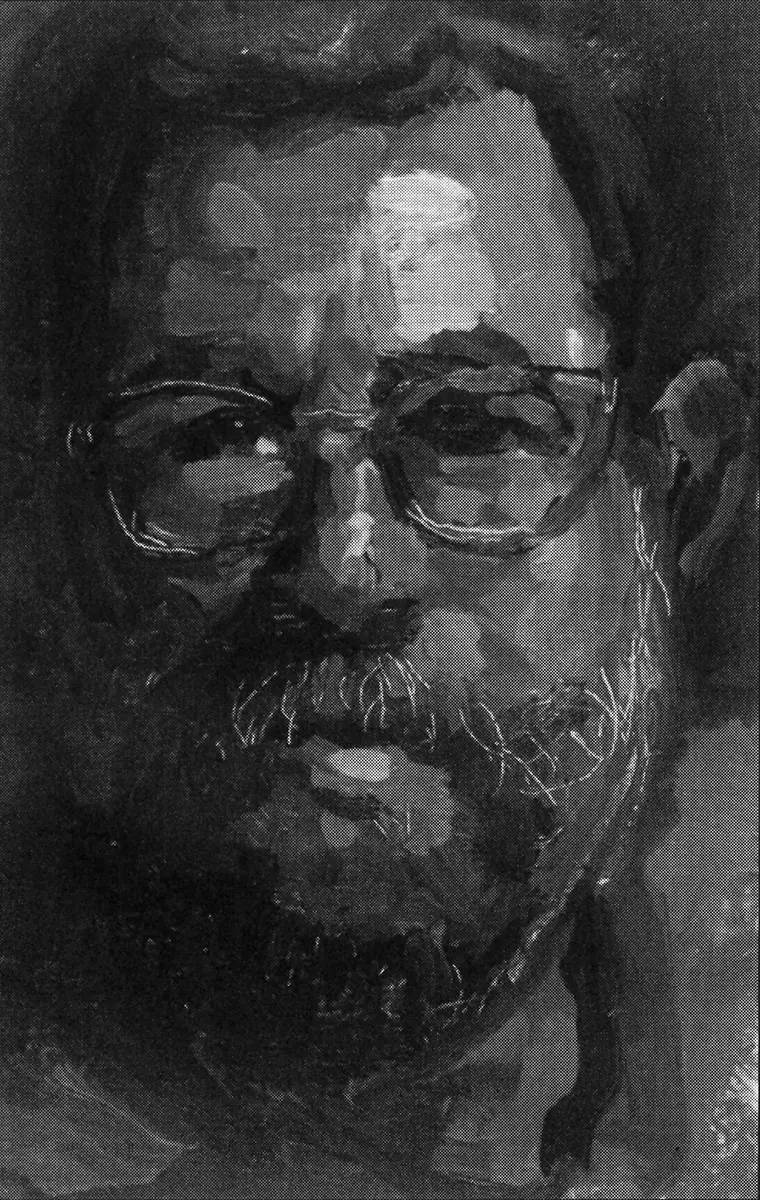
The painted portrait is as old as the history of art. What is paradoxical is the fact that despite its age, it is still so important that it is impossible to replace. It has served many purposes-of familial, social, political, funerary, and psychological, as well as strictly artistic, and kind. In Pujol's case, a face is an excuse for creating a pictorial body, not in an attempt to achieve the commonplace objective of rehabilitating a genre not very much practiced in strictly plastic terms, but rather as a means of expressing his constant passion for the act of painting. In each of his 129 painted faces, we see the illusory side of human materialism—that of the face which seems to be but is not. In this case, the artist's eye carefully recognizes and intervenes in the gesture and movement of his model, striving to define itself in a way outside of fashion while continuing a valuable tradition. In his portraits, Pujol leaves the mark of someone who has studied the history of art, and who has claimed, in another context, a theme that has become anathema in terms of modernity.
The painter sees himself as a creator in each of these small format works, in which neither the face nor features are important, but the possibility of performing an enjoyable creative exercise in pictorial texture is. Pujo, with short and energetic gestures, creates the strong impact of an image that is the target of his glance: the movement of waves, of leaves rustled by the wind, effervescent brushstrokes, strokes of the color of a psychological kind. Above all, these are images of pictorial power. They capture the silence of the face that wants to say everything in one glance and in one pose. In the end, the result is a kind of interior correspondence which is introspective and ontological in regard to the self. The artist does not seek to please his model but to please himself, to carry out the purest act of creation with his painting. This is his own unique kind of freedom, the only freedom that any true creator will defend.
The execution of this series of portraits was an exercise in discipline. The brushstrokes came freely from the artist’s fingers which guided the brushes, generating a creative current that gradually resulted in a kind of mellow pictorial texture, as though the artist were unraveling or revealing the mystery of something as yet unknown. Pujol offered a revelation of the being through an image that resulted from the posing model. Thus all the models (including myself), in a glorious act of narcissism, went along to look at themselves at the Mendoza Gallery. There an exhibition of the 129 portraits was presented, including men and women from the cultural world of Caracas, such as Maria Comerlati, Pedro León Zapata, Simón Alberto Consalvi, Víctor Guédez, María Elena Ramos, Corina Briceño, Rafael Pereira, Sofía Imber and, of course, the artist himself. The series, made up of works done in oil on wood and measuring 25 x 15 cm., was arranged in the gallery in an endless horizontal line, in an intriguing order.
In its essence, the show was a kind of installation within the visual discourse of the horizon line characteristic of landscape—a horizon line made up of a line of faces, which by dividing the wall interrupted its white silence and created a non-existent human landscape totally controlled by the fantasy of the artist who created it.
BÉLGICA RODRÍGUEZ