Jun 2024 - Nov 2024
artnexus #122
Arte in Colombia #168
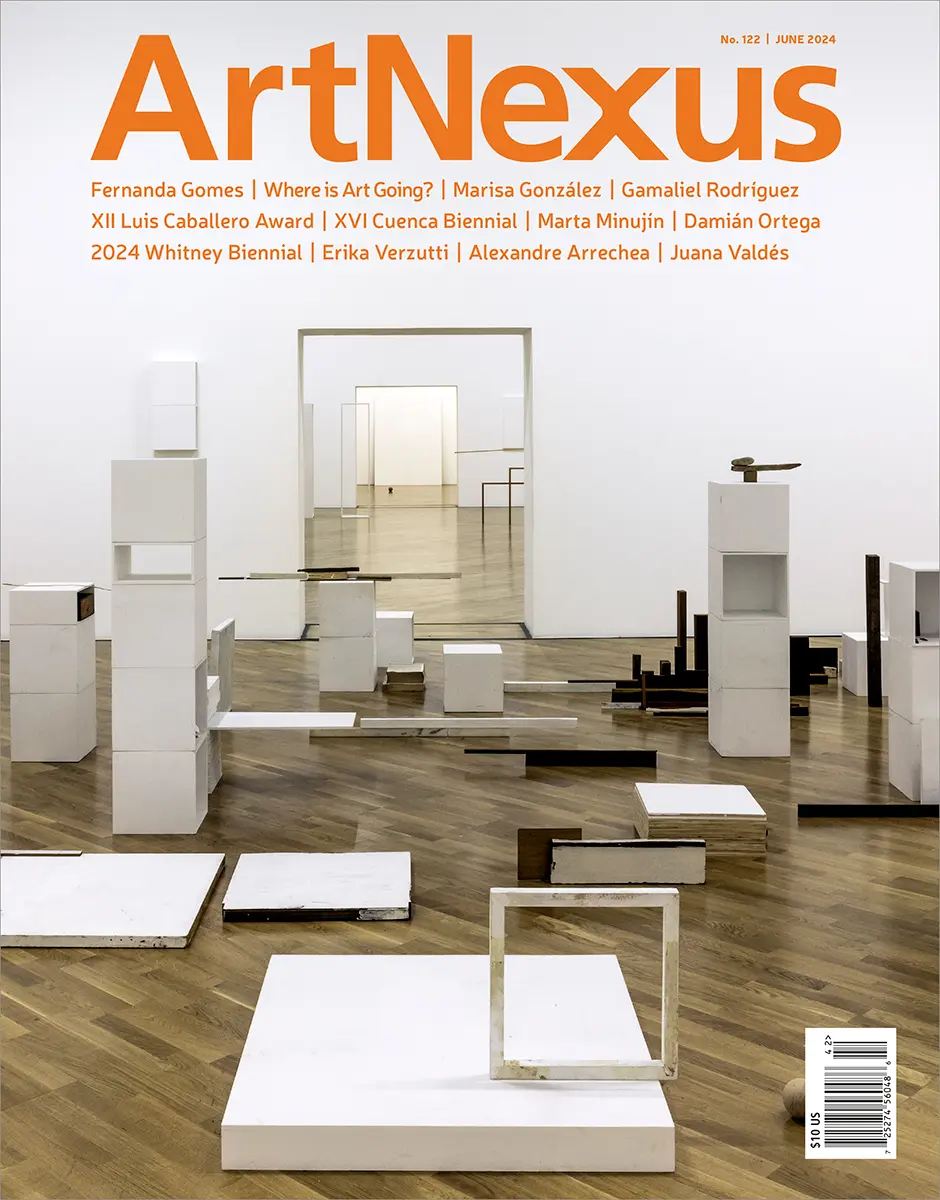
Fernanda Gomes (1960, Rio de Janeiro) studied at the Escola Superior de Desenho Industrial in her hometown. It becomes problematic to limit this artist’s work to its associations with movements such as Minimalism, Arte Povera, or the Neo-Concrete heritage that is so significant for Brazilian art. Her interest in producing an architecture within the architecture of a particular space where she will show her works demands a careful exertion in order to familiarize herself with the place and to propose a unique way of perceiving, as well as of pondering the interactions and dialogue between diverse materials. So much so, that the exhibition space appears to be an extension of her own studio.
Hence the likelihood that her pieces will reappear in other exhibitions, according to the particular conditions of the space. After establishing scrupulous rapports, the transformations of her scenarios require adjusting her objects to uncover the dynamics between them.
Gomes not only uses techniques from painting and sculpture, but also sustains a special relationship between movement, space, and time. The variety of her materials never ceases to amaze: wood cut-outs, bricks, water, book pages, cardboard, thread, plaster, and textiles, among others, without forgetting the objects found in her walks around the city and with which she reveals the poetic value of things by playing with them to portray the erosions generated by the passage of time.
Colors may be left in their natural state or painted white, and objects act in space following a complex layout, including elements that are difficult to focus on, since they usually tend to go unnoticed in their daily use. They occupy a specific place, as if being rescued, and propose a new coexistence with them. The use of white may either be used as a neutral recourse or to highlight the expressive potential given to selected elements.
Implicit is the reference to human beings as arbitrary or selective accumulators. Her installations become particular worlds where small or discarded objects attain a prominent place.
The work on the cover, which was displayed at the Pinacoteca de São Paulo, is a clear example of her ability to build peculiar architectures with a diversity of objects and situations created around them.
IVONNE PINI
Want to read it offline? Download it in the mobile app
Issue Number: 122
Arte in Colombia: #168
Period: Jun 2024 - Nov 2024
You have 3 free articles remaining. Sign up for unlimited access.
Contemporary Latin American art
Exhibition room
The Exhibition Room offers a curated selection of the most compelling voices in contemporary Latin American art. Explore bold proposals, rising talents, and thoughtful curatorial projects.
Editorial directory
Guide
Explore the artnexus Guide, your essential resource for discovering Latin American artists, galleries, and institutions. Browse by category and access detailed information.
GUIDE
App
Download the Artnexus app and explore galleries, museums, and artistic events from anywhere.