“A series of portraits of Yishai Jusidman painted by Yishai Jusidman (…) However, these paintings are not about Yishai Jusidman”. Taken from the introductory text for the suggestively titled Entrevista (Interview) exhibition, that statement attempts to explain, in the most direct way possible, what we are about to see; congealed at a moment in time, it suggests the power and determined lucidity with which Jusidman’s most recent pictorial project anchors itself to/from one of art’s “grand” genres, the realm of portraits and self-portraits.
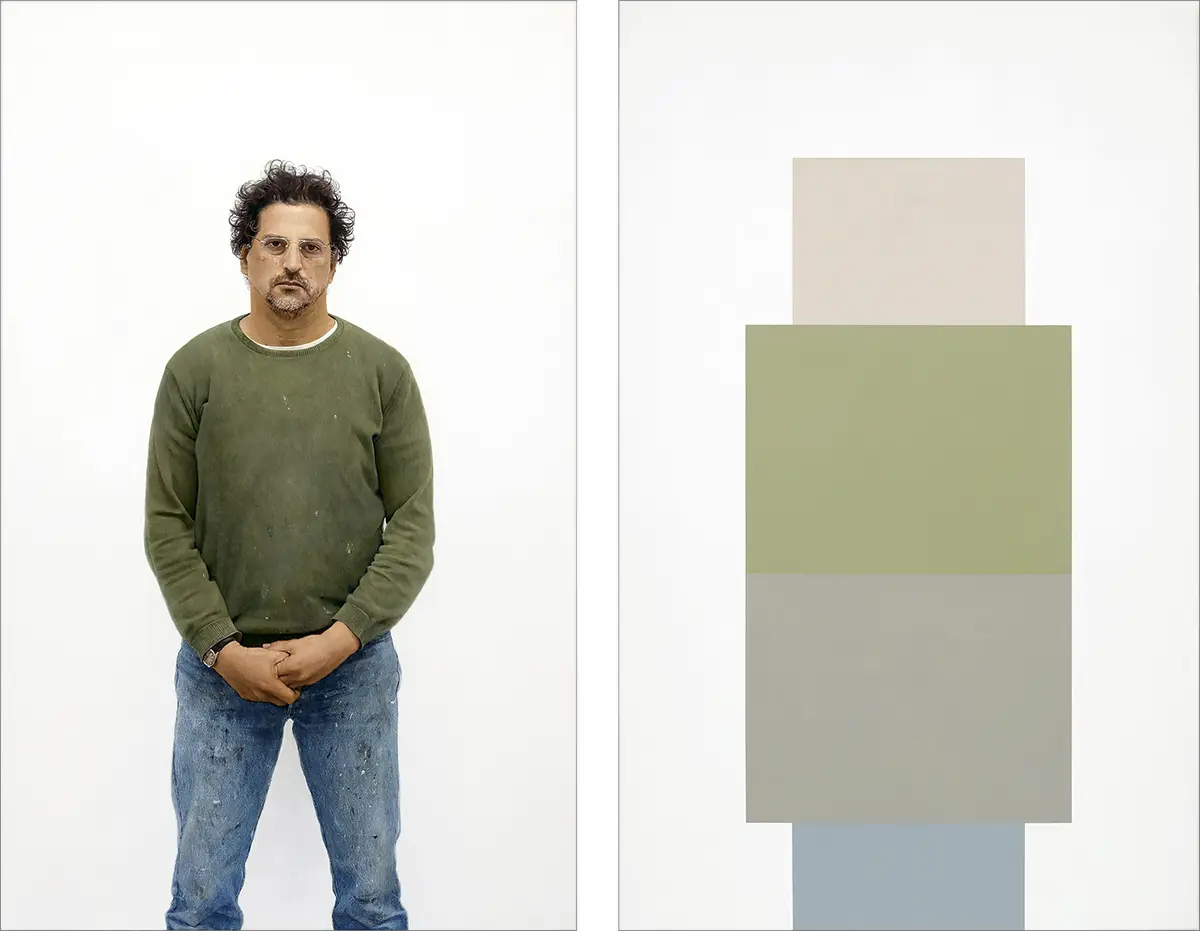
Articulated as potential chess moves, these thirty paintings in various formats (oils, acrylics, and color pencils on linen, dated between 2014 and 2021) by a Mexican artist, Yishai Jusidman, whose body of work has remained discreetly yet overwhelmingly solid since his start in the contemporary art scene, expect as a group to be interpellated in their singularity, giving shape to a play of relationships and movements both physical and mnemonic. So, in the silent space they generate between their views, we intuit that the detailed observation of each work on display is inhabited by the echo of the sound of each color-in-dimension.
Arranged in four longitudinal galleries, almost in the shape of a cross with a slightly displaced center, the show brings together all that interrogates the self-portrait genre as though moving from a predictable, as though spatially determined center (which echoes the museographic plan), displacing the intersections between of truth and fiction, representation and abstraction, what we see and what sees us (Didi-Huberman).
As it happens, two of the four almost cross-shaped galleries hold fifteen “figurative” self-portraits, while in the other two, as though in counterpoint, fifteen “non-figurative” paintings present themselves as formal translations born from an essential pictorial component/challenge: two-dimensionality and an insistence on transgressing it. The works seduce us one by one, setting off exercises in memory, (self)referentiality, reciprocity, reverberation, continuity, (i)repeatability, and unicity.
The exhibition begins with a set of technically impeccable self-portraits where Jusidman faces the viewer frontally; painted from photographs (at a scale close to the original), most present the body in three quarters, others are half-figures, and there is a close-up of just the face. We walk around them searching for the slightest differences in gaze or posture, any small variation that may allow us to penetrate the impenetrable, grasp the indescribable, detour a path, rekindle a memory.
The works in the “abstract” group are an assemblage of inset boxes in a variety of colors, similar in size and composition, set against white grounds. Affable chromatic destinations that follow one another from one canvas to the next, with a strangely conspicuous character. About the intention behind this pictorial project, it has been said that Jusidman wanted to revert the central role given to the artist in the articulation of the meaning of the work. This is to say, the clues that the “realist” self-portraits seem to provide a state of anticipation in the viewer, like monologues in a private narrative, imbuing the first portion of the show with a sequence of pictorial strategies that imply a gradual layering of the “reality”—or, in its place, the “semblance”—of the portrait subject, offering the viewer a level of detail and pictorial inscription so precise as to become silent.
For their part, the other two rooms guide the viewers’ gaze in the opposite direction. We no longer seek out details or facial expressions, but the transformation of the self-portrayed body into its most elemental raw materials. Given the exhibition’s title, Entrevista (Interview), it may be posited that the other fifteen paintings with which the artist and the curator confront us (whose names in each instance include the prefix bis-, meaning “double”) are the pauses, the pulses, the breathing, the silent interrogation of the gaze, the formation of geometric shapes, and the quest for an “interpretive neutrality”.
This is why the curatorship and the museography of the four rooms that comprise this exhibition are key to understanding the logic of the interactions between each self-portrait (“conventional, realistic”) and the pictorial disclosure that accompanies it (“abstract, non-figurative”). Yet, despite us knowing that in the artist’s creative process the self-portraits function as self-portraits-bis-, there remains inside every observer a drive to return to the non-conventional self-portraits, in search of something. It is as if Jusidman were testing historiographical assumptions about what constitutes a pictorial self-portrait, at the same time he questions our gaze. What remains on canvases where pictorial combinations of color boxes have erased the artist’s features? What remains of the lines, the presence-imbued self-portraits, and the tone boxes whose abstraction confirms the intra-connections? In which of these two sets of works does the other—in trace—reside?
That displacement is what prompts us to seek referents, clues, registers-composites between the fifteen figurative self-portraits whose integrality is cyphered as a function of their pairing with the other fifteen works in which the image of the artist is rendered “invisible”, hidden perhaps inside the color boxes that arrange their marked volumes in sync with each self-portrait. The disposition of the color blocks being, precisely, the trace that connects the descriptive self-portraits with their abstract chromic counterparts.
Jacques Derrida wrote about “the trace” as that which remains of the remainder: “A trace destined, as any, to disappear on its own, both to detour a path and to rekindle a memory.” And in the interrogation of what that “destined trace” says, we are offered a dimension that is almost outside of time to give rise to each recognized equivalence and memorized relationship.
MARCELA QUIROZ LUNA