Paysage Géométrique (Geometric Landscape) was the title of an exhibition of works by Madrid-based Cuban artist Waldo Balart (Cuba, 1931) at the Bendana Pinel gallery in Paris, from May 13 through July, 2023.
As befits Balart, spatial arrangements inside the gallery depended not only on the functional unity of the artwork, but also on the presentation of a multisensorial set as a harmonious spectacle. The landscape is defined as the representation of space as a function of a scale or a module; it is the part of a place, an expanse, or a territory that can be seen from a given point.
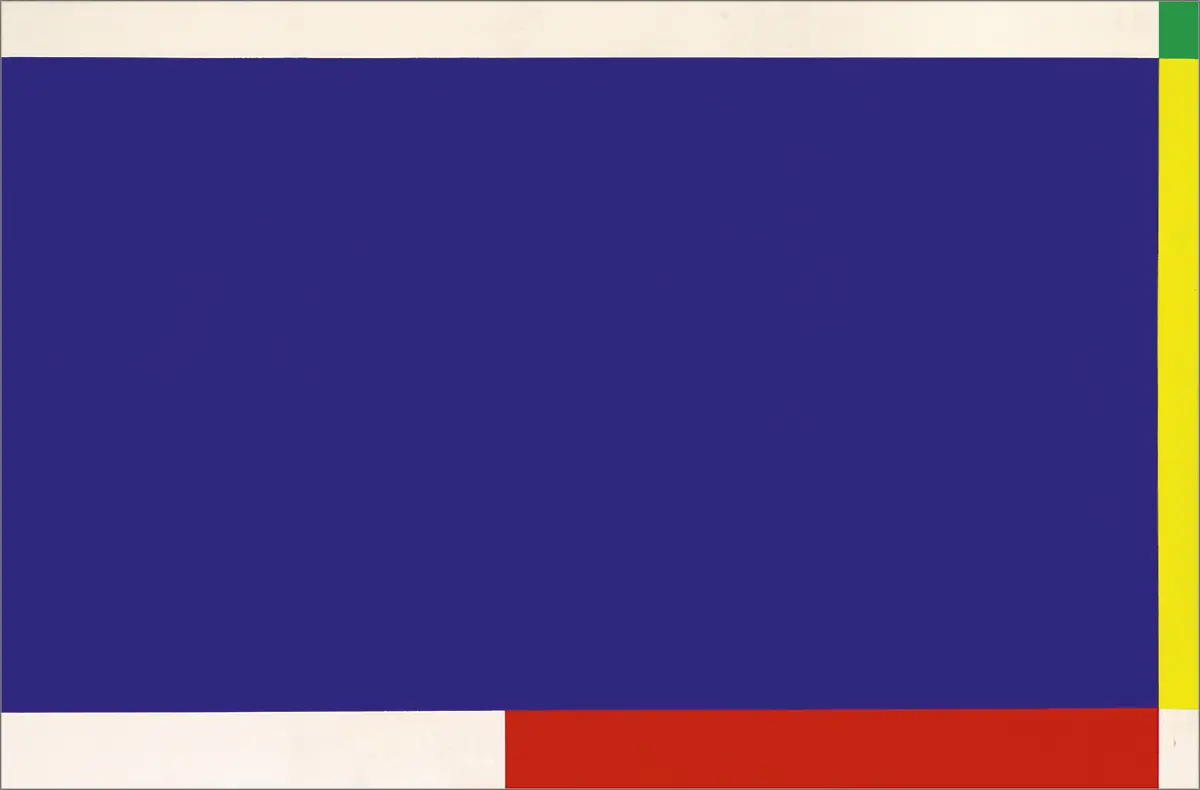
The power of Balart’s painting resides on the axiomatic order with which he works: a logical method based on an extensive experience in the intuitive use of color, which produces a sensation of profundity and spirituality. Following trails blazed by of the grand masters of abstraction, Waldo Balart identifies himself as a practitioner of Concrete art. The reality of the painting presents itself as an object independent of representation, with color playing a central role. Hewing close to Theo van Doesburg’s investigations, Balart also appears influenced by scientific research and by his wanderings through a variety of cultural domains.
The notion of spectacle is one component in an unusual career that includes several films made alongside Andy Warhol, an artist who revolutionized the fields of visual communications and design. Balart’s intention of moving towards the viewer and achieving a specific effect was defined at that point. His work gained early recognition based on the solidité of the proposals.
After his 1972 exhibition at the Museo de Arte Contemporáneo in Madrid, Balart, who prior to that had resided in Paraguay and Brazil, settled primarily in Europe. In 1988 he invented “axiomatic order,” still his method of working with the color spectrum. In Europe, his work distilled the hard edge American school, as well as geometry. An innovative system from that experience emerged, not only in formal terms but also in the combination of elements, translated as stream field forces.
Force Fields N° 4, from 1997, impresses our senses greatly. It comprises four articulated reliefs in painted wood and acrylic, each around 18 cm, allusive to influence factors as the pros and cons of a decision: choosing one manner and disposition or another, inducing the viewer’s active and conscious participation. All of this translates, symbolically, into an examination of the forces that lay at the origin of social situations and drive them toward a given objective. We come to the conclusion that this abstraction is imbued with a high degree of involvement and commitment.
Balart’s mathematical series of rainbow colors plus magenta combine and establish diverse and complex tensions with the black-and-white. In those compositions, the magnetism of the colors is inverted: warm tones low, cold ones high. A rebellion against the rules of academicism. Waldo Balart imposes his revolutionary vision.
Also included in the exhibition are Imágenes fragmentadas integradas de ángulos variables (Integrated fragmentary images of variable angles), Imagen ortogonal (Orthogonal arrangement), or Nudos (Knots). The knots originated in the 1990s and are based on the emergence of four colors. Spatiality as a result of interactions has mathematical underpinnings, and it is on that basis that Balart defines his work as “proportions.”
In Knots: Untitled, from 2014, acrylic on canvas, 97 x 146 cm, the spatial essence of color is made manifest. With these results of perception, Balart moves from the mere anecdote of painting to a higher vibration, given the numeric essence at the base and the perfect adjustment of the chromatic range, practically iridescent, showing a subliminal, elevated level of contrast.
At present, Balart’s works are included in such important collections as the Museum of Modern Art (MoMA) and The Metropolitan Museum of Art (MET), in New York; the Pérez Art Museum Miami, in Miami; Mondriaanhuis, in Amersfoort, and the Museo Nacional Centro de Artes Reina Sofía (MNCARS), in Madrid.
SUSANA SULIC