Víctor Grippo is a referent in Latin American conceptual art, known especially for the social edge of his work in the context of Argentina’s dictatorship of the 1960s. At the time, the local art scene did not identify with what historiographers later came to know as Latin American Conceptualism, which used the resources and languages of Conceptual Art in a situated way, emphasizing the situations of political violence across the region. The group known as Grupo de los Trece (Group of Thirteen), forged inside the Centro de Arte y Comunicación (CAYC) with Grippo as one of its members, defined its practice as “systems art”: a locally and ideologically active mode of conceptual art about which Grippo himself theorized, highlighting its communicational processes: “artist/emitter, artwork/channel, and audience/receiver.” In this Madrid exhibition, divided between Mira gallery’s main location and its booth at the ARCO fair, Grippo’s “systems” are the protagonists.
Curator Alicia Chillida put together a selection of works previously seen in the shows she organized for the Centro Gallego de Arte Contemporáneo in Santiago de Compostela, the Biblioteca Luis Ángel Arango of the Banco de la República in Bogotá, and the Museo Universitario Arte Contemporáneo in Mexico City, between 2014 and 2015. Also included are sketches, drawings, and documentary materials from the Grippo Archive in Buenos Aires, helmed by the artist’s widow, Nidia Olmos, alongside the couple’s daughter, Paulina Vera, and granddaughter, Olivia Coll. Another standout among the contributions of this exhibition is a series of small-format watercolors and oils from the 1970s in which Grippo explored analogies between potatoes, stones, and cranial trepanations, after a quotation from the naturalist Hyatt Verrill that is also incorporated into one of the works on exhibit: “The Inca believed that cranial trepanations determined, in each instance, the emergence of a new variety of potato, and it is worth noting that nowhere is a greater variety of potatoes found than in Peru, nor a greater volume of trepanned skulls.” In Grippo’s paintings, the fractured potato (or rock?) is titled Forma muda de vida (Mute Life Form), and the hammer used to break it can be seen alongside it. The paintings are complemented by Algunos oficios (Some Crafts, 1976), a sculpture consisting of a hammer and chisel congealed on a cement plaque and a piece of construction paper on which the outlines of several tools, such as pliers and saws, have been printed. It is a chilling dialectic between the human capacity to create and destroy, being that these objects are associated with construction, yet their use as instruments of torture is widely known.
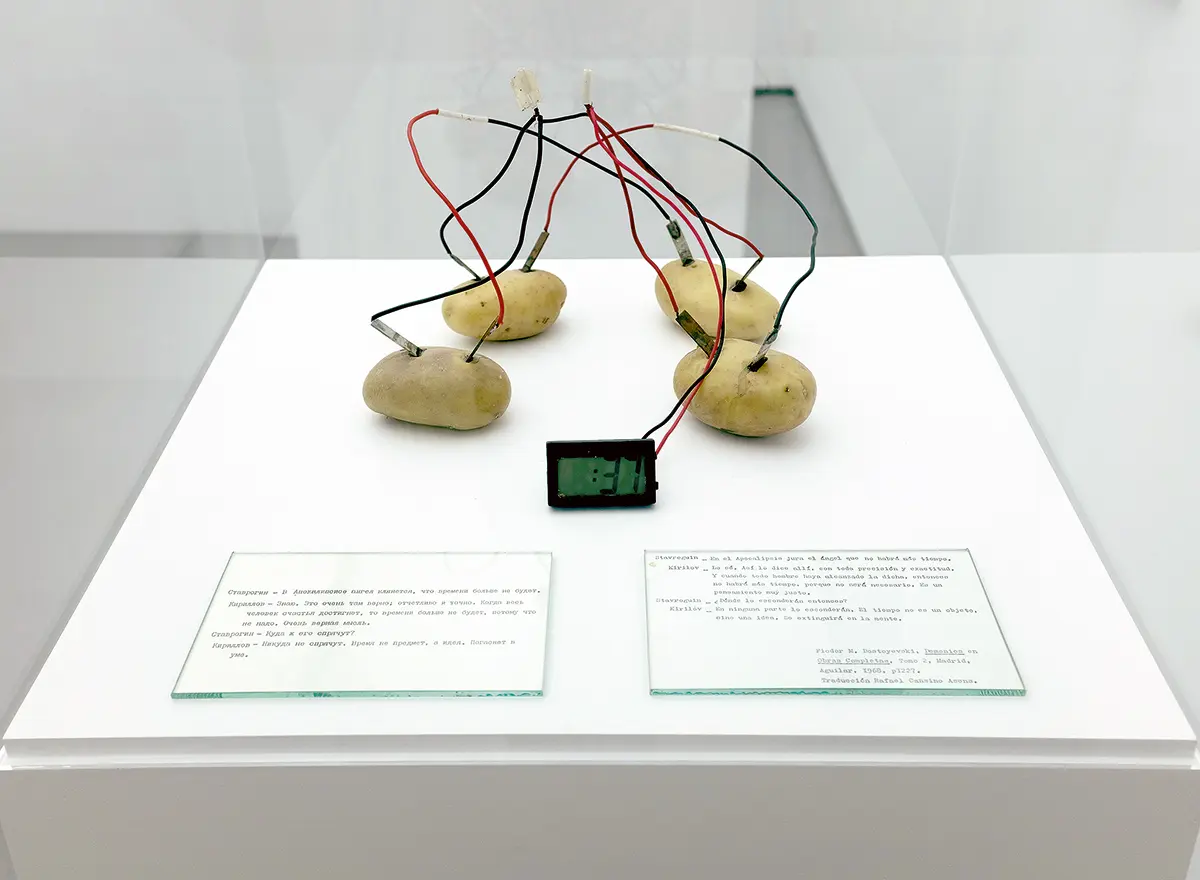
In these artworks, the semantic field of trepanation as a medical or ritual practice extends into an allusion to state violence. As in other works by Grippo, the potato alludes to the the life of common folk, and indeed, his emblematic Naturalizar al hombre, humanizar a la naturaleza (Naturalizing Man, Humanizing Nature, 1977), which uses electrodes to obtain energy from a pile of potatoes, was at the center of the Mira space in ARCO. The title of the exhibition, Todo en marcha (Which can be translated as Everything in the Works, but also as Everything Marching Forward) comes from another one of Grippo’s historic artworks, which consists of saline solutions, glass flasks, and rotting and germinating potatoes that produce chemical reactions. Once again, the potato functions as an allegory of the social base, an active and impetuous element capable of driving change.
Víctor Grippo’s training as a chemist is key for any reading of his oeuvre: transformation and change are two principles that often serve as the work’s conceptual nucleus. Grippo’s art is conceptual, but its political implications always push through. There is also an interest on a different order, which drives him to carry his inquiries beyond the scientific: the golden potato in La papa dora la papa, la conciencia ilumina la conciencia (The Potato Gilds the Potato, Consciousness Illuminates Consciousness, 1978) moves in the direction of alchemy, but it also makes the poetic gesture of giving a sacred character to South America’s basic food staple and identity node. The installation Hipótesis sobre la modificación del proceso fotográfico (Hypothesis About the Modification of the Photographic Process, 1972) takes as its pretext the chemical processes inherent in photography in order to appeal to consciousness-raising. Setting thought and sensibility in circulation, photography, art, becomes a vehicle of social motion. Like the bread-making oven Grippo built in a public square, which was soon enough subjected to censorship, art is the furnace of change.
DIANA CUÉLLAR LEDESMA