Just as our climate emergency demands action, Tomas Saraceno’s exhibition at the Serpentine asks for commitment. By the entrance, a manifesto is available to those who commit to cycling through its entirety.1 Pedaling a stationed bike generates the energy that sends the recording into a headphone, in an immediate transaction. No compromises: any pause would interrupt the audio, requiring it to restart. Inside the gallery, everybody is encouraged to give up their phones during the visit. Far from mindfulness, the exercise is one of pronouncing awareness, drawing attention to our individual implication in the exploitation of lithium, which, turns out, most of us had in our pockets.
Such commitment calls are also the two features in the exhibition that most highlight geopolitical differences. Though the environmental crisis is global, consequences hit much harder those who have historically suffered from colonial exploitation, which the term Global South factors in. Leaning on this terminology, Web(s) of Life breaks down the interconnectedness of cause and effect that pierces a mappa mundi: Lithium consumption in Germany takes water away from indigenous peoples in Argentina, for example. A one-hour video of Saraceno’s long-standing project Aeroceno would later in the show explain that the desert and salt flats across the Andean region concentrate one of the world’s largest reserves of the metal, and how its mining consumes water excessively. The resulting show speaks about the Global South and North with a frankness that is rare, bluntly urging for accountability and action to meet the imbalances of this planetary struggle. In the manifesto, more is addressed about how the vicious cycle of inequality is both structured and struck, and how minor changes are not enough: “relations must become more equitable,” Malian cultural theorist Manthia Diawara claims – if we commit to listen.
The energy consumed to run the exhibition is programmed to vary with the weather. Depending on how much the sky has to give, so will the show. With enough technology available for more advanced sustainable energy systems, the choice of keeping this transaction direct and immediate seems symbolic. It reiterates adaptability and dependency, lowering consumption and heightening the connection between what is inside the gallery and its environment: the park it is in, the city, atmosphere, planet, sun.
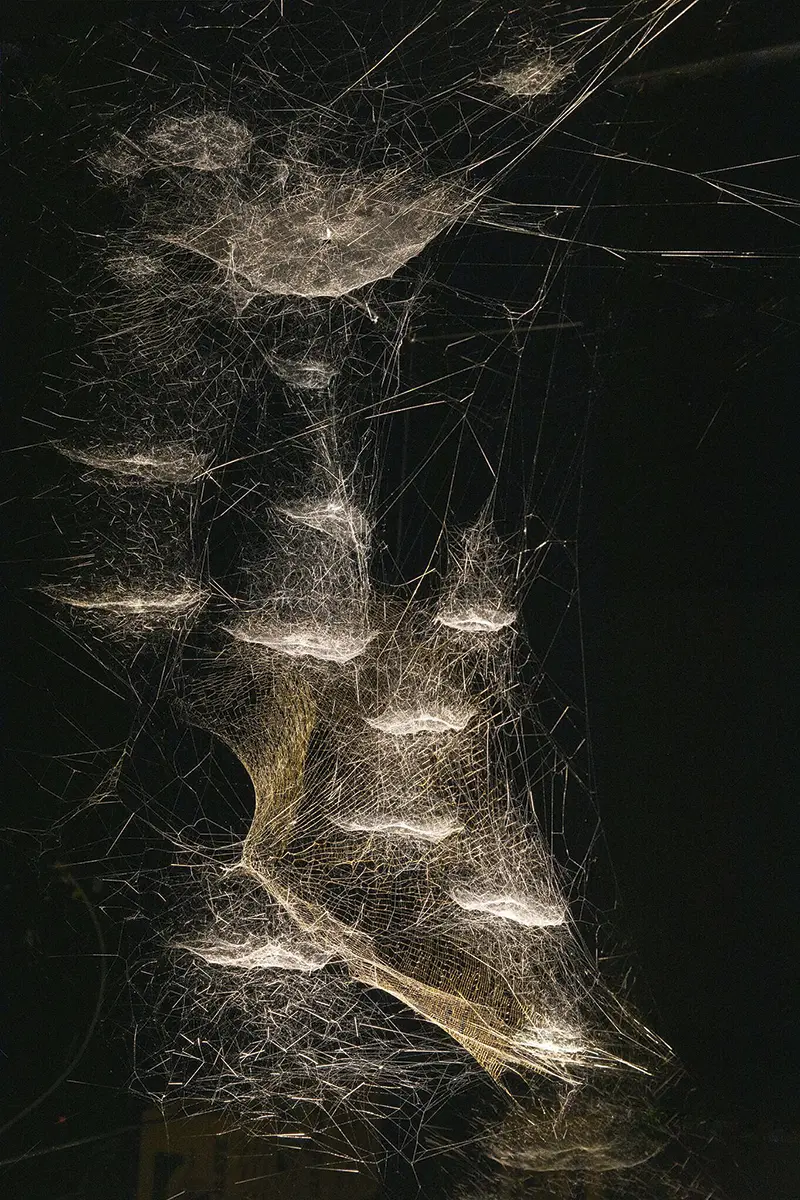
A few rooms in, displays show clusters of spider webs, with varied textures and patterns. In the first, a tangle of webs follows the cubic shape of a display case but no glass isolates them from visitors. As one walks abruptly into the space, takes a breath or exclaims in surprise, the delicate strands tremble. They are one touch away from destruction.
The sparkle and sophistication of the webs lead to dueling over whether it would be more surprising to learn that Saraceno was able to imitate nature so skillfully, or to face that the art of that work is down to spiders. The spiders are, indeed, the star of the show. Visitors will later learn how the varied patterns reflect differences in spiders’ behaviour when they are affected by a parasite, posing parallels about the brutality and sophistication of “an encounter in which one organism benefits at the expense of another.”
The webs are shown in an atmospheric dark room with dried branches like in a natural history museum. Further in, a confessional booth that forms the most humorous part of the arachne-related series carries within it its particular style and aesthetic of period furniture, but of a time and place whose link with the project is not evident. Large-scale spider replicas placed on top feel a little too literal, confusing the atmosphere further.
Works on show are connected by the common thread of addressing environmental issues and a concern with forms of existence beyond the human-centred. They introduce powerful ideas related to the environmental crisis that as many people as possible should encounter, learn, and take in. The exhibition seems stronger, however, on what it talks about over how it does so, as if privileging ethics over aesthetics. Perhaps unfair competition given the urgency of the subject matter. But aesthetics, be noted, lies way beyond the beautiful, or even the visual. It is about the subjective experience. Beyond what is, it is about how things and experiences are conveyed and, ultimately, felt.
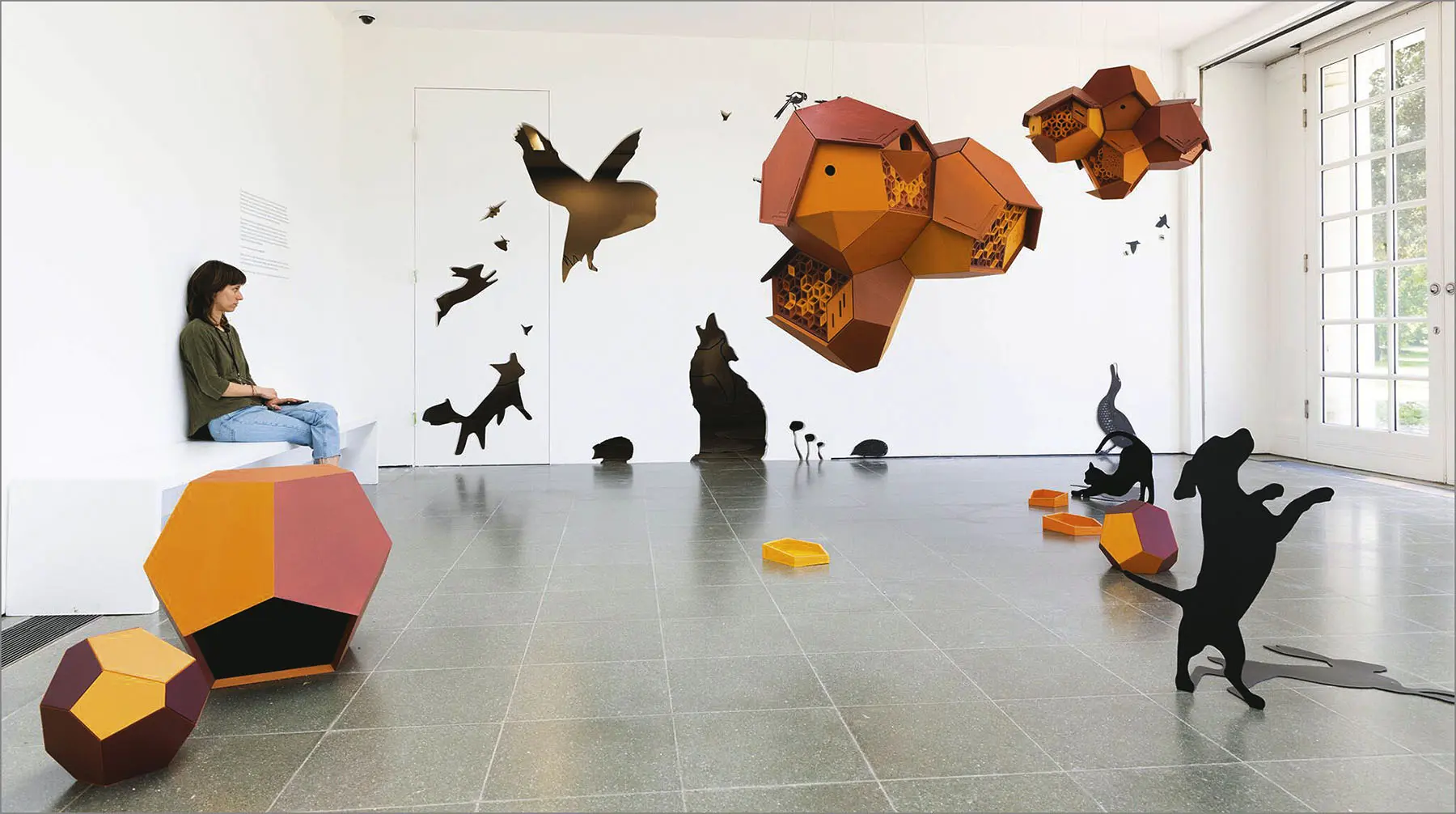
In the last room, small canvases are plain and large scale sculptures combine cartoonish features and colours. The aesthetic experience of this room, which opens up to the park, just does not keep up with the spider webs’ astonishing encounter. It feels underwhelming; perhaps the combination of browns and oranges a little unappealing. Just as I tell myself that this room is not quite for me, do I realise: the room is, indeed, not for us, humans.
These works are designed for the interaction of various other species who inhabit the park. Sleek modules attached to one another like Lego pieces include something for squirrels to climb through, little houses up high for birds to nest in, spots for dogs to shelter. They were developed in consultation with wildlife specialists, alongside the artist’s expertise. How dare I think it would be all about my human experience. Not a bad moment to recollect the manifesto’s call for “political imagination.” As works on show are by and for other fellow species, they may well be seeking subjective experiences in them. And what do I know about what makes their hearts beat faster.
NOTE
1. Alternative access to the manifesto is available for visitors who are not able to propel a bicycle.
*Photography by Studio Tomás Saraceno.
CECÍLIA VILELA