Oração (Prayer) is an occasion to revisit the work of one of the most talented Brazilian artists of the “00’s Generation."1 Over two decades, Thiago Honório has focused more on exhibitions than on individual works of art, which carries with it an implicit idea of “appointment” and “event”.
Vista (Visit), a title that alludes to the Portuguese verbs for “to see” and “to dress”, situates us polysemously in the space of the preamble. In this work, a set of glass eyes of the kind used by Baroque-period artists to enhance the realism of their images of saints are embedded on a wood relief. The specific element of the eyes, placed on the wall at the entrance, opens up an infinite chasm between us, viewers/participants, and the white cube we are about to enter, immersed in a grand event: the procession, another eighteenth-century image arrived from Portugal, emerges from hundreds of cotton branches. It prompts eye movements, not merely rhetorical ones, but in allusion to the expanded field and, if you will, to denuded matter, present in most of Thiago Honório’s works. Also fixed here, however, is a childhood memory of helping create the collaboratively made flower carpeting that adorned the streets of his native city during religious festivities. Bifurcations and linkages that point towards the play of figuration.
In the exhibition’s second act, the necessary detour proposed by Honório produces what Duchamp called a “drive to see”. As we enter the installation, a massive dance, the procession, invokes passion or a desire for cure. A great, plural effort that translates into an auratic unfolding, reinforced by the word “Text” that gives it its title. Meanwhile, in the recesses of our mind we would like to “dress the saint,” who is undressed, and this would bring us to the cloth manufactured with the product of the cotton fields. It is thanks to the irony overlapping the rhetoric of the image that a “decolonized meaning” is added—for Honório, the only viable kind. A native of Minas Gerais, the state where Villa Rica—the capital of Brazil during the eighteenth century—is located, and where, in his own words, “the church was the museum,” he finds ways to interrupt the persistent coloniality of thought. The play of analogies, with its charge of historical revisionism, does not function only as a verbal appeal, but also as a deep move towards a way of seeing that is inseparable from the making of the text, “worked by means of a perpetual interweaving; lost in this weave, in this texture, the subject becomes like a spider that dissolves in the secretions of its own web,"2 says the artist with regards to the meaning of this mise-en-scène. Found at an antiquarian shop in Portugal during a residency at Fundação Gulbenkian (2018-19), this dazzling sculpture showcases a male saint with classical features and hair, resembling St. Ives, patron of lawyers. With the meaning-loaded gesture of carrying in his hands a book or a scroll, now lost, in the past this colossal artwork connected with Flávio de Carvalho’s Expêriencia Nº 2 (Experience Nº 2), one of its referents.3 Later it was part of the artist’s similarly-titled occupation of the Morumbi chapel, yet another space-museum in São Paulo where a sea of cotton provided the support/canvas/weave and/or text. Traversing a bifurcation inside the gallery, we continue on our tour, not before encountering a line of incense pieces burnt over the course of months and mutually repaired, like materials for “prayer”.
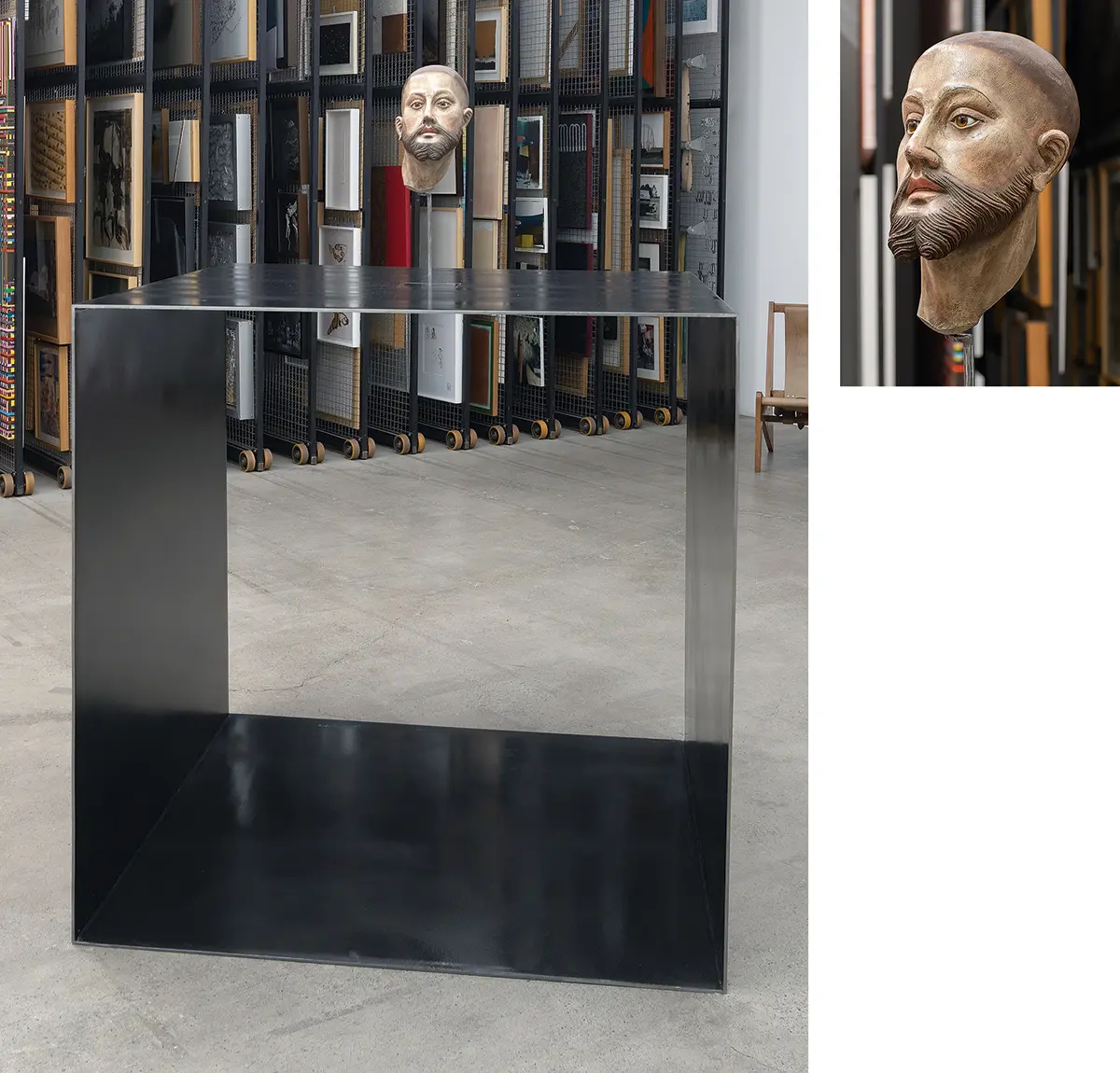
To complete the idea of the literalness of sculpture, two further works were placed in unaccustomed exhibition spaces: the gallery’s library and the director’s office, next to the repository. These works are Lecturas (Readings) and Corte (Cut). In the former, a reproduction of the hands sculpted by Aleijadinho, the great mestizo artist, to represent St. Simon Stock (1779) hold the pages of a book, Mário de Andrade’s essay O Aleijadinho e Álvarez de Azevedo (1935). The work invites us: “You may leaf through” (a copy of the book-object was placed next to it, for its perusal by the viewer.) Andrade, a towering representative of Brazilian Modernism who recognized the greatness of mestizo or mulatto art of the Golden Age, speaks in his essay of a Minas Gerais-based Baroque art focused on details rather than on opulence. The hands and their “incarnation”, to use a verb that in the past named the action of painting sacred images on wood, share the meaning of stories that mine History as such, with their respective doublings.4 Corte (Cut), a work that mounts the sculpted head of a saint, in the nineteenth-century Minas Gerais tradition, on a 1x1-meter stainless-steel cube, retains “the notion of the cut as suspension, the psychoanalytic cut, the Lacanian cut”, the artist says. This effect is also described in the text (in verse) presented by the curator, Ana Cohen. Now sculpture, now context, this hybrid work of art, the fictional spaces and all the other subterfuges produce an “inside/outside” dynamic that breaks decisively with Andrade’s modernist gaze. That closure works more like an evolution opening the exhibition towards these and similar parables in suspension.
NOTES
1. From the 2000’s on.
2. Barthes, R., O prazer do texto. São Paulo. Ed. Perspectiva, 1977. (Brazilian translation of Le plaisir du texte)
3. Performance pioneer Flávio de Carvalho, in Experience n.2, made an appearance in the traditional Holy Week procession of 1931. He wore a green hat that he refuses to take off, provoking the immediate reaction of the devotees. At a certain moment he begins to walk in the opposite direction of the procession. The event gains media coverage. Shortly after, the author launches the illustrated and commented book “Experiencia n. 2, Realizada sobre uma procissão de Corpus Christi. Uma possível teoria e uma experiencia.”
4. There are several interpretations of this image by Aleijadinho. Honório showcases one that assumes the hands to have been a representation of the celebrated author’s own; Aleijadinho suffered from a degenerative disease.
XENIA BERGMAN