Servando Cabrera Moreno (Havana 1923-1981) is a Cuban painter who deserves more recognition than he has received in the history of 20th century Latin American art. His career went through phases during which he was praised, but then through other when he was unjustly marginalized from the official cultural circles in his own country. The commemoration of the centennial of his birth provided a good reason for organizing multiple exhibitions and publications on his life and work. In addition to the activities organized in Havana, two exhibitions in Panama and the publication of a book about the artist were significant steps in making him better known abroad.
The NG Art Gallery in Panama hosted the exhibition Desde mi isla (From My Island) with works from two important collections: the Museo Biblioteca Servando Cabrera Moreno in Cuba and the Fundación Los Carbonell in Panama. The show included not only paintings and drawings, but also extensive historical documentation, such as photographs, exhibition brochures and catalogs, newspaper clippings, and sketches, as well as notes in the artist’s original handwriting. Among the photographs, there were images of his childhood, as well as of the many trips he took through Europe. As for his paintings, there were works from different moments in his career, from his academic phase to later abstractions, to the influence of European artists such as Picasso and Miró. There were also paintings in an epic vein, a subsequent expressionist style, and finally, some examples from his erotic series.
Gallery exhibitions that offer a combination of original artworks with such rich and interesting historical materials are exceptional. In this regard, the recent publication of the book The Blue Hour: Fernando Cabrera Moreno at the Los Carbonell Foundation is also commendable. The 460-page bilingual volume contains thought-provoking texts commissioned from experts on his career such as Reynaldo González, Gerardo Mosquera, Neida Peñalver Díaz, and Rigoberto Otaño Milián. There are excellent reproductions of his works as well as an illustrated chronology that highlights relevant biographical facts. It is based on extensive research, even in terms of the provenance of the works themselves, for which a comprehensive catalog raisonné was put together.
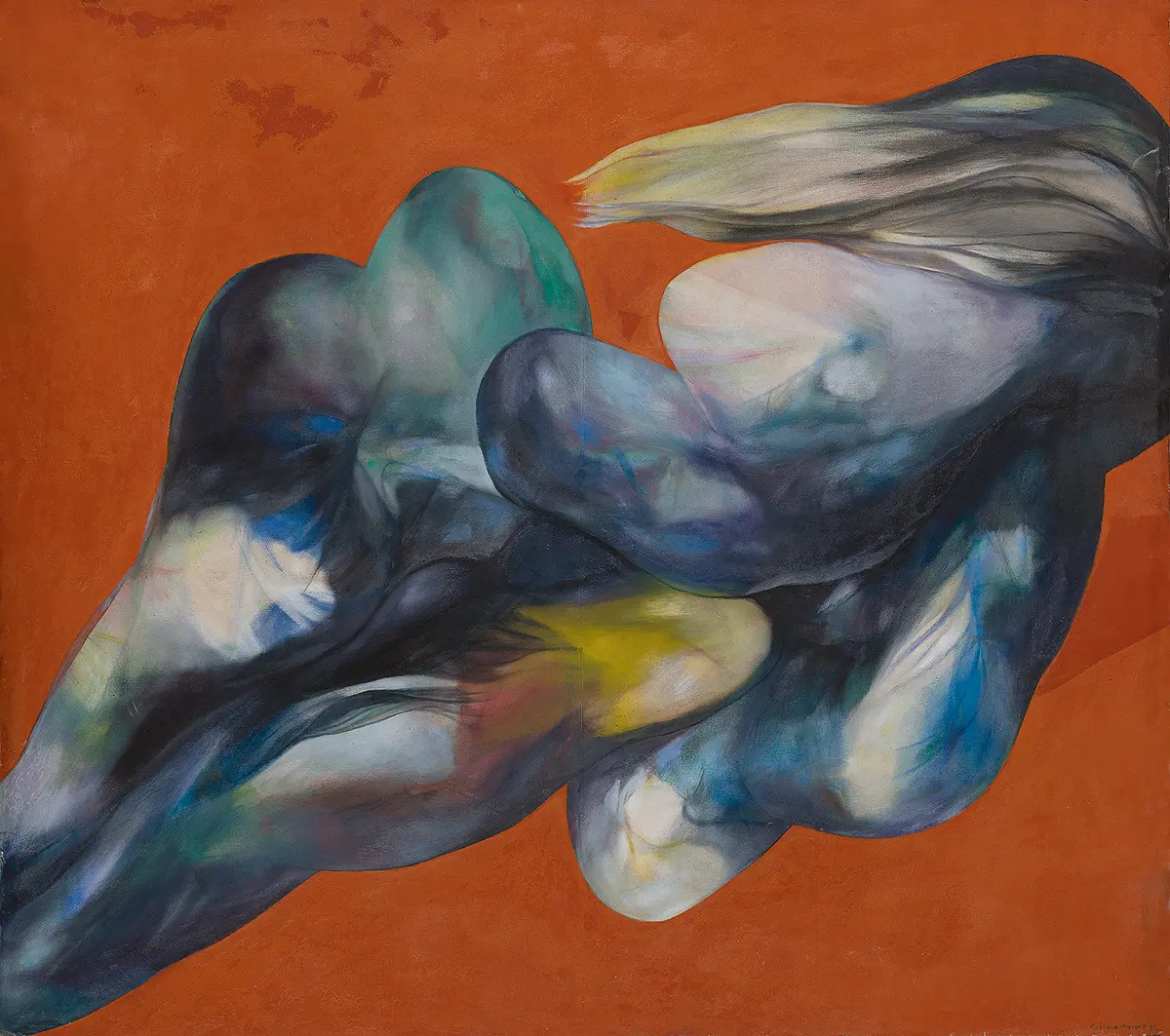
The Museo de Arte Contemporáneo (MAC) hosted the other noteworthy exhibition of the artist’s work in Panama. Entitled Pansexualidad. La obra erótica de Servando Cabrera Moreno (Pansexuality. The Erotic Work of Servando Cabrera Moreno), it was curated by renowned Cuban critic Gerardo Mosquera, and included drawings and paintings, most of which have never been exhibited outside Cuba. Mosquera was a pioneer in recognizing the value of Cabrera Moreno, carrying out seminal research on him in the 1970s, which became the source for references to the artist in Cuban art books and numerous articles. In addition to choosing the works and installing the show, Mosquera wrote the main essay in the catalog, which he entitled Apotheosis of the Body, an ideal description for Cabrera Moreno’s erotic phase. We are referring to numerous depictions of intimate gestures, both homosexual and heterosexual, which constitute an outstanding aspect of his body of work, but which were also the reason for his rejection in Cuba during a large part of his career. In Mosquera’s words, “that cycle of paintings coincided with the end of the 1960s, when an idealization of culture was imposed, numerous intellectuals were marginalized, and the leadership of cultural institutions was placed in the hands of the military.” Cabrera Moreno suffered the consequences of that political moment.
Earlier, Cabrera Moreno had been admired by the Cuban public, as well as its authorities, most especially during the period when he painted social realist works (as of the mid-1950s), as well as epic compositions about the Revolution (from 1960 to 1964). However, he later moved on to an intense expressionism and then to erotic work—clearly shocking at the time—which he would continue to produce until his life ended prematurely in 1981. He began with works he called Columnas humanas (Human Columns) of dramatic, sensual, and almost abstract vertical forms, as well as paintings of intense gestural physicality such as La patada (The Kick) of 1968. His visual language evolved into more and more clearly anatomical forms, of bodies embraced, almost fused, in which he painted torsos and genitalia with notable sexual specificity.
The exhibition at the MAC included several ink drawings on paperboard from an extraordinary series that Cabrera Moreno called La soledad de un autorretrato (The Loneliness of a Self-Portrait), works symbolically dedicated to each year of his life. They are drawings of insinuating black lines and textures, of intertwined limbs and bodies, in delicate semi-abstract compositions. The exhibitions at NG Art Gallery and the Museo de Arte Contemporáneo (MAC) offered an invaluable opportunity to get to know Servando Cabrera Moreno and to appreciate examples of his oeuvre, which broke with tradition during his own time. He is an artist admirable for his technical skill and excellent handling of color, in addition to what even today might seem to be daring subject matter, painted in a manner that is both expressive and poetic.
MÓNICA E. KUPFER