Challenging institutional insularity, artists have re-evaluated value systems. Some have expanded their roles, putting on a lot of different hats: collector, curator, historian, mediator, interior decorator, and anthropologist.
All of these hats fit Pepón Osorio, who describes his installations and assemblages as “social architecture.” A major retrospective at the New Museum recreates several of Osorio’s most groundbreaking works in a visual riot.
I came into the exhibit on the second floor, through a small door at the end of a staircase—not from the elevator’s main entrance—into a room that seemed like a staff hangout. Had I stumbled into the workers’ area? This sense of displacement made me smile. Osorio had disarmed me, undermining expectations and replacing them with a slow burn of recognition.
Here were all the accoutrements of a teaching atmosphere. Uniform chairs with green tennis balls on the end of each leg to keep from marring the floor, chalk you could actually use on a blackboard, a row of lockers. Backpacks branded with pop culture consumer icons hinted at the disparities inner city youth face. The atmosphere reflected the impersonality of a state-run enterprise, yet the room exuded hope. Anonymous ghosts of countless efforts mingled.
Along one wall, giant yellow pencils stood like organ pipes. Each pencil was adorned with a personally decorative shrine. Inside, a video showed students voicing their aspirations. Visually and audibly, this chorus of crystallized ideals evoked a cathedral breaking out from its confines.
This art intervention/installation, called reForm Project, was a response to Philadelphia school closures (2014-2017). Osorio collaborated with students (akin to Tim Rollins and KOS), reprising their lost classroom as a monument cum laboratory for change. Osorio and the kids met there for months, creating art and awareness about the situation.
In a talk with curators Margot Norton and Bernardo Mosqueira (that appears in a catalogue accompanying the show), Osorio says, “I saw the power in these kids. I saw the transformation right in front of me.”
At the beating heart of Osorio’s work is the possibility of transformation. Along with the community, his own life shows up in his pieces. His pulse thrums from within a dangling, six-foot tall piñata heart sharing the show’s title.
Along with this and several other sculptures, five large-scale installations are presented. A Badge of Honor portrays the anguish of mass incarceration for fathers and sons. Convalescence is an ongoing piece considering health care, modern and ancient. A maximalist choreography prevails, involving characters, notions, perceptions, and objects from a Puerto Rican background, all interacting.
Osorio began doing performative/activist work in 1981 when responding to negative stereotypes perpetrated in the film Fort Apache— police slang for his new home turf, the South Bronx.
After a solo show at El Museo del Barrio in 1991, Osorio’s first large scale installation was shown at the Whitney Biennial in 1993. Scene of the Crime (Whose Crime) draws on his experiences as an activist and social worker. A room stuffed with religious and PR-themed tchotchkes, is cordoned off by caution tape. Questions about responsibility, identity, and invisibility hang in the air uncomfortably.
Lonely Soul is a freestanding sculpture inspired by an Afro-Caribbean woman selling shaved ices. Her cart is propped up on dozens of crutches (which suggest the miracles of Lourdes). The work references the Catholic iconography of the Anima Sola, usually depicting a woman in flames. Inside the cart an openmouthed head silently alarms us. Part hearse, part circus wagon, this “combine” spotlights interdependence, systems of support and oppression, and women’s labor and sexuality within a patriarchy.
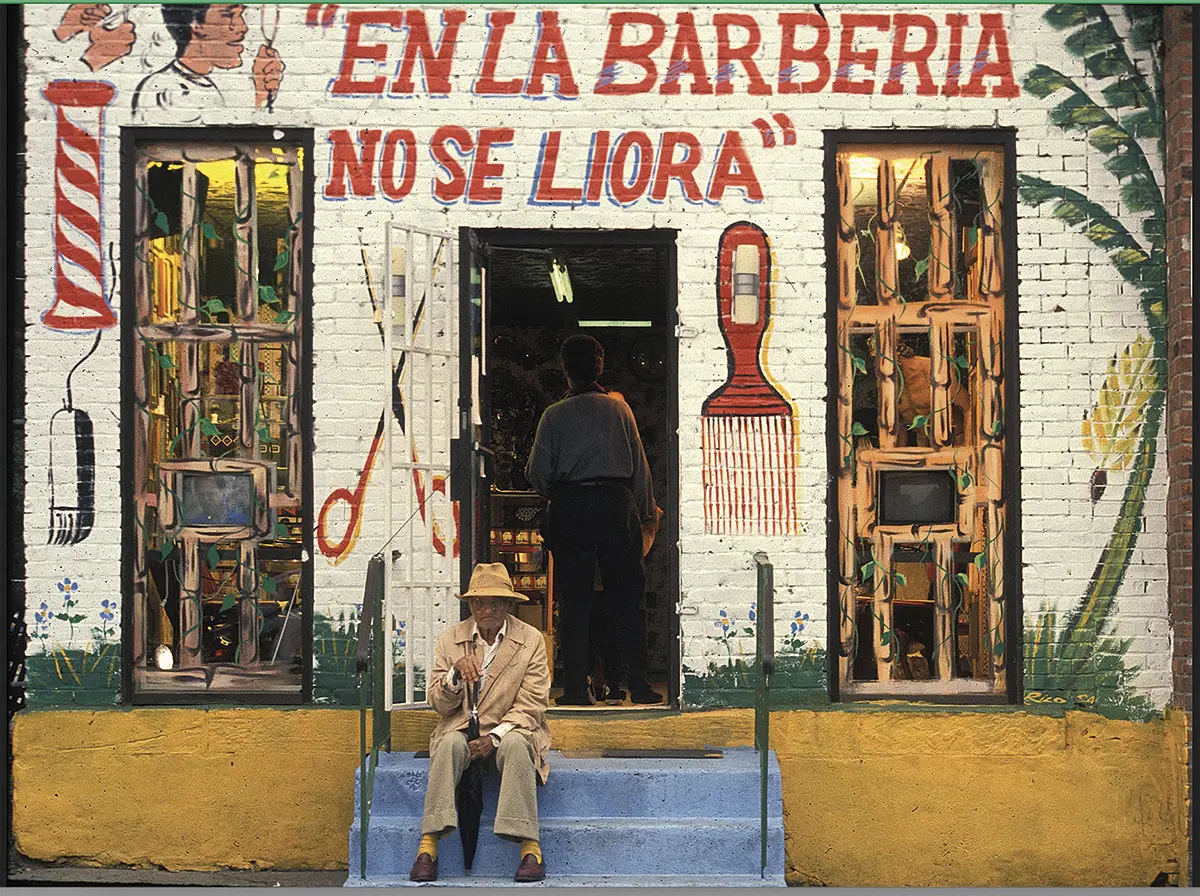
Concepts of masculinity and vulnerability butt each other in the immersive No Crying Allowed in the Barbershop (En la barberia no se llora) which was commissioned and staged at an abandoned barbershop in the Frog Hollow section of New Haven in 1994. A homoerotic undertone exudes from the over-the-top, man-cave scene. Narcissus meets Macho Man.
Hubcaps line the walls like exotic trophies. The barber chairs are velvet-covered thrones in a ritualized space replete with a life-sized Saint Lazarus and a pool table. A large checker pattern covers the floor activating the entire space. Sometimes an actual barber is buzzing away.
Mirrors allow viewers to picture themselves inside the scene—becoming part of it and belonging in the space. They also provide a metaphor for self-reflection and critique. Osorio is intent on redefining what a “museum experience” is like, to make it inviting and meaningful to his community.
A quixotic quality (comparable to the duende in Lorca’s poetry) infuses all the works. A mournful aspect yields to a humor that can be revealing and healing. Within the crowded atmospherics, Osorio invites us to find room to meaningfully process a multitude of contradictory emotions, interpretations, and revelations.
JEFFREY CYPHERS WRIGHT