Integrating the roles of anthropologist, archivist, curator, connoisseur, collector, and artist provocateur, Pablo Delano confronts destiny personally and universally. Both his parents, Jack and Irene Delano, were leading cultural forces in his native Puerto Rico. His own work has migrated from colorful painting to social realist photography to conceptual installation.
About a decade ago, Delano conceived an ongoing, blockbuster project called “The Museum of the Old Colony.” The consequent body of work tweaks the notion of a museum in a postcolonial era. The artist basically made his own museum, challenging institutional prerogatives and selections. Iterations of “The Museum of the Old Colony” have been shown at the Museo de Arte Contemporáneo de Puerto Rico (MACPR), New York University (NYU), and James Madison University (resulting in a book on the exhibit), and other venues.
To realize the project, Delano collected relevant material and researched historic images, advertising, and texts regarding Puerto Rican life. He enlarged newspaper stories and photos, stamped them with “The Museum of the Old Colony” and displayed them, fostering a fusion between art, history, and authority.
The title derives from the Old Colony soda company, a part of the island’s heritage. It highlights Puerto Rico’s unique status as a quasi-sovereign region and echoes the former status of the United States. It summons the artist’s childhood, adding another dimension. Multiple reactions thwart any quick, didactic reading. Yet, throughout, we see the elevation of the humble and an evocation of the spiritual.
Anachronistic hierarchies are reconsidered in the book’s cover image. A rustic in a wide-brimmed, straw hat peers up at a military, twin-prop plane. Contradiction and complicity are central to Delano’s complex vision. Insensitive assumptions are exposed, considered, and revised. Now, the person in the photo induces nostalgia and the plane is no longer a shiny symbol of progress. Indeed, it presages a future of anomie. Pushed together, the frictional combo bears the potential fruition of an asymmetric but symbiotic relationship.
Delano’s latest show, “cuestiones caribeñas / caribbean matters, assemblage and sculpture,” notably advances his aesthetic and methodology. At the Widener Gallery at Trinity College, he recontextualizes samples of folk culture, figurines, antique bric-a-brac, stereotyping merchandise, plus texts and photos culled from newspapers, books, advertising, and promotional materials. Curator Amanda Guzman notes a dramaturgical aspect: “(…) Delano stages a material-mediated performance of the Caribbean as a multi-sited landscape of past and ongoing engagements characterized by merging, collision and intersection.”
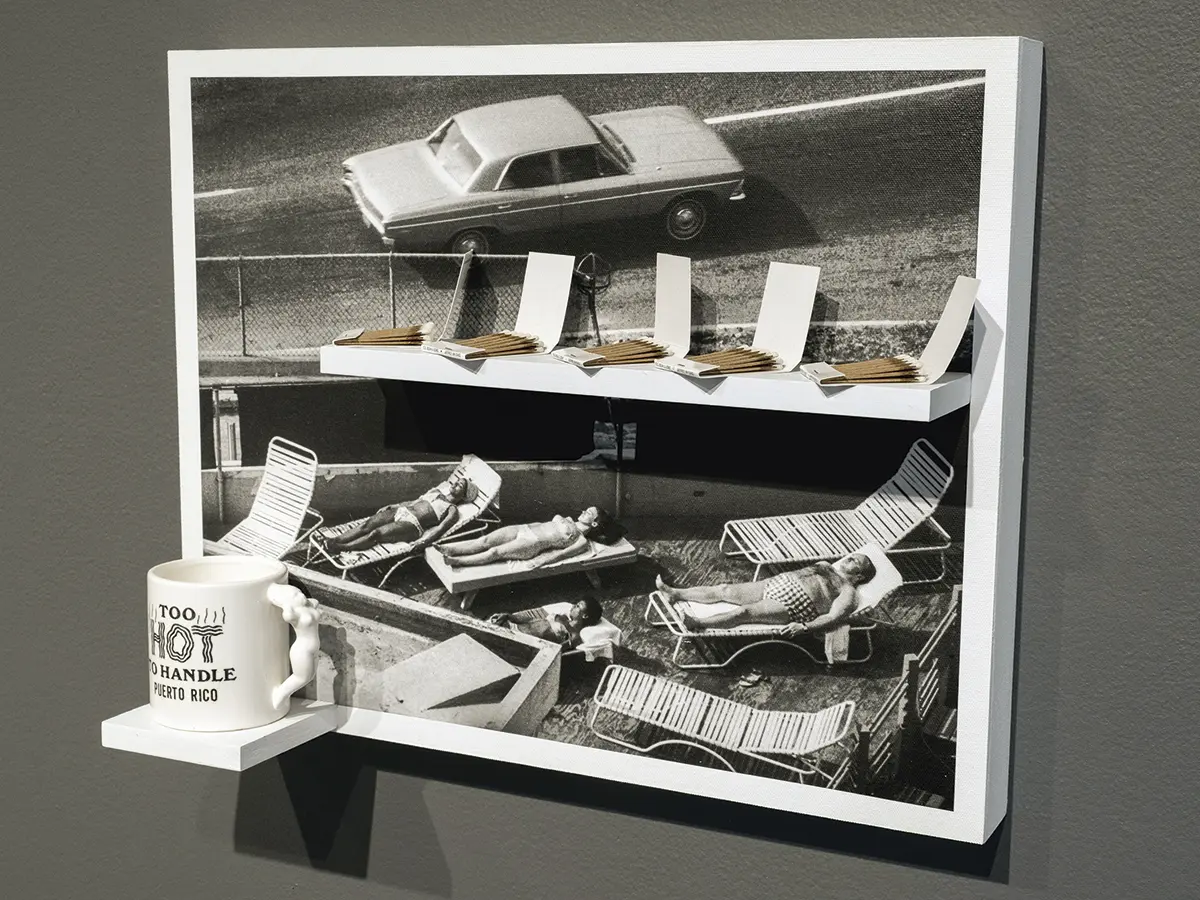
Dualities lie at the crossroads of Delano’s practice. Many of the works initiate an interchange between a single image and an object or two. “Too Hot to Handle” is a perfect example. A grainy, old photo depicts a sleek car passing some tourists by a pool. The black and white image is paradisiacal, but musters a latent resentment aimed at the leisure class.
A small shelf protrudes from the frame, bearing a souvenir cup which states: “TOO HOT TO HANDLE PUERTO RICO.” On a higher shelf open match books rhyme with the lounge chairs. The elements bounce off each other in a fugue of debating associations. Humor (irony’s best friend), exclusivity, aspiration, and commerce converge, stirred up by the crackling dialogue between object and subject.
A complicated triptych, “la (Re)conquista,” [the (Re)conquest] conflates Spanish and American colonialism. Three conquistadors cast in bright red, white, or blue, allude to perseverance, vitality, and discovery but also to a reckoning with inhumanity, hubris, and avarice. Though bold, their uniformity relays the blindness and blandness of monoculture.
Mirroring the conquistadors, three US soldiers swagger in an enlarged 1940 cover of Que Pasa (What’s up), a government tourist guide. Imposed on the cover is a red and black carnival mask, made in the town of Loíza, the center of Afro-Puerto Rican culture. Both frightening and fun, the traditional mask promises renewal through recognition and reconnection with our roots. It looks back in time. It looks out for us—and at us.
Between conquistadors and soldiers, a bottle labeled “aire de la madre patria” (air of the motherland) is both holy relic and mediary, a bridge offering illusive solutions and literal transparencies.
Delano’s pairings resonate as activist interventions. Dichotomies intrinsic to the Caribbean with its multi-ethnic societies and political diversity, slam into each other. Overarching themes erupt, including independence, interdependence, and determination, (both self-determination and the determination of a people continuously forming and reforming the parameters of a community).
Delano’s assemblages uncover shifts in values while affirming a bedrock core of belief. The tensile conjoinings make room for varying, exponential reflections. His abrupt syntheses of identity and subjectivity bear the weight of history yet contain a zingy exuberance that aids us in navigating our current status. This recent work is unique, prescient, attractive—and seriously thought-provoking. Giving us questions rather than answers, Delano offers insightful connotations that reveal the generative potential of a new, ever-evolving mythos.
JEFFREY CYPHERS WRIGHT