Artist Óscar Abraham Pabón (San Juan de Colón, Venezuela, 1984) presented his second solo show at Galería Fernando Pradilla in Madrid.
Under the title “Amor vacui,” he invited us to reflect on the deep fondness for open spaces and the solid conceptual structure that modernity established during the first half of the twentieth century to justify the creation of objects for purely utilitarian purposes. The title of the exhibition sets the tone for its interpretation, reaction, and reflection on the philosophical transition against all gratuitously overloaded elements, in a play of words that evokes the pejorative term horror vacui, which translates as the fear of leaving spaces devoid of ornaments.
Trained as an architect, Óscar Abraham Pabón’s theoretical and conceptual proposal revolves around major pillars such as Le Corbusier, Mies Van der Rohe, and Adolf Loos. The latter wrote Ornament and Crime in 1910, a lecture and a published essay that made him one of the most influential voices of his time in architectural theory, art, and interior design, being fundamental, among others, to the Bauhaus.
If ornamental objects quickly fall out of fashion, why clutter the spaces and render them obsolete? The beauty of a pristine space would make it eternal. Loos played with the veining of beautiful colored marble slabs on his walls, along with typically Turkish tables and rugs to create contrasts in domestic interiors. The rug was frequently used by Loos as an iconic, warm, and legitimate element. It was a transition.
Óscar Pabón perceives such subtleties and directly uses the rug as a philosophically transitional element, which was the starting point for his profound artistic reflection in the two series that came together in the exhibition.
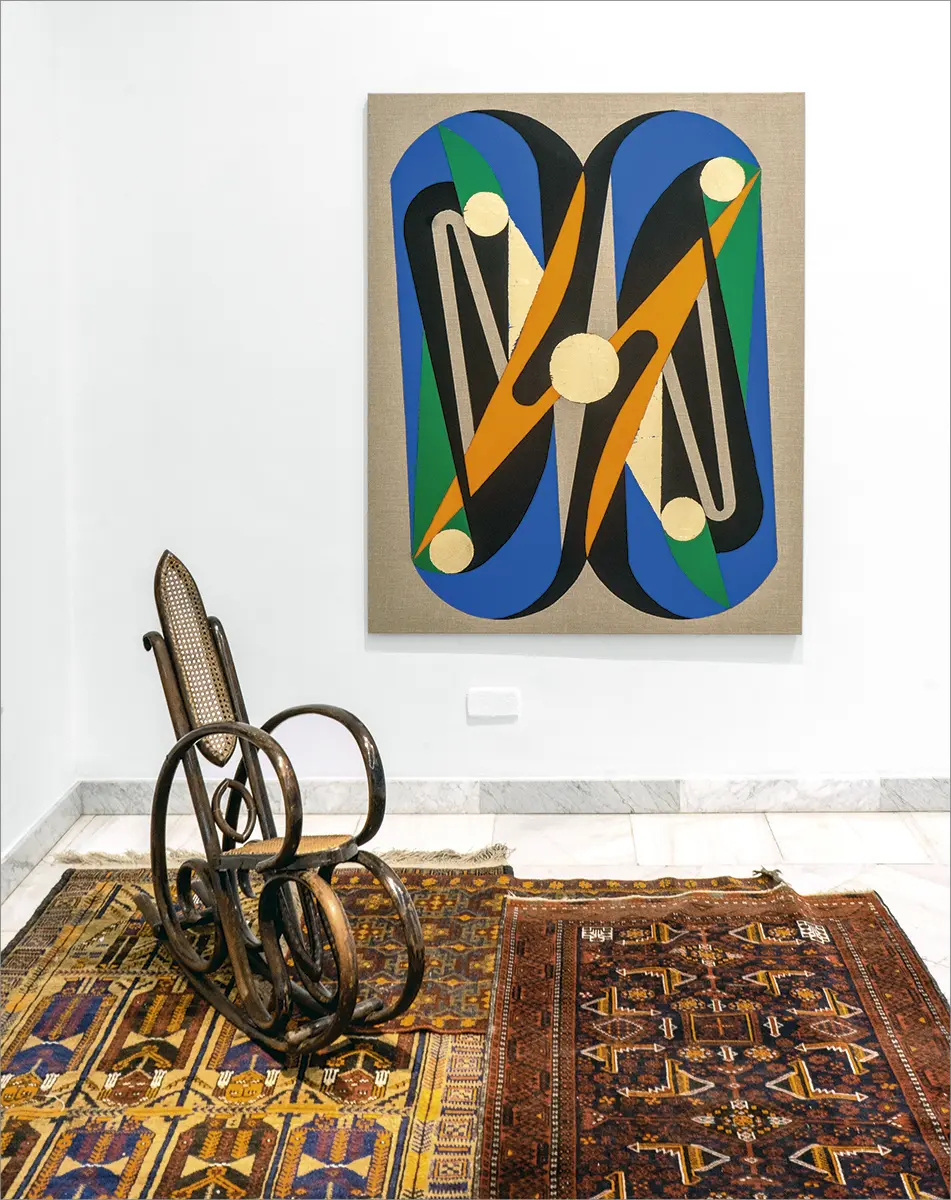
In the main hall of the gallery, there was a set of overlapping rugs, and on them, the Silla de una dirección, Thonet (One-way Chair, Thonet, 2022). Pabón segmented a replica of the Thonet Chair (a technical marvel of handcrafted bentwood created in 1859, and later mass-produced), which he found by chance in Barcelona. By intervening it, he nullified its use value and lent it a contemplative character. The chair ended up being exhibited as an ornamental object, a paradigm of how the industrial process manages to give continuity to a handcrafted process, and, later, how a handcrafted process leads to an artistic process.
Displayed next to this installation was the series of paintings called Nereida (Nereid, 2022-2023), whose composition arose from observing the growth patterns of classical rugs that have been constructed from the center outward. After having cut and displayed other pieces with rugs over the gallery space in the past, Pabón insists on his need to deconstruct and analyze these rugs’ compositional principles, wondering how is it possible to operate from this logic within the pictorial field.
Nereida (Nereid) series is the answer. On raw linen canvases, these fascinating paintings, some of them symmetrical, display vibrant colors to which the artist gives body and character by adding brick-dust pigments or highlighting segments with golden paper. Measuring 160 x 120 cm., just like a standard rug, “Nereida” (Nereid) work equally right-side-up and upside-down.
Amor vacui (2022-2023), the second body of works brought together in this exhibition, is composed of photographic transfers on terracotta bricks in order to celebrate the purity of exterior views and iconic buildings constructed between 1926 and 1930 by Wittgenstein & Engelmann, Adolf Loos, Mies van der Rohe, and Le Corbusier, in Prague, Vienna, and Paris. Even though modernity demanded to cover the exteriors of these rational buildings with immaculate white, they were still structures built with bricks that produced contrasting and sometimes overloaded interiors.
With this set of works, Óscar Pabón reinforces fundamental concepts in his oeuvre, such as the contrasts between exterior/interior and foundation/ornament, while also maintaining his fascination with bricks in their purest state, which he then has geometrically sectioned, glazed, and fired with durable pigments throughout his career.
As Pabón explains, the Red House, built by Philip Webb in 1859 and commissioned by architect William Morris, is made of exposed red brick. They did not want to cover the surface with stucco, as was the process in Victorian architecture. Revealing the raw red brick constituted an artistic statement.
With the exposed brick surface and his research on monochrome in art, Pabón states that white only exists as an abstraction and the concrete, intimate material is red. With the series of photographic transfers on bricks, the artist highlights the work of architecture photographers, anonymous or little recognized, but fundamental for the recording and study of iconic buildings, some of which have been modified or disappeared.
It is an interesting moment in Óscar Pabón’s artistic career. In October of this year in Barcelona, he will present an ambitious terracotta intervention at the Mies Van der Rohe Foundation Pavilion during Gallery Weekend and his own solo exhibition at Lab 36 (Galería Senda).
ELISA RODRÍGUEZ CAMPO