From the everyday, all the way to the religious universe, the concept of “radiance” served as a guide for Brazilian artist Nino Cais’s solo exhibition, hosted by Casa Triângulo between May and June 2023, and curated by Diego Matos. In contemporary art from Brazil, Nino Cais’ production stands out for its diversity of supports and materials (photographs, drawings, collages, sculptures, videos and apparel), for the poetic and narrative discourses revealing the dimensions of daily life, and for the artist’s intimate and formative repertoire, which endows it with subjective and autobiographical undertones.
The title of the exhibition, Clarão: do pó ao corpo, do corpo à terra (Radiance: From Dust to Body, from Body to Earth), highlights the artist’s broad trajectory, fluctuating between transcendence and materiality. Ordinary objects, prints and decorative illustrations refer to memories that constitute a visual universe of assemblages and drawings: that which to superficial glances could be assimilated in the context of kitsch, but in the exhibition were imbued with intimacy and affection. The show was structured around the very cornerstone of Nino Cais’s artistic performance: the recollection of a core of affections and memories, the appreciation for the intuitive forces of creation, and a refined and amplified view of the sculptural language. In this way, the show became a space for the encounter between the traditions of Brazilian art and the experimental exploration of the senses.
The political nature of art, inherent in all artistic gestures, was evident in the symbols, utensils, and words, and in the balance and composition of every work. In alliance with the body’s expressive power, Cais created a sense of direction pointing to his critical perception of the creative act and casting an inquisitive gaze on “object-worlds.” The language evoked in the works is plural, as is the meaning of the word “radiance” (clarão, in Portuguese), present in the very title of the exhibition, which can mean clarity, illumination or blinding; stimulating either the fixation or the distraction of the gaze, and signaling a moment of rupture. Already in the expression “from dust to body, from body to earth,” the presence of the body is emphasized with an artistic operation that transforms it into objects, while the cyclical movement of some works explores the impermanence of life and suggests a perpetual recommencement.
Entering the exhibition space, one observes a sort of “epicenter,” a focal point established by the work Querência (Fondness, 2023), a word that in the Portuguese language has two main meanings: the place where cattle graze and the place of origin and reference of a person. The artist was expressing a deep desire for a connection with the land, with an origin and an end. A large circle was created with twelve deep plates, each one densely filled with powder made from a different Brazilian food or condiment, and on whose surface the outline of the Brazilian map was drawn, bringing to mind the political notion of place and of concepts/signs that are fundamental to this artist: body, territory, and Brazil. Its circular arrangement reminds us of an installation by Brazilian artist Lygia Pape, Roda dos prazeres (Wheel of Pleasures, 1968), since both works share a ritualistic atmosphere symbolizing the constitution of our social body.
This central point radiates traumas and memories, references to the Bible and art history, and semantic games, embodied as subtle revelations of our presence in life. In the series Veronica (2023), one of the few memories of his father (according to the artist) is present. On a framed square piece of paper, a handkerchief (?), considered to be a classic utilitarian accessory of men’s clothing is drawn with the technique known as frottage; the same resource used in Rita (2023), which represents the dishcloth made by Nino Cais’s own mother.
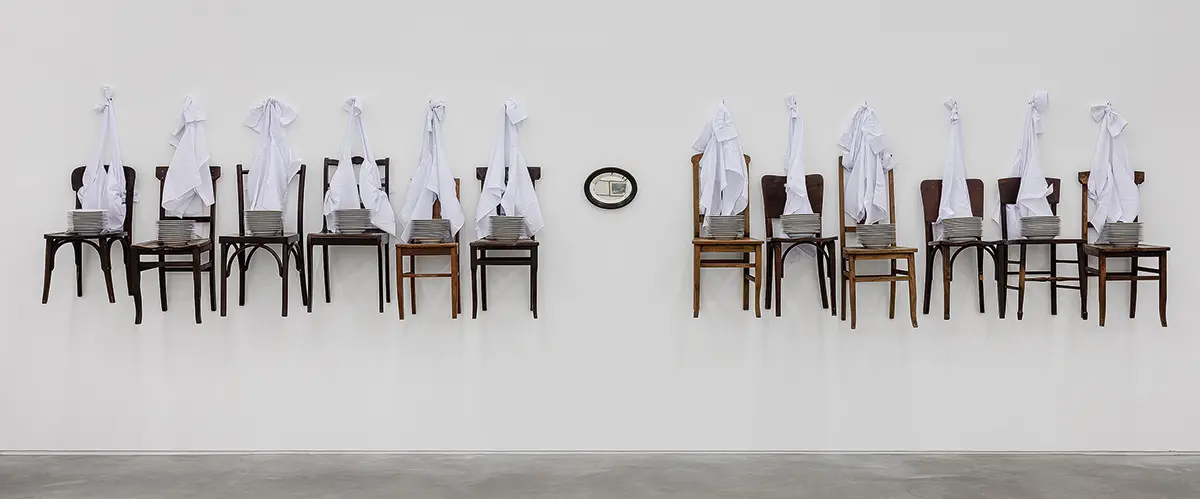
In the sculptural piece Santa Ceia (Holy Supper, 2023), one detects in the artist’s poetics a certain scholastic element that reconciles Christian faith with a body of thought mostly related to Greek philosophy, and a “Duchampian” affiliation that revalues the concept of the ready-made; that is, the operation of decontextualizing industrialized objects from their ordinary use to transform them into works of art. Twelve wooden chairs of different formats were suspended, fixed to the wall, and tied with white shirts. On their seats, piles of white plates, and in the middle, a mirror in the wall reproducing the image of the person standing in front of the work, who became the thirteenth “biblical apostle”.
The vast repertoire and experiences belonging to Nino Cais’s artistic practice are an invitation to continuously remember and reconstruct, clarify and embody.
CRISTIÉLEN RIBEIRO MARQUES