A career spanning over fifteen years backs the work of Nicolás Paris (Bogotá, 1977), whose oeuvre begins with the architectural and moves towards a strong preference for pedagogy and its processes. In Protobosque o un intento para estar juntos (Proto-Forest, or An Attempt to Be Together), his exhibition at Galería Elba Benítez in Madrid, Paris revisits the lines he has pursued during these years and pushes them one step further. While architecture becomes a framework to contain learning and its development, what truly interests him is the exchange of knowledge: Paris wagers in favor of a two-way dialogic pedagogy where the artistic framework is part of the means, not an end in itself. Drawings, installations, and videos are presented as parts of a continuum that, for the duration of the show, the artist brings into the real space of the gallery, through workshops and unregulated, participative encounters with professionals from such diverse fields as the visual arts, arts-and-crafts, music, cuisine, and science.
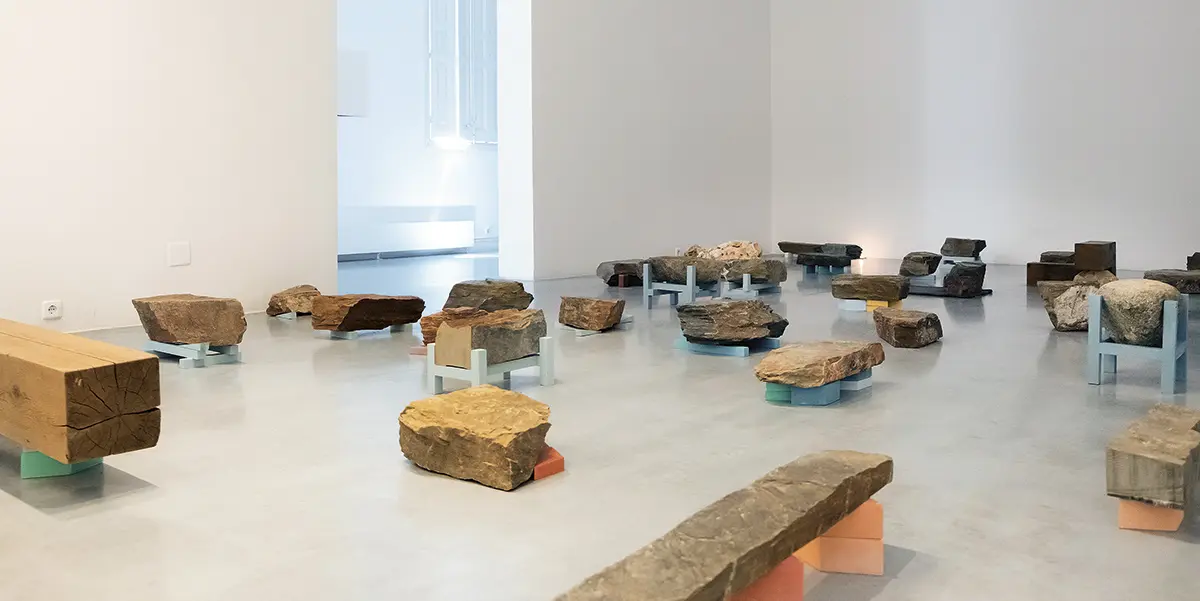
The collaborative strategies supporting Paris’ work are given concrete expression inside the gallery by a series of drawings on the wall, several video works suspended between the exhibition spaces, almost floating, and a floor installation with elements like rocks, wood, and paper. The latter is among the works that are activated gradually as the exhibition progresses, with open encounters that included the participation of Claudia Segura (curator at MACBA Barcelona) and Alicia Mansilla (Director of Neuroscience at IRYCIS), among others. In each instance, music accompanies the conversation, and Paris’ true work takes place in the cross-pollination between disciplines, presenters, and audiences: dialog, a search for new ways of relating, and collective creation in a non-hierarchical, mutual learning process. Such encounters are indeed the leitmotiv in the activation of the works: the corporeal presence of the participants, their emotions and thoughts, or the connections established between them, are what charges the work. Perhaps because of this, Paris’ work has elements of the master/apprentice duality, but also of the shaman/neophyte connection, where the exchange of knowledge occurs more through unseen means than through the final object. Like heterodox talismans, the works in this exhibition acquire meaning precisely through the process and through the people who take part in it, their dialogs, and their experience of the encounter. Each shared experience remains connected to the object.
As Paris notes, the conversations that accompanied the exhibition were “light, broad, sensible, corporeal,” and sought to foster “understanding towards consciousness, rather than reason”: this is key to the Colombian artist’s work, something he has developed over the years, the act of knowledge exchange, favoring non-hierarchical process and non-normative learning. Perhaps because of this, we should not let the simplicity of the conceptual final formalization of the work, that minimal gesture that interests Paris so intensely, occlude for us the meaning it has acquired for its participants, how they have charged it with the imperceptible and immaterial element of knowledge and experimentation.
Protobosque o un intento para estar juntos (Proto-Forest, or An Attempt to Be Together) updates Nicolás Paris’ work without casting aside the interest on the pedagogical value of art that has occupied him so persistently since the beginning. The painstaking attention to formal details in each of the works (both in themselves and in their arrangement inside the gallery), with spatiality and its distribution also playing a foundational role and becoming part of the pedagogical constellation, comes from Paris’ origins as an architect. His spaces are instigators of experiences and encounters. They fulfill that function here as well, and the gallery offers more than an art show: it provides a site for experimentation, inviting visitors to appropriate, participate, and become part of the process.
The “protoforest” that took over Galería Elba Benítez is, indeed, an attempt to be together, to leave behind the mere artistic object and its central role in the marketplace in order to, in the manner of the Avant-Garde and of artists such as Luis Camnitzer, move boldly towards pedagogy, wagering for the usefulness of an art that turns the audience into an essential component. In the midst of our fast-moving present, when the market value of the art object is preeminent and we become increasingly more isolated in the digital realm, and as the planet shows symptoms of exhaustion, such a gamble for the creation of a forest inside a gallery and for the fostering of creative, cross-disciplinary, creative encounters is, at the very least, revolutionary.
SEMÍRAMIS GONZÁLEZ