Nicolás Franco’s exhibition at the Museo Nacional de Bellas Artes has a daring title: Materia gris (Gray Matter). Daring, because it sets out for us a complex game within the boundaries of abstraction, consisting in puzzling out the artist’s proposal.
Viewers are confronted with large, impressive paintings leaning against the walls, and may fear that the walls will not support them, or think that the paintings have been left there temporarily, in transit somewhere else. There is no possibility of permanence, they lean as if rejected or waiting to be received. It is a strange composition, seeing large rectangular artworks, their wooden frames wrapped in aluminum sheets, set against walls rather than hung as is customary. The formulation is certainly brilliant, because in a space as large as Sala Motta’s, art loses its power when attached to the walls. This is how we are introduced to Franco’s installation, an artist with fifteen years of experience in this modality of the visual arts.
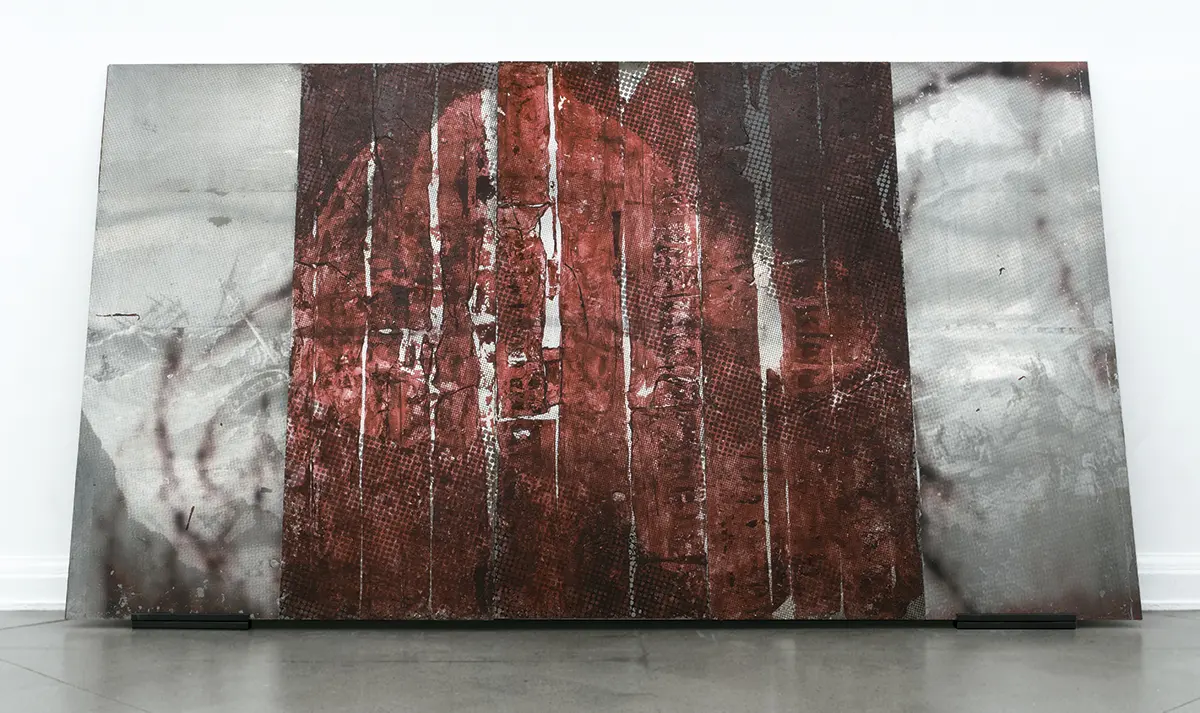
The installation presents viewers with a game. First, to recognize the original; second, to discover the artifices that alter it; finally, to conceptualize the final image achieved through the use of chemicals that drip on the original and deform it.
This conception of art is wholly abstract; from every angle, it reveals the artist’s interest in framing a reality through a disparate medium, different yet current. The image is achieved in his mind, in his thoughts; thus, Materia gris (Gray Matter). To fuse an accepted fact to his lived experiences, in the face of isolated facts. Clearly, formal reasoning does not apply to these works. The mind captures the image, which, ensconced in memory, is subjected to tests of identity and then goes through a nebula in order to be materialized in a new image.
If formalities are followed, such as proportions and colors, the results of the technique adopted are uncertain; everything can happen. It is as it was with the earliest photographs, when the slightest distraction in the development room would produce an unexpected result, which would then be accepted or rejected.
In his daily labor as an artist, as he has said, Nicolás Franco searches for images of the past and processes them, seeking to mold them into later experiences—his own or others’—in a peculiar game of abstraction.
Generally, viewers of Franco’s installations are able to connect the work with their own experiences in a particular way, and for years Franco has been on a quest for the interplay between what exists what viewers carry in their memory. It goes without saying that this work is an experiential game, thus the name, Materia gris (Gray Matter).
The use of materials in Materia gris (Gray Matter) deserves attention. Franco uses aluminum in symmetric, uniform cuts, deformed by corrosive chemicals incorporated into the images of paintings, sculptures, ornaments, documents, press items from the Museo Nacional de Bellas Artes, caretaker of the nation’s visual arts.
Materia gris (Gray Matter) dives into the world of pictorial materialities and explores referents of local art history. This unique approach allows the museum not only to display works from its collections, but also to reinterpret them in surprising ways. From the point of view of the artist, this exhibition allows us to contemplate iconic artworks, witnesses to past eras and events, while at the same time subjecting them to complex revisions and transformations. In this way, the works become complex artistic formulas that probe and challenge the boundaries between figuration and abstraction, generating a captivating, contemporary tension. In exploring these pictorial materialities, Materia gris (Gray Matter) invites us to reflect about the interaction between the past and the present, tradition and modernity. Each brushstroke and each line transport us to a visual dialog between tradition and the present moment, between known forms and new interpretations. This exhibition captivates with its singular way of looking at our local artistic legacy, challenging us to see it from a new perspective. Materia gris (Gray Matter) invites us to immerse ourselves in a world of possibilities, where painting becomes a powerful tool to interrogate and reinterpret our visual reality.
ERNESTO MUÑOZ