Artist Natalia Castañeda (Manizales, 1982) presented the solo exhibition Raíces y futuro (Roots and Future), a project curated by José Jiménez and co-organized by the Museo Extremeño e Iberoamericano de Arte Contemporáneo (MEIAC). The exhibition was displayed there from October 28, 2022, to March 12, 2023, and continued its journey to the Museo Nacional de Antropología de Madrid (MNA) from March 24 to June 11, 2023. Roots and Future is part of the program “Critical Visions: Art and Anthropology” and is the fifth exhibition in the cycle titled “Ibero-American Expression.”
To understand Natalia Castañeda’s work, the first thing we must grasp is that her approach to nature through artistic means is multifaceted and involves a profound human scale. The artist approaches her surroundings from shared vulnerability and the immense respect and admiration she holds for nature. In the artist’s words: “This is an exhibition project that compiles my recent explorations of fragile and minimally intervened ecosystems, reflecting both poetic possibilities and radical changes (...) I stop to observe the perimeters that reveal geological, tectonic, and volcanic movements, human and non-human interventions.”
Raíces y futuro (Roots and Future) also allowed an approach to different elements of nature from a scientific, cartographic, and narrative perspective, supported by a scientific team.
Throughout the exhibition, Castañeda engaged the audience, raising essential questions about our existence, defined in three realms: Who are we? Where do we come from? Where are we going? The pieces in the exhibition encompass various formats: painting, drawing, sculpture, installation, and video.
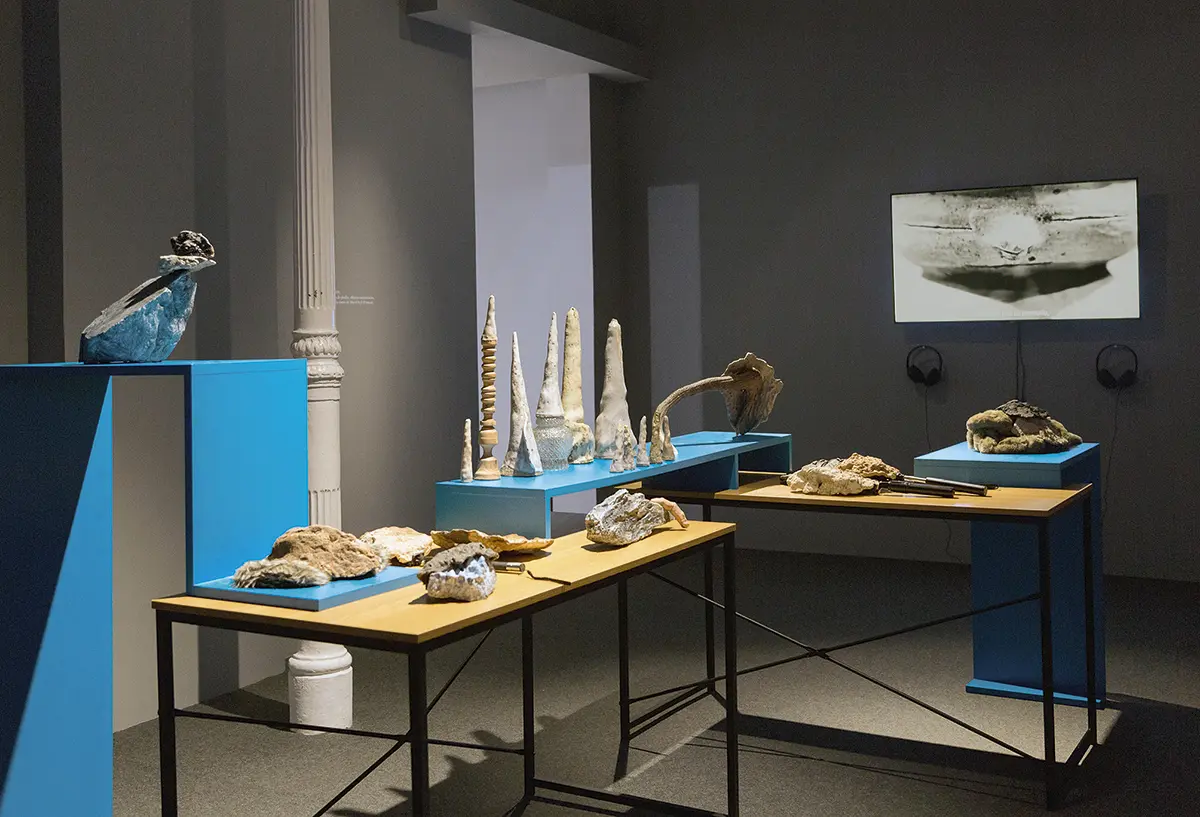
At the beginning of the exhibition, there are beautiful notes: 360-degree foldable panoramas with the robust silhouettes of the imposing mountains she visits. Natalia Castañeda recounts how during different expeditions, she has peacefully stayed at the foothills of the mountains to detail them in her notebooks. She also shows us installations with pieces molded in ceramics, replicating, with a noble material, plastic objects and packaging. In Natalia’s words, it’s a “domestic landscape,” contrasting the malleability of the material against the hardness of industrial and ordinary waste, and serving as a record and memory of daily actions. The exhibition also included the installation Convertirse en piedra (Becoming Stone), a cabinet of curiosities consisting of plastic fragments, earth prints, and found objects, described by the artist as “tactile records.”
Raíces y futuro (Roots and Future) constituted a mapping that delved into archaeology, geology, poetry, and naturally lead us to a concern about the future, stemming from ecological awareness. When we become aware that we are not the measure of all things and understanding the impact of our presence, realizing that the minerals flowing in our blood compress the rocks, we come to understand that we are one with the flow of the river among the pebbles rounded by time.
Natalia Castañeda presented the sculptural and participatory installation El río (The River), which encompassed the stages of creation and transformation of this body of water. Visitors were invited to intervene in the different plaster droplets that form the river, leaving their traces, redrawing its flow, and imbuing it with stories of collective authorship. With this powerful metaphor, Castañeda urges the public to be aware of the impact and transformative power of humans on nature. The installation in the room continued to grow, and with the assistance of the MNA mediation team, visitors became immersed in awareness, filling El río (The River) with their contributions.
Throughout the exhibition, we constantly heard Natalia Castañeda narrating her works, a journey imbued with subjectivity. The sweet thread of her voice guided us through the sublime scenario that opened before her when she stood face to face with the snow-capped mountains of central Colombia. Entre el volcán y la vertiente (Between the Volcano and the Slope) is a two-channel video installation that shows the record, with a handheld camera, of her journey over seven years through these places, subjectively bringing us closer to the mountains. Castañeda speaks to them, asking about their time. The sound design for the film is done by Sergio Castrillón, a musician and composer from Manizales, now based in Helsinki.
Mirar adentro (Looking Inside, 2019) is a video that establishes correspondences between pre-Hispanic figures from the archaeological collection of the Universidad de Caldas, taken out of context, eliciting new (fictional) readings from the present with a different purpose.
As a conclusion to the exhibition, and in response to the third question, “Where are we going?” was a body of work that Natalia Castañeda dedicated to glaciers. In the artist’s own words, she aims to “map the extinct.” The video-essay Cuerpo glaciar (Glacial Body, 2022) starts from experimentation in editing and addresses these icy titans, survivors of the Colombian landscape. We can also see interventions by scientists alternating in the editing. Cuerpo glaciar (Glacial Body) is a collage of reasoning, which can be inferred as a precursor to her most recent piece: Cuerpos glaciares, ancestros hídricos de una extinción futura (Glacial Bodies, Water Ancestors of a Future Extinction), presented in August 2023 at the Galería Santa Fe. The artist brings us, from a sensitive, scientific, and artistic standpoint, closer to three ice masses, out of the six existing in Colombia: Nevado del Ruiz, Nevado del Santa Isabel, and Nevado del Tolima volcanoes. It is said that in 1850, 170 years ago, there were seventeen registered glaciers in Colombia. We are witnessing the extinction of glaciers and the reduction of glacial masses globally. Natalia Castañeda urges us to see them as suffering family members and to act accordingly.
ELISA RODRÍGUEZ