L’Outreligne (“Beyond the Line”), an exhibition curated by Christine Frérot, opened on May 23 at the Maison de l’Amérique latine, in Paris. It brings together Milton Becerra and Pancho Quilici for the first time, in a survey of their respective careers.
A priori, what connects these two artists is their biographies: their nationality (Venezuelan), their cohort (born in the 1950s), their move to Paris in the 1980s. But, beyond those facts, what’s the common thread? “The line,” replies Christine Frérot.
Quillici’s universe takes us to an experience where drawing challenges the two-dimensionality of paper. His roots in architecture and design have percolated over the years, and he possesses impeccable freehand drawing technique. His tool is a granite pencil, humbleness itself, and he uses it to materialize extraordinary landscapes, as firmly based on scientific knowledge as they are free in their imaginative interpretation. Becerra’s work, on the other hand, is intrinsically tied to our world and our time. First of all, because it occupies our same dimension: installations, sculptures, weavings, bas-reliefs, all in interaction with our senses. The plant fibers, wax, gems, feathers, and hides he uses invoke our most basic human instincts. Intimately anchored to the heart of his Latin American roots, Becerra’s work evokes the wind sweeping the region’s valleys, the water coursing through its mountains, the magma of its volcanoes, and the land where the Amazon forest has sprung. Becerra’s art is more texture than form, more smell than color.
At first glance, then, perhaps the connection was not altogether evident. The artists themselves, interviewed by Jordi Batallé on RFI, admitted to not seeing it clearly. “But as we developed the project,” Quilici says, “we gradually understood the commonalities.”
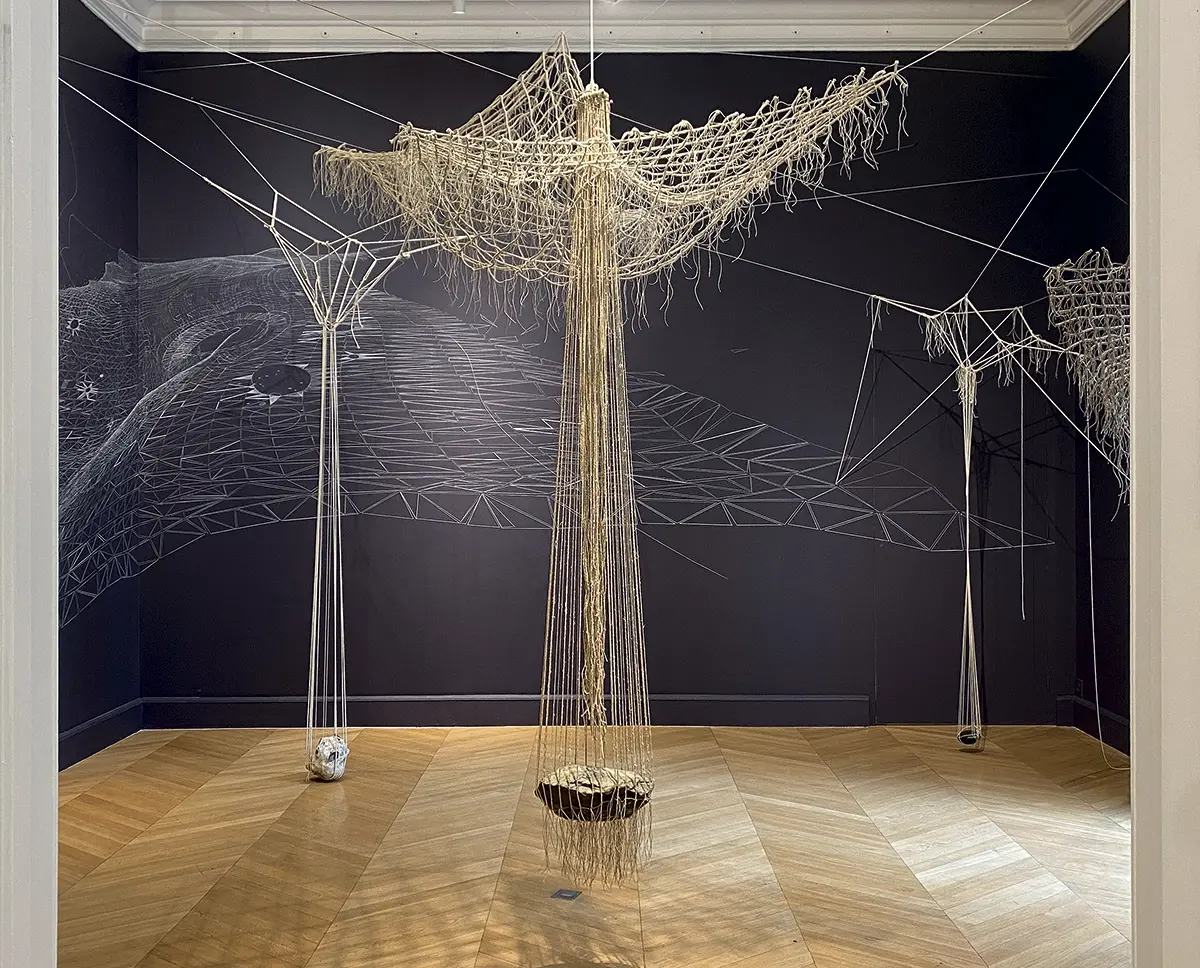
The exhibition’s first room gives expression to those words: strange hammocks, cobwebs or improbable nests woven in linen fiber hang from the ceiling. Each holds a rock, delicately and at different heights, while white lines drawn on the walls shoot out of them, becoming a geometric representation. In that way, the nests are transformed into energy connections in space, while the rocks become black holes. There is where the magic happened: Becerra and Quilici, together forty years after reaching Paris by separate routes, realize the correspondences between their works, in a marvelous dialog that preexisted them but only came to take material shape under the knowing gaze of Christine Frérot. An ephemeral work of art, by two pairs of hands: a toast to the health of the virtuosic encounter.
The exhibition continues in the lower-level galleries, with a room devoted to Quillici: The Tuneloscope (2023), a kind of serpent in iron, transparent acrylic and mirrors, three meters in length, invites viewers to enter into a world of geometries where the human gaze loses its bearings in an unending series of illusions. Le grand plongeon (The big dive, 2022-2023), twelve drawings in graphite and pastel on paper, measures 400 x 210 cm. An aquatic vortex, black holes, tectonic figures, and constellations of lines combine in a vibrant composition in gray hues. In an adjacent room, visitors found the series Errances and Dérives (Wanderings and Drift, 2017) and Quillici’s sculptures in transparent acrylic; later, other grand works like Multiplicité continue (Continuous Multiplicity, 2013) and Transition (2017). Their restless lines seem to register the movement of space, like seismographers or electrocardiograms of intimate worlds; fractals connecting the infinitely large with the infinitely small in an unstoppable cosmic rhythm. Ruins of past civilizations appear at the same time that extraterrestrial presences make themselves felt. However, there are no human figures, nor animals, not even a trace of vegetation. Only, suddenly, letters that seem engraved on stone, mysterious numbers in constellated points, and messages from the artist, in small writing: “conflit d’ubicuité” (ubiquity conflict), “suivre” (follow), inviting us to decipher both the works as such and the “hidden messages” they contain: the artist transforms us, in that way, into archeologists or astronomers of his worlds.
The works by Quilici on exhibit here cover the last twenty years; in the case of Becerra, the span is longer. The oldest work in the show, his Hexagonometría (Hexagonometry) dates from 1972. It functions as a premonition of sorts, or a confirmation, for this very exhibition. Reina (Queen), a woven installation, comes from the same grid: a sculpture comprised of several layers of suspended linen fiber mesh, sketching in negative (almost as a cast) a face in profile. While the legacy of kinetic art is evident in this work, the sculpture-installations are closer to the aesthetic conception of Arte Povera, appealing to potent messages: ritual objects that imbue us with energy, as in Cetro de poder (Power Scepter), from 1988; the value of what is broken and of history in Pentagrama (Pentagram, 1993); the critique of capitalism as a source of currency devaluation [Râpe de monnaie (Coin grater, 1992)].
Milton Becerra closes the exhibition with a monumental site-specific work: Irradiation d’énergie (Energy irradiation). In the middle of a large room painted deep blue, a selenite quartz dislodges itself into our gaze, monumental in its brute stone simplicity, suspended in the air by myriad nylon threads in frank colors (yellow, orange, green, sky blue). A jewel in this exhibition: the stone seems to irradiate its energy and its light, to diffract into uncountable color lines.
L’Outreligne is a neologism coined by the curator, which could be translated as “beyond the line.” Indeed, there is something beyond the line. Lines connect, encompass, interact, and continue to operate in the tangible world, our world, reminding us that everything is light and vibration, and that we are all connected to the whole. Quilici, Becerra, both and each in their own way, guard part of the secret and, in the simplicity of every line, know power.
CHRISTINA CHIROUZE MONTENEGRO