The chamber exhibition titled “La monarca” (The Monarch) in Room 2 of the Ruth Benzacar gallery, once again evoked the talent and audacity of Mildred Burton, the creator of a legendary and liberated artistic world. She explored various genres, techniques, and styles according to her expressive needs, with fantastic imagery, wild details, shrewd associations, and occasional appropriations. This show is also an excellent opportunity to write about the artist and her work, which is little known outside of Argentina.
Burton had at least five-hundred individual and collective shows. Several posthumous solo shows were held in Buenos Aires, and she also participated in group exhibitions linked to Surrealism, partly due to the characters’ experiences and the absurd situations portrayed in her numerous paintings. However, she did not want to be pigeonholed and refused be labeled a surrealist.
Burton can be considered an “artist of myths,” as described by Marta Traba (1923-1983). The famous Argentinian-Colombian critic believed that artists can perceive the exceptional in the everyday, feel the magic of sunrises, and discover the ominous around them. Many of the images conceived by Burton arise from her extreme sensitivity—following a path that led her to reflect on the mysteries in the lush flora and fauna of her birthplace, the Mesopotamian-like province of Entre Ríos—and from the deep ocean of her impetuous imagination.
Burton was born in Paraná in at least five possible years between 1923 and 1942. However, one thing is certain: she died in Buenos Aires in 2008, leaving behind a prolific and captivating body of work that always surprises for its enduring mystery. Yet those who knew her well believe that perhaps her life should be considered her best artwork. Many of her pieces are based on fragments of her true or invented biography.
Magic realism appears mostly in the works that are both tranquil and revulsive, delicate and sinister; such as the drawings and oil paintings presented at Benzacar with a text by María Gainza. The exhibition also includes a compilation of four interviews with the artist, conducted by theater director Analía Couceyro in 2002. These make up a chapter of the Biodramas cycle; each one representing the story of a living person transformed into dramatic material. It was only a few years before her death when, loquacious and seductive, with sparkling eyes and a performative attitude, she narrated aspects of her life that are even more interesting since her existential tale is intimately tied to her unclassifiable work. The stage director did not need to add much since this histrionic artist’s story was sufficiently moving.
Her corrosive humor, technical expertise, and endless inventiveness, along with certain perverse details, inform works that represent people from her environment (her grandmother was the target of her wrath), notable public figures, small objects that come to life, folklore legends, European traits from her ancestors, designs from indigenous villages, snakes and dinosaurs, motorcycles with human attributes, animals with a fierce and altered appearance, anthropomorphic forms with acorn faces and root-like feet, such as the untitled and undated drawing shown here. But not everything in Burton’s work is delirium; the paintings with political undertones and against gender violence evidence a vigilant mind connected to the political and social events of Argentina. For example, the the series La familia del torturador (The Torturer’s Family) made in the 1970s during the time of General Perón’s death, possess chilling, sinister details, such as the severed finger worn as a pendant by the elegant lady portrayed in La madre del torturador (The Torturer’s Mother).
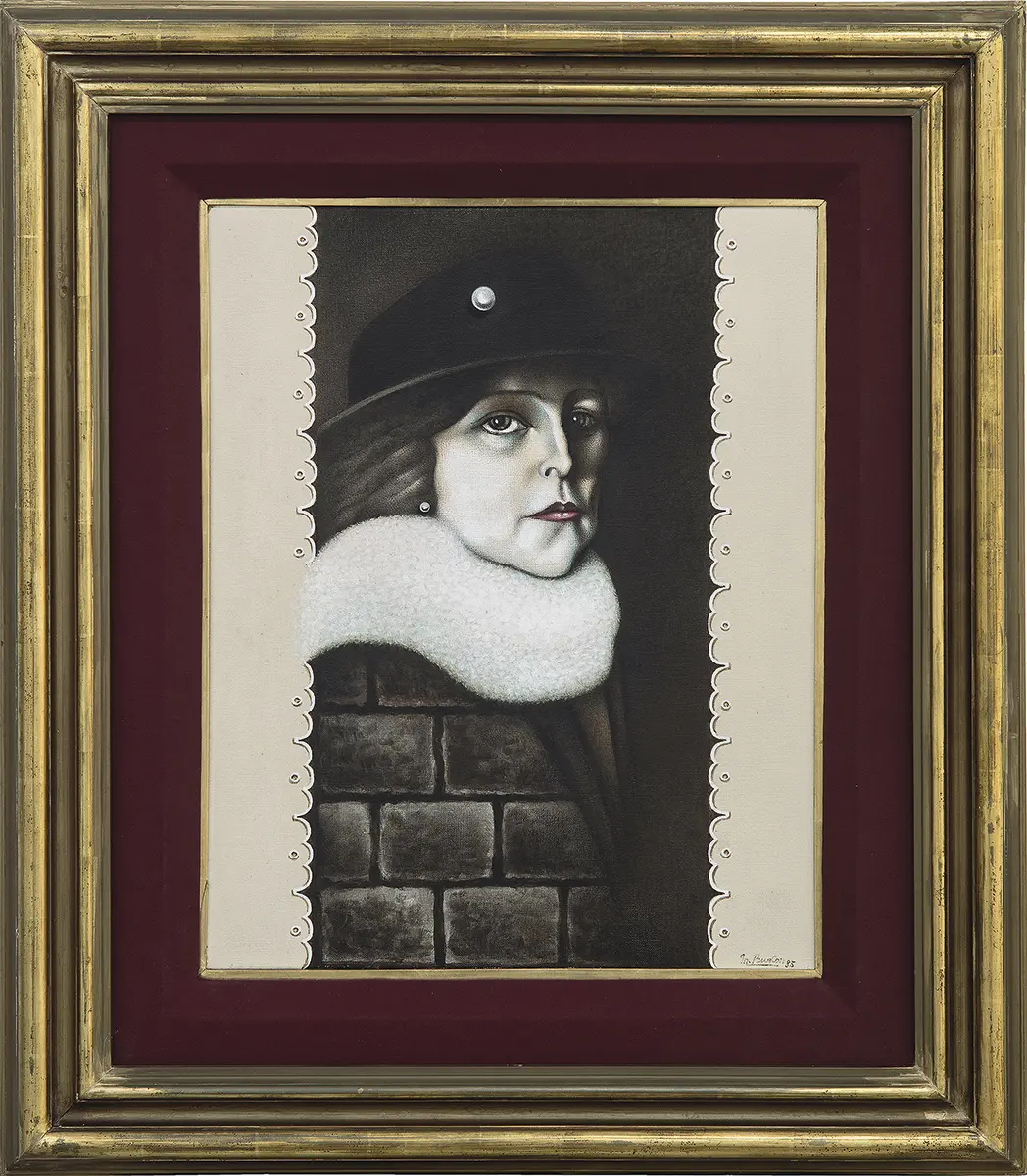
The exhibition offered some of her frequent word games, as in the oil painting Corrientes Langosta (Lobster Corrientes) from 1985. Its title may refer to the tango Corrientes angosta (Narrow Corrientes), the central avenue of Buenos Aires that used to be narrow before it was widened in the 1930s. Indeed, narrow is the portrait of the unnamed and haughty lady. Is she trapped in the bricks of that demolition?
The ensemble with apples in the foreground of the gallery’s installation—just like the 1982 acrylic painting titled Levitación (manzana verde) [Levitation (Green Apple)] or the 2001 oil painting named Jaime Cosme atisbando en la misteriosa fonda (Jaime Cosme Peering into the Mysterious Tavern)—depicts the metamorphoses that disproportionately-sized fruits, vegetables, and bread often undergo in her work, flying and strolling through unusual landscapes and surprising architectures, and sometimes engaging in invasions, suicides, or executions.
Smoke from a train rises from the pages of an open book resting on a table: a small example of the artist’s ability to represent and reconcile the real and the prodigious. Children that look like they’re made of porcelain do not escape the contradictions she likes and knows how to portray. Innocent and somber, the sometimes have a stern, vacant gaze, as seen in the mixed-media piece Narcilindo Baby Doll. No one, and nothing, escapes the sarcasm, the contradictory sensations, and the sharp humor of this artist, who also delved into song and performance, reinventing herself whenever she felt it was necessary. Burton continues to interest us because the significance of most of her works seems inexhaustible.
VICTORIA VERLICHAK