Equilibrio (Balance) is the title of Colombian artist Lydia Azout’s solo show at La Casita. In this house in Bogotá’s El Polo neighborhood, outside from the parameters of both traditional galleries and independent spaces and known for the new challenges it poses to mid-career and long-established artists, Azout—born in Bogotá in 1942 and still brimming with creative energy—takes us through several moments in her career. The show was curated collaboratively by the American cultural promoter Rebecca Schapiro; Camilo Chico, director of La Casita; and the artist herself. Long established as a sculptor, Azout took the opportunity to present also other aspects of her production, expanding the range of materials, techniques, and formats with which her work is commonly associated. Equilibrio (Balance) may very well be a first step towards a broader and deeper retrospective. The details of Azout’s thought revealed here give nuance to the artistic portrait of her time and her context.
Azout says that her artistic practice began “late”; she focused first on raising her children. When it felt like the time had come, she took lessons with David Manzur and then with the conceptual artist Luis Camnitzer; later, she combined both experiences and launched into a path of her own. In truth, the idea that she began late means that she began when she had to, and has not stopped producing art ever since. She couldn’t; being an artist is a necessity for Azout, akin to breathing oxygen or drinking water. In the exhibition, the interests she has explored at her own pace, with a deep sense of balance, are distributed into three broad areas: geometry, memory, and water. A tour of the exhibit at La Casita reveals, again, an artist of personal yet universal worlds who self-defines as part engineer, part alchemist.
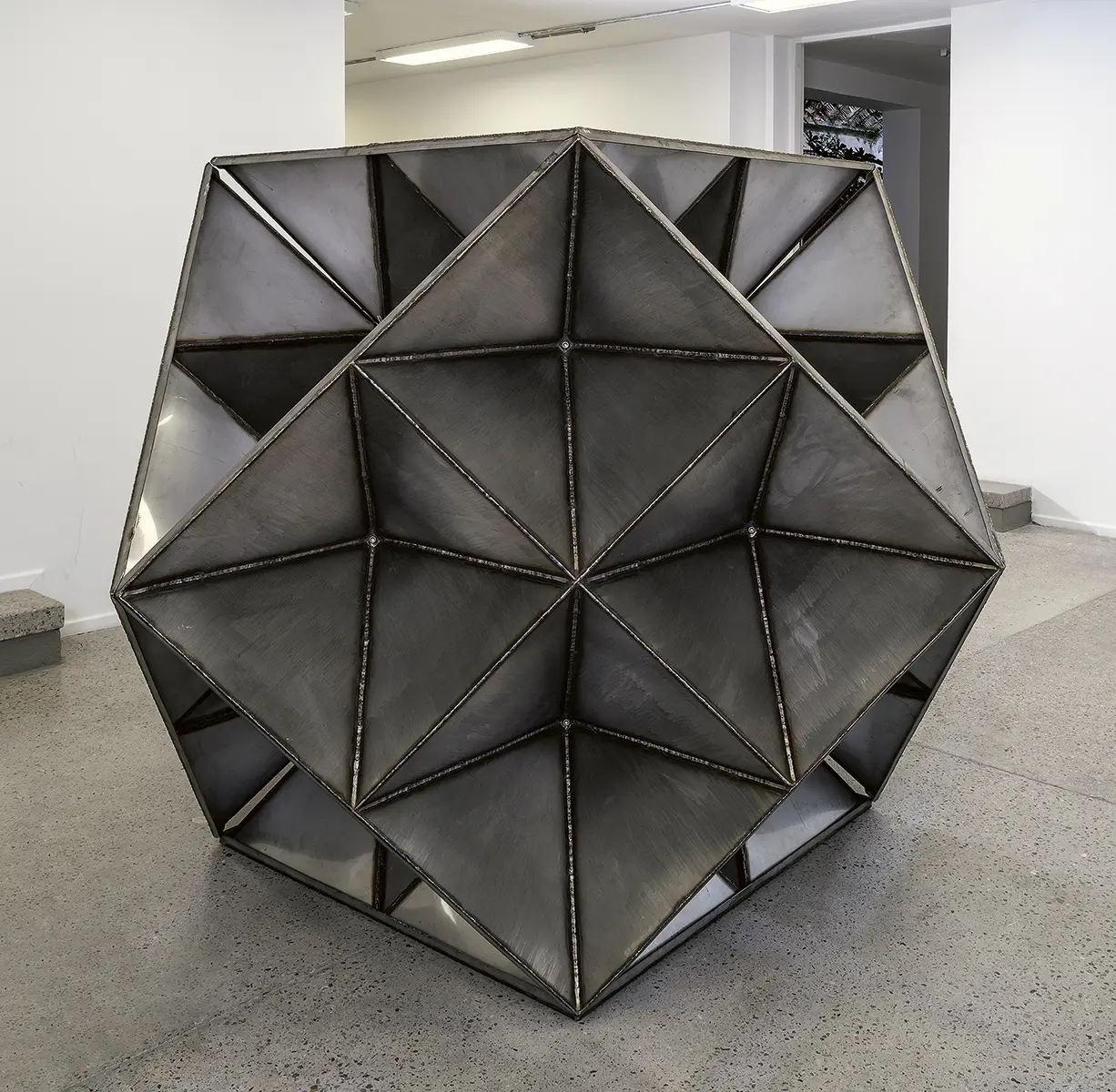
For those familiar with Azout’s work, her best-known language has been that of large-format geometric structures, most often encountered in the city’s public space. Reminiscent of exhibitions like the one at MAMBO a few years back, here we find several works from the series Estructura del vacío (Structure of the Void). These works take sacred geometries as their starting point: basic elements like the triangle, the square, or the circle form portals of sacred shapes and plots. Estructuras del vacío I (Structures of the Vacuum I) is the skeleton, the absence, air; its complement, Estructuras del vacío II (Structures of the Vacuum II), is skin, cover, solidity. With these two works, Azout delves deeper into the world of Platonic solids, the study of forms with universal resonance.
The Memory chapter encompasses works like Homenaje a Obregón (Homage to Obregón) and Naturaleza muerta (Still Life). Dating from the 1980s, they give us a better understanding of an artist concerned with the balance between humanity and nature, showcasing her prescient intuition in topics that are at the top of today’s agenda. Homenaje a Obregón (Homage to Obregón) raises its voice in protest against an ecological disaster in Cartagena, which resulted in the death of large quantities of Ciénaga fish. It is a sculpture of a fish bone (in reference to a still life with fish by Obregón) hanging from a marble base, carved on the front and back. It brings to mind an archaeological or paleontological fossil, and displays on its back the diagram that gives the exhibition its title. Already at this point in her life the artist was carving the signs of her ecological awareness in stone, her view of the conflict involving overpopulation and fragility, life, progress, and the necessary interdependence of all living things in the planet, threatened by human destructiveness.
Finally, we enter—both literally and figuratively—into another of Azout’s passions: water. While her best-known penetrable works are those in iron, in this case we have an opportunity to amble through Paisajes (Landscapes), a series of digital prints on canvas of blown up images of ocean waves that signal the artist’s fascination with nature’s forms, with the color and flow of water. Our immersion is reinforced by another audiovisual work commissioned to the Colombian photographer Camilo George, Esencia…agua (Essence… Water), which invites visitors to feel surrounded by the ocean. It bears noting that Equilibrio (Balance) was held at the same time as Esencia…Tierra (Essence… Land), another exhibition by the artist at the Alonso Garcés gallery; nature and water are the nexus that connects them, particularly in the Paisaje (Landscape) series and in Esencia…agua (Essence… Water), made in different formats for different locations. With regards to these two approaches at such a unique moment in her artistic production, Azout gives a poetic summary of her thinking: WATER… PRINCIPAL ELEMENT / OF THE EARTH, / MOTION, MEMORY.
Considered a master of iron sculpture, devoted as she is to the material—she fell in love with iron for the ease with which it lends itself to sculptural work, for its origin in the Earth, and for being fire—Azout gives us access in Equilibrio (Balance) to her passion for water, and to her ecological conscience avant la lettre. Let us not forget that her sculptural works pay homage to air, to which she gives space so that the work, sometimes light-weight in appearance, can be traversed. Starting from nature, Azout opens for us paths into a mystical inhabiting of the four elements. Although spirituality infuses her practice, however, Azout never forgets that her roots are in this world.
CARIDAD BOTELLA LORENZO