Bogotá is an example of a city in motion: entire zones are built, razed, and abandoned. Recent mayors set about dismantling entire neighborhoods, such as El Cartucho and El Bronx. Only piles of rocks were left. The goal of such radical operations is to “clean things up,” laying the ground for a different use of those areas. A good idea, perhaps, but also an incomplete one, which renders it unjust: the people living there are displaced, seek refuge, and end up abandoned on the margins of social and urban life. But that is a tale for a different day.
What is true is that the idea of progress that guided the country since the mid-twentieth century came with its own counter-idea, a flight from and dereliction of established neighborhoods and a lack of interest on the impoverished human populations that cannot be accommodated by capitalist dynamics. It also prompts questions about such institutions as Congress, the presidency, and the judiciary, which appear at times self-assured and at times erratic, corrupt, ultimately porous, ramshackle, and impermanent.
Leyla Cárdenas was born in Bogotá in 1975. An artist from Universidad de los Andes, she decided to explore those dynamics in aesthetic terms. Her signal achievement is forcing matter in the process of crumbling—I am talking about fragments of wall, ancient wallpaper, rocks—to speak of the instability of solid things. One can, of course, speak of ruins; it has become commonplace. But beyond the ruin as a manifest container of time, the issue is that Bogotá fulfills Marshal Berman’s idea that “all that is solid melts into air.” In Cárdenas’ work, all that is solid crumbles, cracks, piles up in disarray. And not just in Bogotá; across the world we experience earthquakes, the precarious settlement of marginalized migrants. In other words, Cárdenas’ work pushes the space of art towards a paradigm shift: solid constructions fall to pieces.
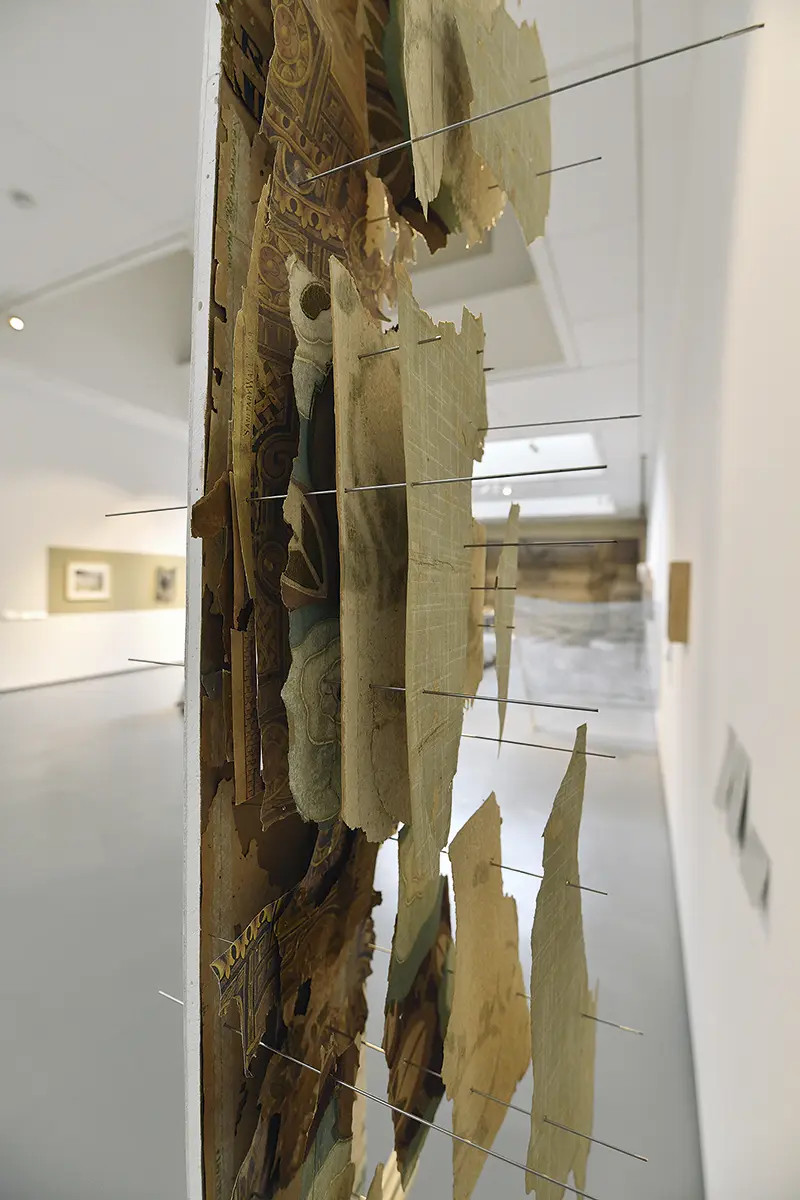
Cárdenas’ artistic endeavor, it seems to me, consists in painstakingly, almost lovingly, collecting those pieces of construction material, and also in inventing for herself multiple ways of containing, supporting, and presenting them anew in space. There is no other intention: it is not a question of putting them together again, but of supporting them in their fragility. That could well be another paradigm shift in Cárdenas’ work: to support fragility. An attempt to raise it from the ground even if slightly, to prevent it from falling.
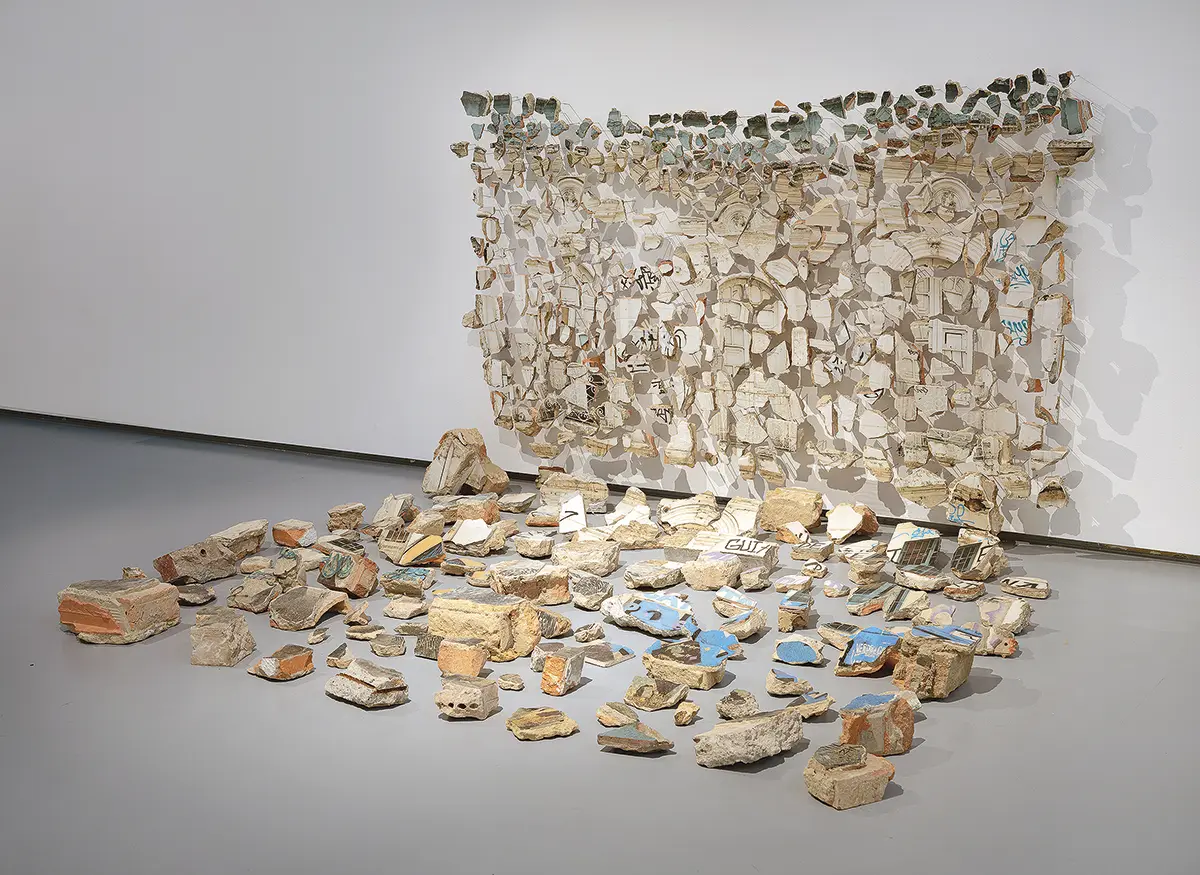
The debris of a wall or the paint on the adobe of an old church are supported by very thin plexiglas or metal rods, forcing viewers to look at them from the side; we are invited to observe the front and back of each fragment, all suspended very close to the wall. In this way, what viewers see is a kind of weaving, of embroidery, put in place so as to raise the fragment of wall. A task that could well be fruitless, but which nevertheless illuminates the wear and tear of life; fragility, yes, but also art, presented as a technique for inventing operations, as I said, and for investing time. Time in this exhibition is present not only in the ruins as such, but in the artist’s dedication to lifting them.
Definitely, Cárdenas’ work is not aligned with radical urban renewal and the non-acceptance of one’s own history that it involves. It is aligned with the acts of crouching down, squatting, assuming terribly uncomfortable physical positions, face against the wall, in order to raise fragments of material history from the ground. It is aligned not with glorifying those fragments, but with giving them a mode of support that hews close to what they used to be. As we observe these carefully supported materials from the back, we feel something; they must be taken into account. I believe that Cárdenas’ work wants to make viewers feel solely by means of her treatment of the materials. This constitutes yet one more paradigm.
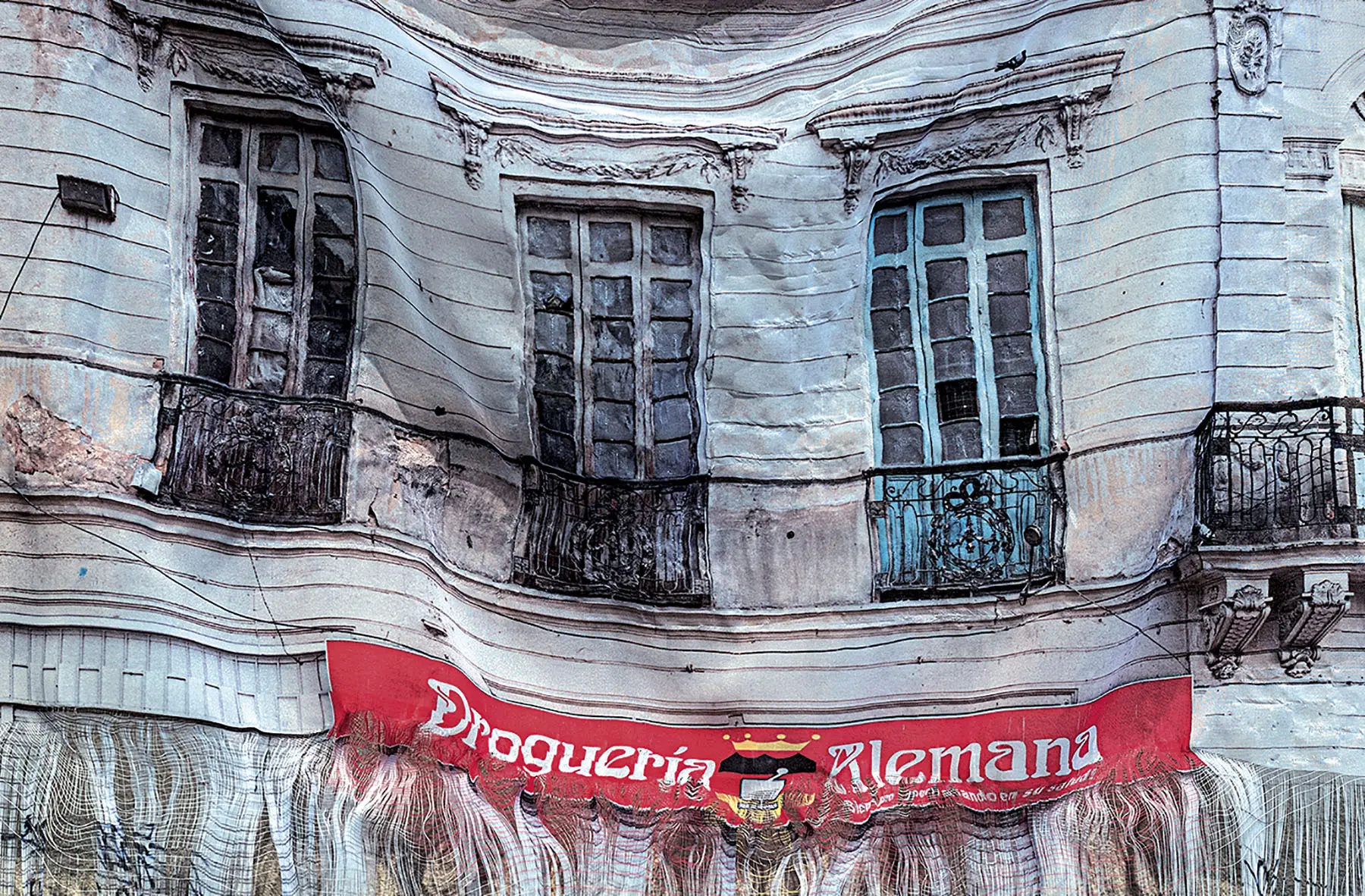
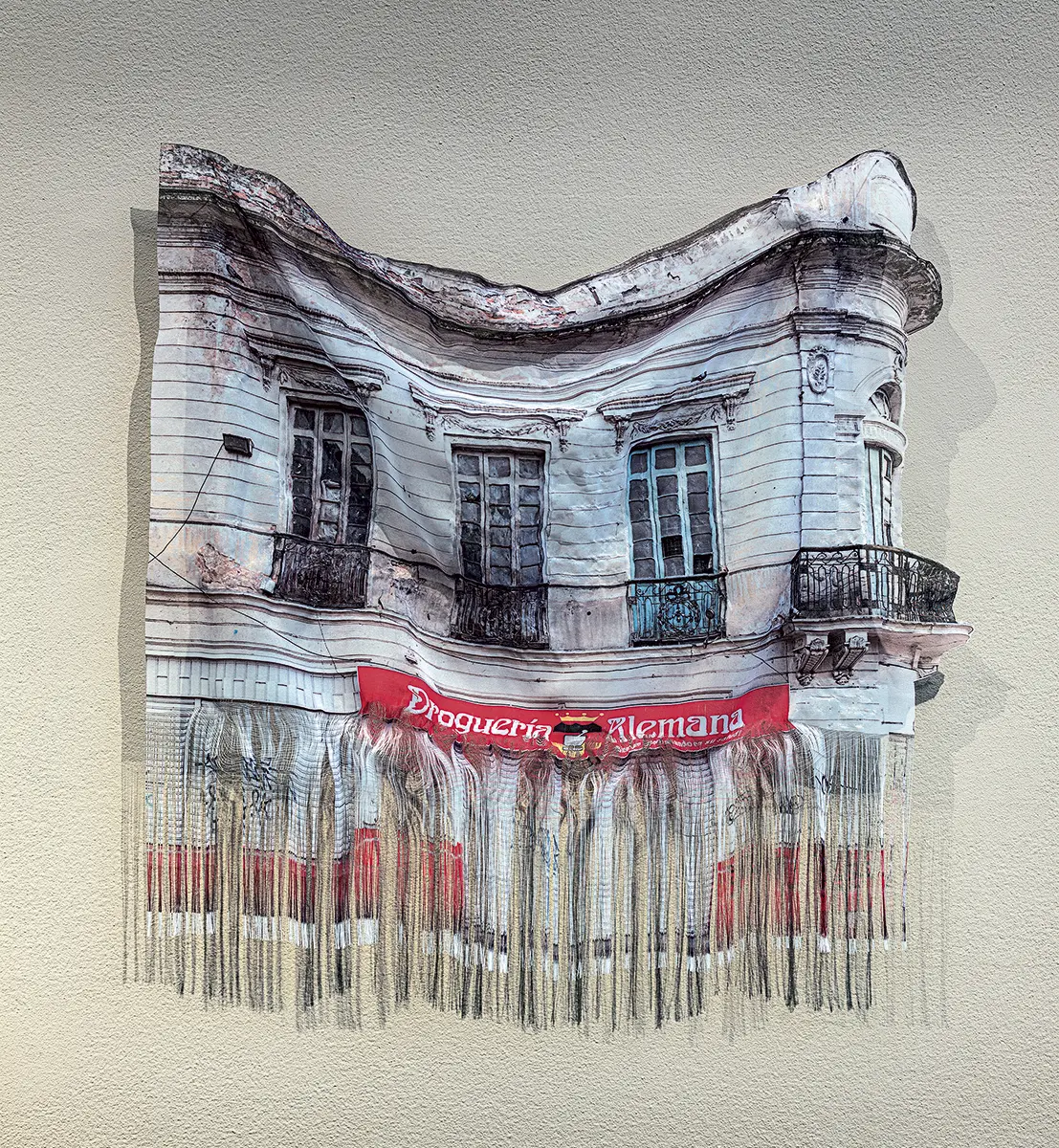
On polyester silk, Cárdenas prints the façades of old buildings and unoccupied public institutions such as the Estación de los Ferrocarriles Nacionales en Bogotá, with its emblems, crests, and glorious condors, almost entirely faded today. The material does its job: on the polyester silk, the façades are deformed, resembling face masks. These are rests of skin. One is reminded of the threat of decay that lurks behind every powerful institution. Buildings are skin that stains and cracks. Aside from raising and supporting fragments, then, Cárdenas, also explores the exfoliation of these buildings, their skin. But the silk also does its job when it displays the weave of its threads supported by a wooden post. A strange construction of tensors appears, more resistant perhaps, transparent, innovative. The strength of the fragile, another paradigm in this exhibition.
I only have one complaint or wish. As a viewer, I would have liked to see less respect for the exhibition space. The white cube was the protagonist, with its corners and its lighting. I am certain that this artist possesses all the tools needed to explore what Ilya Kabakov calls total installation and to aesthetically subvert the manifest power of limpid white spaces.
* Courtesy: Casas Riegner
NATALIA GUTIÉRREZ ECHEVERRY