Capitalism may yet evolve towards forms of exploitation so far unknown to humanity. Nahuel Moreno
Acumulación originaria (Primitive Accumulation) is the title of the exhibition that Bogotá’s nueveochenta gallery presented in March with works by Lester Rodríguez (Tegucigalpa, Honduras, 1984). The project evolved from prior proposals, among them Simetría territorial (Territorial Symmetry), in 2012; Geografías radicales (Radical Geographies), in 2020; and Business and Investment, in 2022. All found ways to situate the global economic crisis and its direct or indirect consequences for humanity, in particular for those whim Frantz Fanon called The Wretched of the Earth. The new show has a particularly sustained dialog with Acumulación originaria (Primitive Accumulation); there is a relationship of continuity between the two projects, albeit with each defining its own frame of reference.
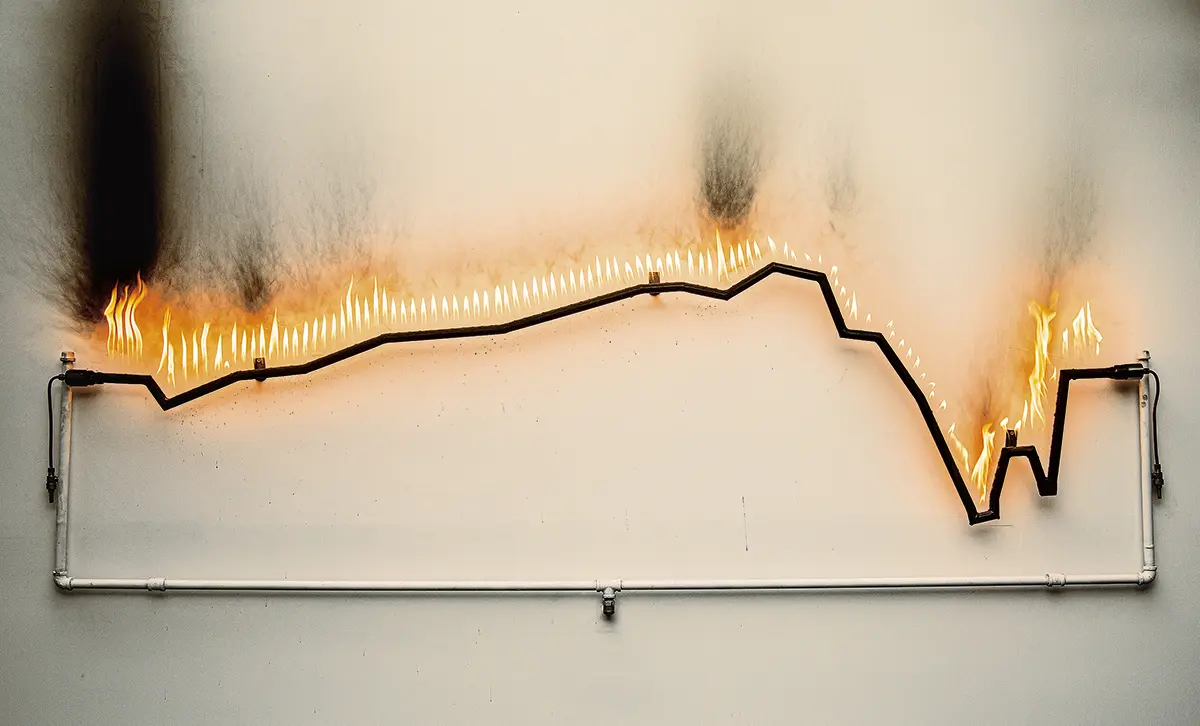
Business and investment was more attuned to financial flows, the dynamics of the stock markets and their geopolitical and biopolitical implications; its approach was more technical, in a sense, with greater weight given to a study of the configuration of the economic model and its ability to influence the structure of the new world order. In turn, Acumulación originaria (Primitive Accumulation) takes those financial processes and their impact on the markets as a starting point, but its concern is with the social, psycho-bio-social, and political consequences of the process of capital accumulation around the world; which is to say, it centers its reflection on a more humanistic perspective.
My goal in this review is to highlight the mechanisms through which Lester Rodríguez approaches these realities aesthetically. First of all, I must note that the new modes of production, accumulation, and circulation of capital are often extremely subtle and come masked behind a highly ideological language, one that hides the new forms of exploitation and alienation generated by the system. From that perspective, Rodríguez’s project takes shape on the basis of a sublimated visual narrative, articulated from the deepest, most unstable regions of language. It could not be otherwise: it is the only effective strategy to put the relationships between the economy, power, and language in tension. Rodríguez’s maxim seems to be: if the world’s inequality is written in an economic language of highly specialized and abstract lexical units, then any unmasking of its behavior must be written in the codes of a highly polished, synthetic, and functionally sublimated artistic language.
Among the various languages active in the project, I want to examine the concept of pictorial hyperrealism deployed by the artist. This is not a language centered on a kind of figurative representation according to the cannons of photorealism; such an approach would push the project away from its own discursive logic. What we are presented with is a pictorial structure based on graphics, a landscape that quantifies, coldly, the disasters wrought by this economy on the lives of the most vulnerable. It is a highly rationalized pictorial discourse; its sources are numbers, data, statistics. It is also a language capable of prompting profound reflections, as a critique not only of the new modes of capital accumulation, but also of the painting medium as a modality of visual expression.
Rodríguez’s pictorial move is intended to provoke thought, to inquire, to pose questions. It is true that he respects traditional canons of harmony, composition, and proportion, and uses oils and brushes on canvas. This apparent traditionalism, however, is an ironic gesture. It ultimately frames those classical forms of the genre within a contemporary matrix, and on that basis gives way to a new pictorial realism that formulates a key time-related tension: the acceleration of financial flows in contrast with the atemporality of painting. The image remains static while the reality of the economy shifts by the second. The tension to which these temporal relationships are subjected is not fortuitous: contemporary art can only be understood through the dialectic of the ephemeral and the eternal, which Baudelaire understood as a key to the modern era but remains useful to parse the logic of what we call the postmodern.
Vorágine, Acumulación y desgaste (Maelstrom, Accumulation, and Erosion) and Principio de probabilidad (Probability Principle), among other works in this proposal, partake of these reflections about a capitalistic logic supported by irrationality, the moral decay of humanity, the destruction of nature, unequal exchanges, shameless exploitation, and, ultimately, the violent plundering of human dignity. The true value of this exhibition, however, resides in the fact that every work it features is treated on the basis of a visual narrative that has been able to set itself apart from the commonplace and install itself at the heart of the system’s snare. Brutalized by the most refined mechanisms of alienation, we see a torn, uprooted humanity unable to recognize itself; only art, through an operation of perceptual decentering, is able to bring the subject to an encounter with its lost identity. Acumulación originaria (Primitive Accumulation) is the visual antithesis of a false representation of the individual; it is the “other coin” of an atrophied reality created at the dire heart of capital.
CARLOS LANZA