
As part of the “Prietitud” (Blackness) project, which seeks to promote the protagonism of the black community in the art world, the group show Las estrellas son negras (The Stars Are Black) was held at the ARTBO Salas space in Chapinero. One of the exhibition’s purposes was to address diverse aspects of black people’s lives, which dignify their existence, as well as to appropriate social practices and discourses that have historically been denied to them. The show brought together projects by seven artists with different conceptual and thematic approaches and from different generations. What they have in common is their experience of being discriminated against, segregated, or violated due to their race, but above all, their interest in situating themselves within blackness, understood as a way to extrapolate their own life experiences into a public, social, and political sphere.
The show’s curator, Laura Campaz, had previously developed exhibition projects centered around the relationship between black individuals and their social and cultural environments through the powerful concept of blackness. Las estrellas son negras (The Stars Are Black) highlights the strength and beauty of black individuals whose works address concrete relations between their creative practices and their own life experiences, whereby they question the different ways in which their existences have been socially recognized or not.

The title of the exhibition refers to the book by the same name, published by Arnoldo Palacios in 1949. This novel starkly portrays the structural racism that has characterized social dynamics in Colombia, leading to extreme inequality in all areas. It focuses on a series of discriminatory actions imposed on the protagonist within a span of only 24 hours. This narrative is one of the main references for understanding the subjectivity imposed on Afro people as subalternized subjects, with their disadvantages covering all spheres of existence.
The art world is by no means an exception to the mobilization of racialized cultural representations around Afro-descendant, Black, Palenqueras, or Raizales communities (terms used in public policies), which have led to their systematic exclusion from the hegemonic art canon. The reason why it is so significant to carry out a project entirely spoken from the perspectives of blackness is because it highlights the structural racism experienced in Colombia, as well as in other parts of the world.
Two of the most experienced artists in the exhibition were Liliana Angulo and Fabio Melecio Palacios. They were joined by Alexandra Idrobo, Carmenza Banguera, Eblin Grueso, Walter Caicedo, and Yeison Riascos.
Liliana Angulo created an installation made with her own hair, which she lost due to anxiety caused by having to deal with discriminatory situations associated with the racism and misogyny she experienced as a result of assuming a high public position in a cultural institution in Bogotá during the pandemic.
Fabio Melecio Palacios’ work Trapiches (Sugar Mills) complements a series of pieces by the same name that recreate these simple machines used in sugar plantations as facsimiles or prototypes. His experience as a worker in a polystyrene factory, the material used in their construction, is an additional reference to trace his interest in creating these objects. The small and large industries that have historically developed this economic activity have employed many people from Afro communities in the southern Pacific region of Colombia.
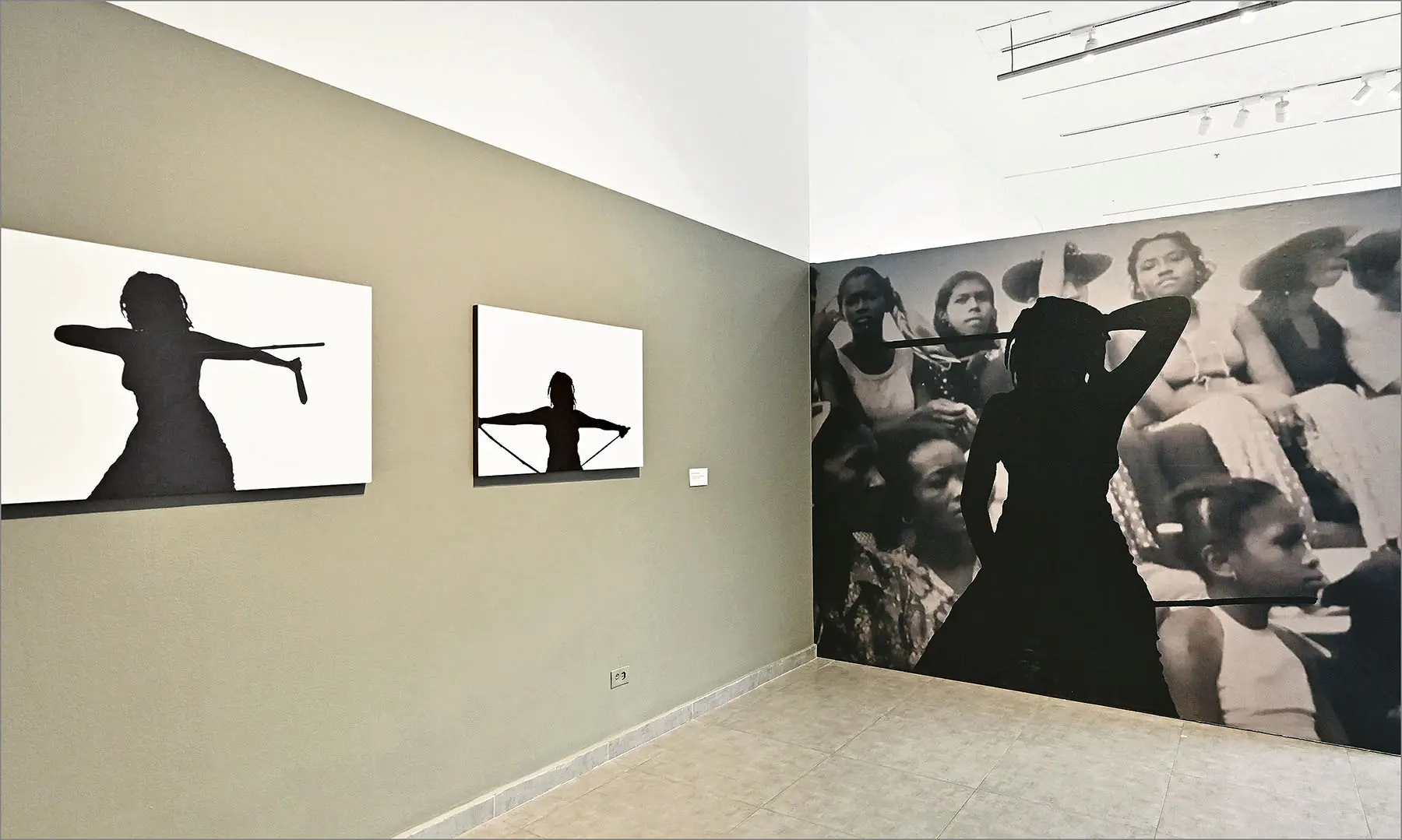
Alexandra Idrobo presented three photographs from the series El día en el que yo nacía nacieron todas las flores (The day I was born, all the flowers were born), where the body appears as a silhouette against a white background, and also against a photo of a group of people. The body’s actions in performing different gestures seem to assume either an offensive or defensive attitude, resembling stills from some kind of dance. These images evoke aspects of machete fencing that has been practiced for a long time in the Pacific region.
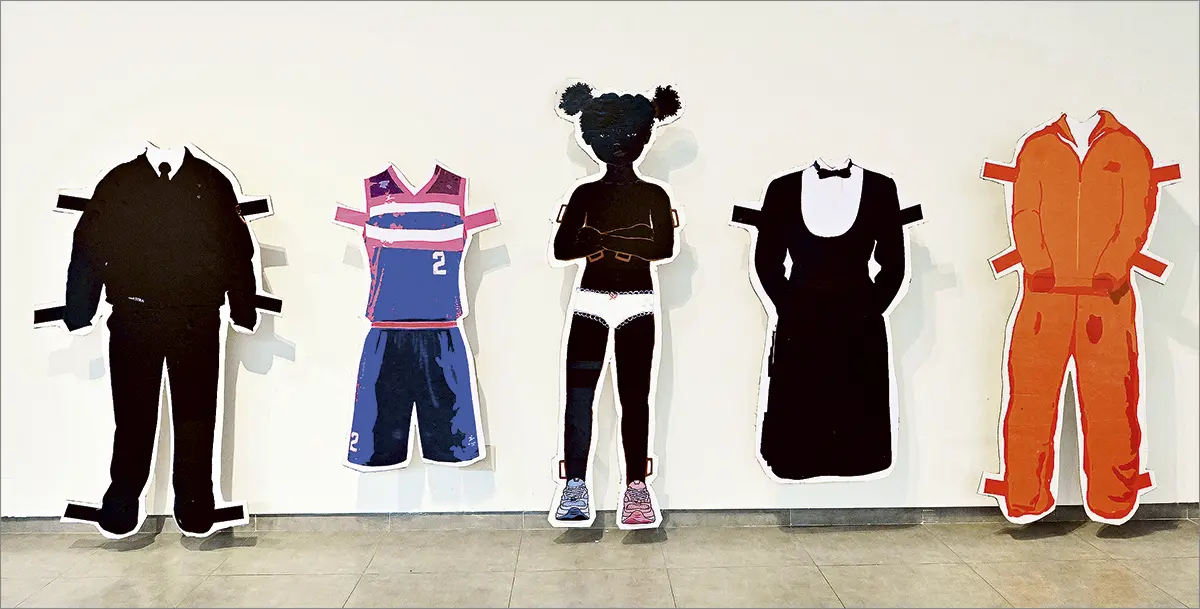
Carmenza Banguera had two pieces that refer to the commercial consumption of the Afro imaginary. There’s a cotton candy machine inside the head of an Afro woman; the cotton production mimics pink hair that will be consumed by the viewers. In another piece titled The Visible, she recreates a hypothetical children’s game on a large scale to question the stereotypes associated with the roles of Afro people in social contexts.
Walter Caicedo contributed with a sound installation called Sitio ideal (Ideal Place) and composed of a staircase resembling bleachers where glasses filled with water were placed. It was complemented by an installation of a white curtain embroidered with red roses, titled Adiós (Goodbye). This work explores the relationship between the symbolic elements of funeral rituals and the festive culture of the Pacific, which has also undergone transformations due to migration processes.
Eblin Grueso presented a textile mural titled ¿Todas las vidas importan? (Do all lives matter?), consisting of the sentence “The lives of black and indigenous people matter” sewn in white on a black cloth. This phrase resonates from different contexts and moments but gains particular significance in this case due to the violence inflicted on the bodies of black and indigenous people during the social unrest in Colombia; a violence that has been present throughout history.
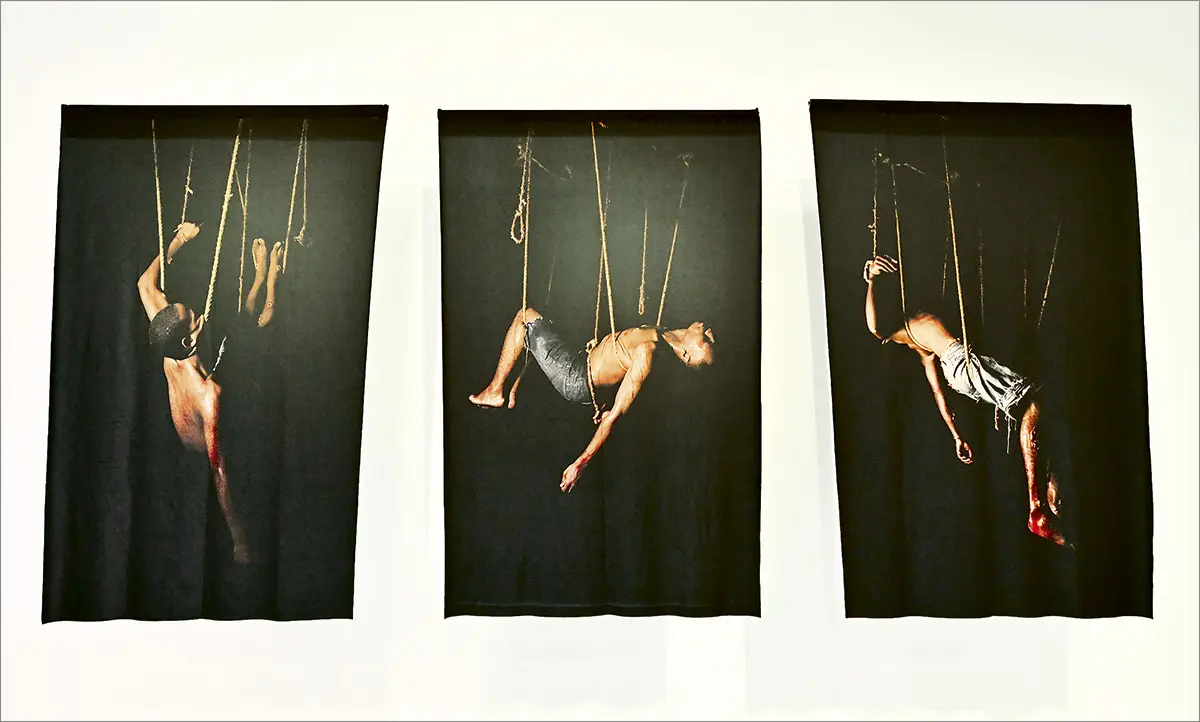
Yeison Riascos presented four projects that combined different cultural components. Descendimientos (Descents) refers to the murder of twelve young Afro individuals in Buenaventura. To create this piece, twelve Afro men posed to reconstruct the iconography of Christ’s descent using thick ropes. Three of these images were included in the exhibition. Nativity in the Pacific explores the relation between birth and green bananas as symbols of hope, and the other two pieces, Sacred Heart of Jesus and Sacred Heart of Mary, literalize the bodily connection implicit in motherhood.
This set of works was complemented by a video performance titled Lo más bello (The Most Beautiful), which added a queer perspective to the approaches of the other pieces regarding “Prietitud” (Blackness).
The artists, artworks, and perspectives presented in Las estrellas son negras (The Stars Are Black) complicate and question cultural policies of equity and democratization promoted by the Colombian state since the 1991 constitutional reform. Additionally, the field of art and art history is challenged for the enormous silencing it has systematically promoted regarding the artistic practices of non-hegemonic groups in the country. “Las estrellas son negras” (The Stars Are Black) seems to emphasize that “the lives of black and indigenous people matter,” as Eblin Grueso’s piece reminds us, and so do their artistic and cultural practices.
* © Cámara de Comercio de Bogotá.