Inside the exhibition space, gold projects a yellow light, bouncing it back as if the works had a luminosity of their own. To walk around La abstracción, un lenguaje disidente (Abstraction, a Dissident Language), an exhibition of works by José Ángel Vincench (Holguín, Cuba, 1973), is to move between ancestral suns, modern dreams, jewels that hang from an architectural body, and universal symbols that transcend time and boundaries, bringing forth what is evident and what is secret about human nature. The precious metal seduces and attracts, ensnaring us in the viscous web of conceptual geometric abstractions about the relationship between language, meaning, and reality posited Vincench.
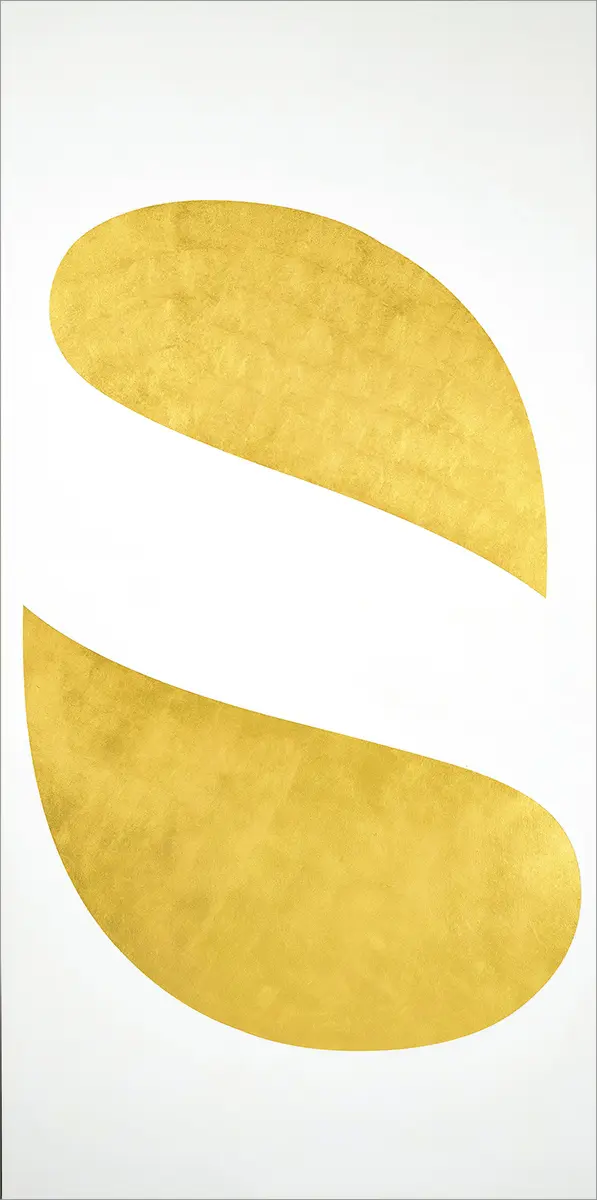
Vincench works in series to which he returns over time. The series have titles such as Sedición (Sedition), Plebiscito (Plebiscite), Activismo (Activism), Oposición (Opposition), among others. Each is comprised of several pictorial works—although the artist also creates objects and sculptures— that give the series its numbering: I, II, III, etc. Each work in the set is a letter of the word in question, at times easy to intuit and at times less immediately evident; hurling ironies at the viewer and the art system, Vincench takes us from the clarity of the concept behind the word to the distorted reality it represents, in a journey through several layers of relationships and gestures based on the universality of his language.
Vincench plays with the relationship between concept and design. His series give the words their precise weight; those words are intended to refer to Cuba’s social and political reality, but they can also be situated in other contemporary contexts, expanding the work towards a universal understanding. Here, gold’s materiality is an obvious metaphor of far-reaching revolutionary dreams, but it also works as a metaphor of ambition and the unbridled desire to accumulate valuable things that characterizes human beings more generally. While gold symbolizes abundance, that which is most precious and spiritual, the idea of a limit is also woven in the painting itself. Vincench accentuates the constrictions imposed by the frame, and, within them, employs metallic structures to apply paint, as a metaphor of the lack of freedom (of expression, for instance) experienced as a consequence of revolution’s vestigial dreams.
The word Sedición (Sedition) is engraved in a gold bar (2023, gold leaf-covered wood); we also see it on the wall, printed in golden letters and set up as a dictionary entry, with the two definitions provided by the Royal Academy of the Spanish Language, RAE. The series includes a number of small-format works involving an abstraction of letters transformed almost into a graphic-design play that clashes squarely with the idea that the word represents. Starting from this definition, Vincench begins to work not with gold leaf, but with oil on canvas, creating works in brilliant, high-contrast colors demarcated by transitions in the palette. The constrained shapes with which he manipulates the reach of his meanings and encircles the color zones, gesture in the direction of artists to whom he pays homage, such as, for example, representatives of the historical avant-garde, practitioners of Abstract Expressionism, and Cuba’s Luis Martínez Pedro. Other words, like Plebiscito (Plebiscite, 2018), Activismo (Activism, 2022), Confundido (Befuddled, 2022), are present in the show via deconstructed letters, their meanings faded, transformed into positives and negatives in large-format canvases where we intuit an S or an O, and in others where the artist explores the totemic by taking the graphic aspect of the letter, rendered unrecognizable, to the vertical axis.
Lastly, the exhibition includes one item from the series Pintura de acción (Action Painting, 2023), another aspect of Vincench’s body of work. Here, we no longer see the precise representation of a graphic abstraction, there are no clearly defined planes or fine lines marking boundaries and enclosing meanings; this work contains something splotch-like, something amorphous without apparent outlines, like the smudge of a deleted text—in this case, a censored image. The title and the action encompass the reality the opposition in Cuba and the consequences it suffers. In the same way that Jewish homes were marked by the Nazis in the twentieth century, dissidents in Cuba have their homes painted, their ideas stigmatized by paint with no other meaning. The artist appropriates this gesture, reinterpreting in gold leaf the stain left by such attacks. Is being a dissident symptomatic of a heroism symbolically encased in the precious metal? With these elements, taken from a long pictorial tradition both European and American (North and South), Vincench creates a language and a space of his own in order to speak, blur, and reinterpret reality, revising in the process—somehow, this is already latent in the viewer—the values and emblems created by society and by time. What will the future be like, once the dreams of gold have changed masters?
CARIDAD BOTELLA LORENZO