Over the course of his career, Jose Dávila has developed a unique artistic language that makes his work easily identifiable. His training as an architect is a result of his concern for balance, as well as a sensibility for construction structures and materials. The use of natural elements, such as volcanic rocks or pieces of wood, is also characteristic of his poetics.
For Balance frágil (Fragile Equilibrium), his exhibition at Travesía Cuatro gallery, in Madrid, Dávila brought together his customary sculptures where balance functions as concept and materiality, with a series of abstract-geometric paintings. He often draws on a knowledge of optics and mechanics for the assemblage of compositions that seem to challenge the laws of physics. The conceptual reach of these operations involves an expanded field of reflection around such notions as illusion, weight, form, and space.
In some of Dávila’s works, our perception fluctuates with the angle of vision. In the optical illusion theorized by the German physicist Christian Poggendorff, by superimposing a rectangle on a set of tilted line segments, the continuity of the segments becomes distorted for the viewer. Similarly, shapes and materials come together in suggestive ways to create the fragile balance so precisely summarized by the exhibition’s title.
Resting at the “summit” of Ilusión de Poggendorff (Poggendorff’s Illusion) is a glass sphere. This work is a composition of red-enameled metal beams supporting each other in a fragile, misleading equilibrium, leaning on such objects as a piece of volcanic rock or industrial-use cylindrical drums. In this type of work, Dávila plays at the boundary between calm and anxiety: the metaphysical moment when all seems about to fall, yet remains in place.
These may seem purely aesthetic divertimentos infused with an aseptic minimalism, but it is my impression that Dávila’s exercises connect with and are nourished by his relationship with local culture, and more specifically, with Mexican urban structures. The improvised, amateur architecture and poor infrastructure maintenance of Mexico’s cities, along with the earthquake-prone terrain on which they rest, place them under permanent threat of collapse. With some caution and caveats, the metaphor can be extended to a broad field of precarious Latin American situations, and beyond.
In an interview with the newspaper El País, Dávila said that, in his view, modernity’s greatest failure is “its inability to transport the soul that lived in unknowledge towards order."1 One key for reading his work can be found in that way of looking at things. I understand the artist’s reference to “the soul of unknowledge” to mean the atavistic world’s non-systematized knowledge, the most ineffable dimension of the natural, which the progressivism and order of modern projects were incapable of absorbing.
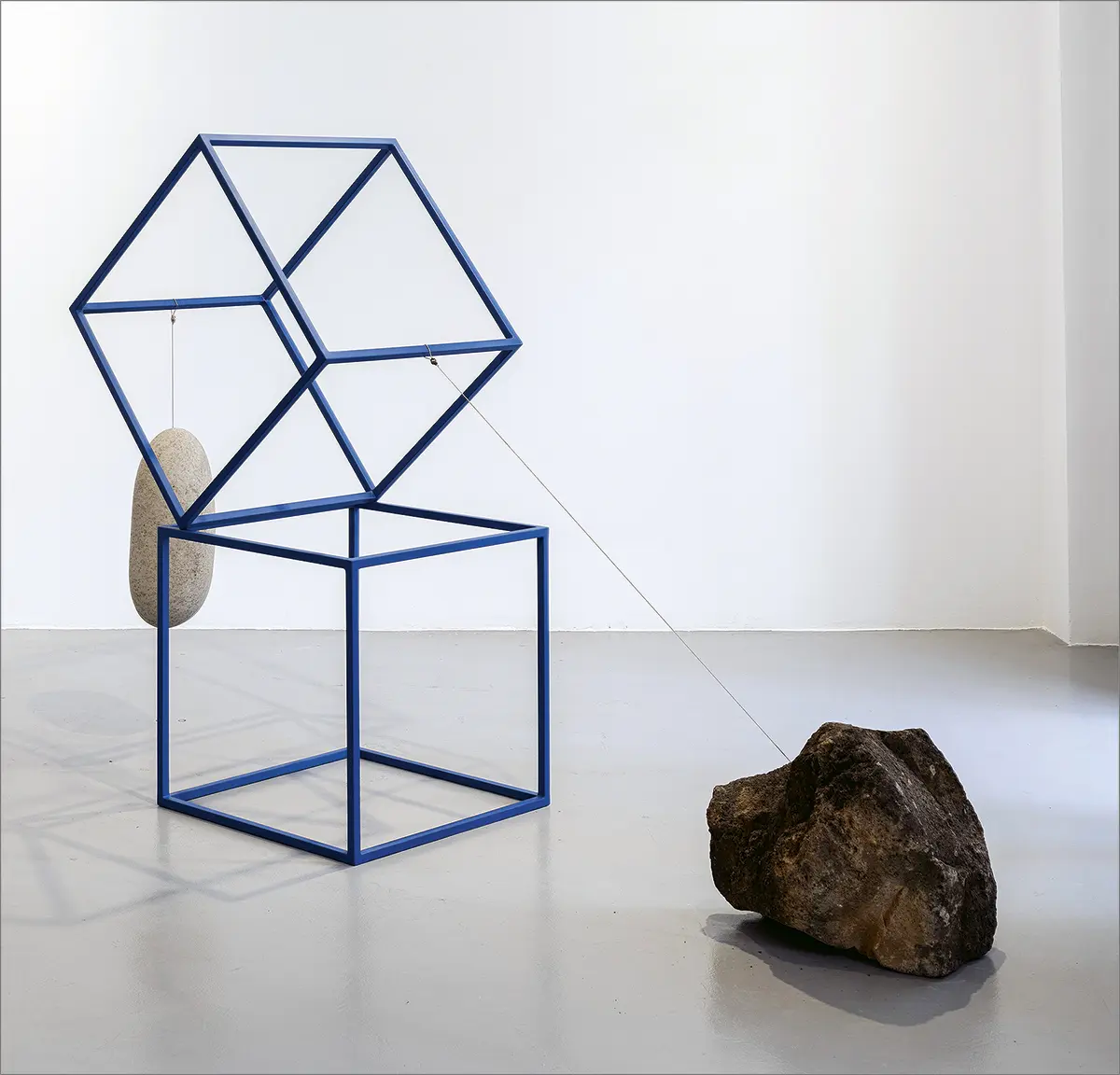
Balance in Dávila’s work is a matter of form and content. It is not restricted to the realm of mechanics; it expands into domains of sensibility. In Construcción frágil III (Fragile Construction III), the interplay of forces and tensions makes a perfect suspension of two metal cubes possible thanks to the counterweight of two rocks, in a complex metaphor of telluric forces as a principle and support of industrial order, nature as the sine qua non or condition or possibility for artifice, and, ultimately, the order of nature as the basis of universal equilibrium.
In a speech given on the occasion of Pensar como una montaña (Thinking Like a Mountain), his 2020 exhibition at Museo Amparo, curated by Amanda de la Garza, Jose Dávila talked about his love for a beautiful ranchera song composed by Cuco Sánchez. In the heartrending style of the genre, the lyrics suggest a telluric quest resulting from romantic sorrow: “…tell me about mountains and valleys, raise your voice about rocks in the fields….” A subjectivity desperately seeking, in primordial elements, respite from heartbreak and suffering. It is an atavistic gesture, beautiful and potent, which Dávila has been able to incorporate into his sculpture without falling into literalness or folklore.
Mircea Eliade said of Constantin Brâncuși that the latter’s exploration of rocks was equal to “a prehistoric man’s.” Dávila also explores and brings forth, fascinatedly, the qualities of rock as a foundational cultural element, from the origins of civilization to the present day. While this Mexican artist’s refined aesthetic language seems closer to the experiences of brutalism or of Brazilian concretismo, the primitive cult of rocks also pulsates in his work.
NOTE
1. April 4, 2023. Jose Dávila, artist: “A la gente le gusta identificar cosas de manera fácil. Lo justo es ponérselo difícil”. Interview by Tom C. Avendaño.
DIANA CUÉLLAR LEDESMA