Brazilian artist José Bechara, known for his abstractions, just had his latest solo exhibition. Continuing this trend, he presented a selection of his most recent works, made in 2022 and 2023. However, these pieces surprise with their use of very bright colors. This exceptional colorfulness undoubtedly corresponds to a new stage in his creation, reflecting a more optimistic view of the world. The exhibition, titled Dancing in My Room, takes its name from a song by the Canadian pop group @347aidan: a simple and cheerful theme, and to some extent banal.
Conceptually, Bechara continues his foray into constructivism and informalism, following his interest in space and volume. The works in this show evidence his concern for both aspects. The artist has clearly explored the artistic possibilities they offer, added to his even more powerful attraction to the expressive qualities of color this time around.
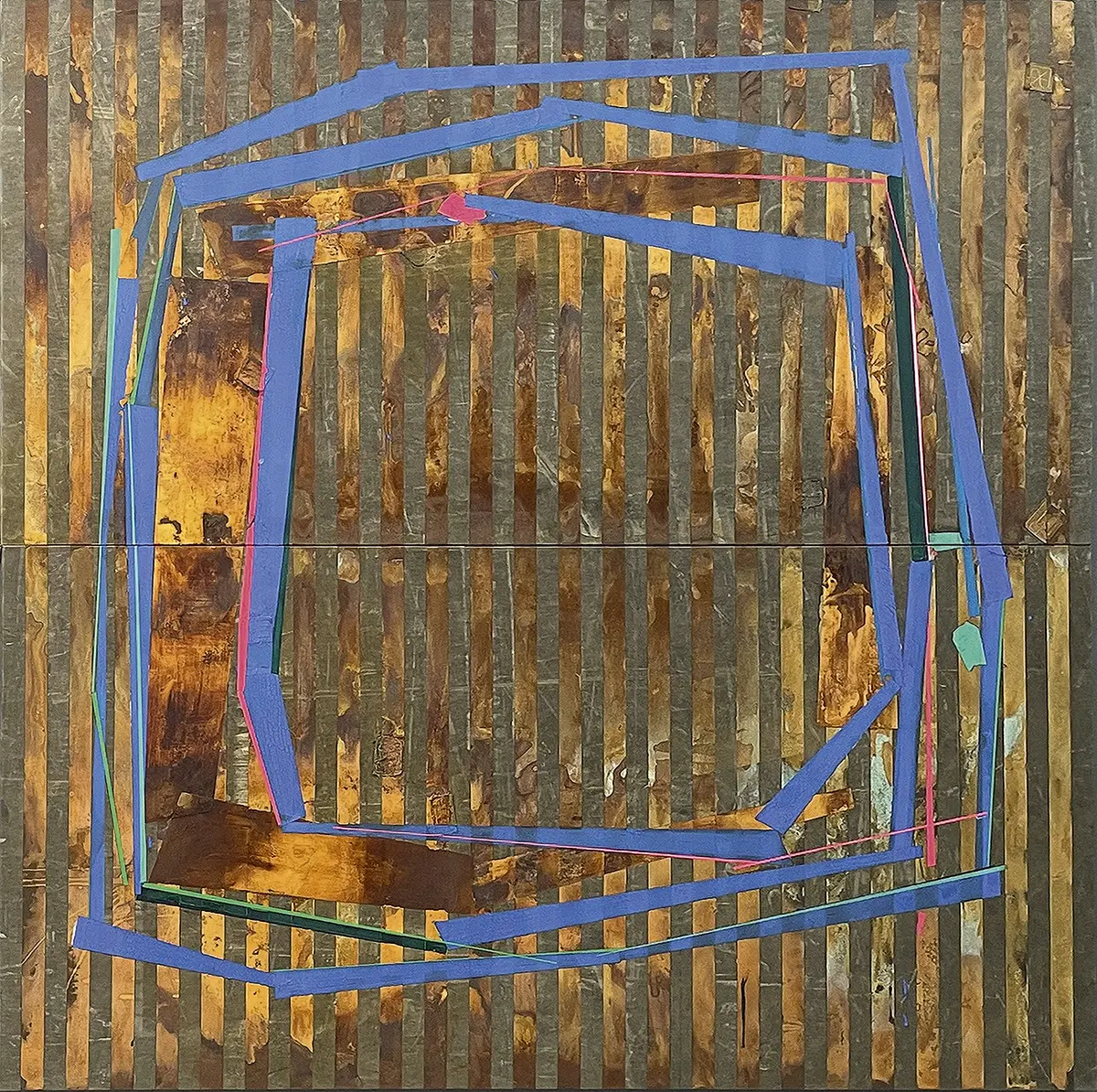
The pieces feature his characteristic combination of metallic rust with paint, creating visual compositions where color is enhanced by comparison to the rusty metal. Most of the pieces display stripes of alternating colors with bands of rust, creating a tension that gives them an innate dynamism, an optical play suggesting three-dimensionality. Moving from one dimensionality to another is not new for the artist, who started as a painter but later moved on to sculptures.
The exhibition installation was conceived from sets of pieces grouped according to their format and composition, creating various visual spaces in the room. Formally, the works in this exhibition can be divided into four distinctive groups. The first, containing most of the pieces, has horizontal bands alternating color with rust. A second group presented dark, checkered surfaces, some with spheres. The third group included two pieces with red backgrounds with smaller grids, and the fourth, also consisting of two pieces, featured floating spheres in space.
The latter are vertically formatted, each displaying a combination of two parts: an upper and a lower one. Untitled #228 presents a combination of contrasting colors: the upper part red and the lower part white. Overlapping circles connect the two parts; the larger one is blue, and the smaller one is red. The second work, Untitled #229, presents a similar solution, but both parts are of the same light color. The spheres share the same color but are inverted and visibly separated. These two pieces are distinctly different from the rest.
Most of the works are of medium and vertical format, and there are several circular pieces, with one exception: Untitled #216, which is substantially larger and square in format, standing out from the others. It consists of two parts, one on top of the other: a solution Bechara has applied extensively. The support is canvas; the type used on transport trucks, which the artist acquired directly from drivers and recycled into this work. This is something he has done before, and there are other smaller pieces in the exhibition made on the same type of support.
As for this specific work, the canvas apparently had been used for some time: it was torn, and the previous owners had repaired it in several places. The original patches of fabric, made for purely utilitarian reasons without knowing that it would be repurposed, are still visible. The recycling and transformation of material from everyday use and exposure to climatic elements, from a position of utilitarian punishment to the pristine sanctuary of art, speaks of a shift in perspective. These “fabrics” have a history, a memory based on previous uses, transitioning from utilitarian object to artwork, from the harshness of weathering to the pristine shelter of a gallery or collector’s space.
Bechara exposes parts of his canvases to an intense oxidation process, discarding the preconception of immaculate surface care. This intervention not only creates a visual effect but also presents a texture in contrast to the entirely smooth surface of acrylic paint. The process is a controlled oxidation for which steel fibers of different proportions are subjected to a metallic emulsion. There is a certain level of control, and yet room for the unexpected during this process of experimentation. It is during this process that he allows for accidents that may occur during oxidation. Bechara’s work leads us to reflect on the possibilities of a before and after, which can be applied to the metal he uses and its changes after oxidation; and also to the canvas, from its “original” pragmatic function to its conversion into art. He offers a contemporary perspective focused on the reality of a world changing at dizzying speed. Philosophically, this process points to a lack of control over life and the unexpected paths it can take.
IRINA LEYVA