Las Islas Vírgenes (The Virgin Islands) is the title of Jorge Macchi’s exhibition at Galería Elvira González in Madrid, which could be considered a compendium of his oeuvre. In other words, a representative sample of the heterogeneous group of tendencies that have driven his work so far, and which also brought to light a not-so-subtle yet crucial element: music. In fact, the wall text began with Macchi mourning the shortcomings of the image, which music surpasses: “I think music incorporates a dimension that the visual arts do not have. The image is easier to translate. On the other hand, music is pure form; no text can translate it. Communication through music is something absolutely direct.” And to endorse these convictions he made a selection of musical pieces that inspired and accompanied the composition of the exhibited works. It could be argued that he proposed this selection as a guide to understanding the pieces.
The names included in this selection are essential in any list of significant figures from avant-garde music of the past century and the previous one: György Ligeti, Erik Satie, Olivier Messiaen, and Claude Debussy. The mere choice of these artists demonstrates the extent of Macchi’s penchant for music ranging from Impressionism to Serialism and beyond. The inclusion of Debussy is particularly revealing, as his work indeed represents a link between poetry and music, closely aligned with what Macchi himself has created. Debussy was not only a friend and frequent companion of Stéphane Mallarmé, but also a great admirer of Mallarmé’s poetry, which he considered akin to his own music. He once stated that he curtailed “the ornaments of music with the same economy of language that Mallarmé pursued.”
Therefore, it’s not surprising that terms like “ornament minimization” and “language economy” are appropriate for describing the extraordinary formal austerity of the works included in Las Islas Vírgenes (The Virgin Islands). Nor is it unexpected that Macchi’s connection with Mallarmé is revealed through the fact that, when viewed as a whole, the exhibition functions as a visual poem in which blank space holds as much importance as the elements it contains. The white space on the gallery’s walls serves the same role as the blank page in Mallarmé’s poems. In both cases, it’s not merely a support overshadowed by what it holds; it is an unmistakable protagonist. The white space or the intervals between verses and artworks are essential for granting plenitude to both the verse and the work.
In the engraving Las Islas Vírgenes (The Virgin Islands), which gives its name to the exhibition, the white space takes on connotations of absence, erasure, and disappearance. It depicts an archipelago with no islands; all that remains are the names of their towns and cities, as well as their geographical features. A similar situation occurs in the installation El último continente (The Last Continent), where the corner formed by the perpendicular meeting of two white walls, flanked by the terms ‘Atlantic Ocean’ and ‘Pacific Ocean,’ becomes the signifier for the American continent. In the installation Diario de palabras muertas (Diary of Dead Words), the logic is different. If Futurism went further than Mallarmé by dismantling the verse and allowing words to float freely on the blank page, Macchi disintegrates words in this work, keeping only the letters of the alphabet that make up every word. Each letter is engraved into a marble crescent and placed in a white niche, which becomes a step on a staircase that climbs the wall. The result evokes Arnold Schönberg’s Jacob’s Ladder, as each isolated letter in its niche asserts itself, much like the notes and measures in the famous oratorio by the dodecaphonic master.
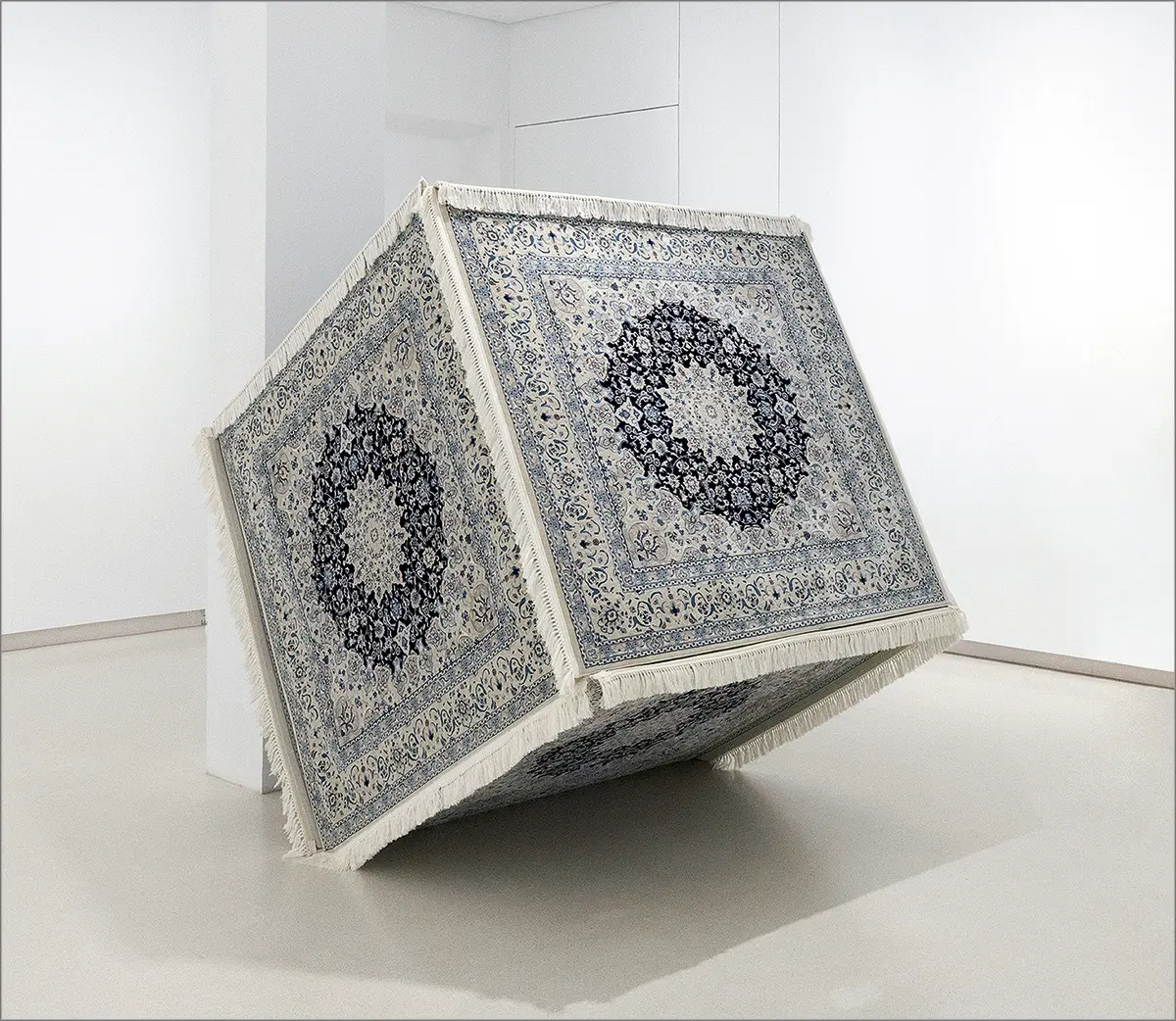
The exhibition also included works that do not belong to Minimalism’s registers. Debajo de la alfombra (Under the Rug) featured a large cube, every side covered with a carpet and resting on one of its edges. Máscaras de la tragedia (Masks of Tragedy) was a sudden poetic discovery. Two large white replicas of ordinary wall sockets are instantly transformed into the classical Greek theater masks that express astonishment and sadness. Scarface, twelve color portraits selected from magazines and posters, refers to the origins of Macchi’s artistic career, when these kinds of publications often served as raw material for his pieces.
CARLOS JIMÉNEZ