The retrospective of Rigoberto Torres and John Ahearn, like the recent exhibition of the work of Martin Wong, also at the Bronx Museum, during the Fall of 2015, is once again revealing a side of New York’s art scene that had been, until recently, consistently ignored by the official art world. Luckily for Ahearn and Torres, museums in America are now much more interested in making a major correction to their exhibition programs by showing the diversity of race and cultural background.
The surprise here is not that it has taken this long for their work to be acknowledged, the time gap of recognition being similar in length to other Latin artists of their generation, but the fact that the curatorial team has taken care to explain how even after it was a well known fact, that they always worked together, often enough, only John Ahearn was credited with the work while Rigoberto Torres was omitted, or credited as an assistant and not a full-fledged collaborator. Crediting John Ahearn much more frequently is undoubtedly due to the fact that Rigoberto Torres is Latino and his skin color markedly different from the level of whiteness that was deemed acceptable for being exhibited and getting recognition as a serious artist in the New York art world.
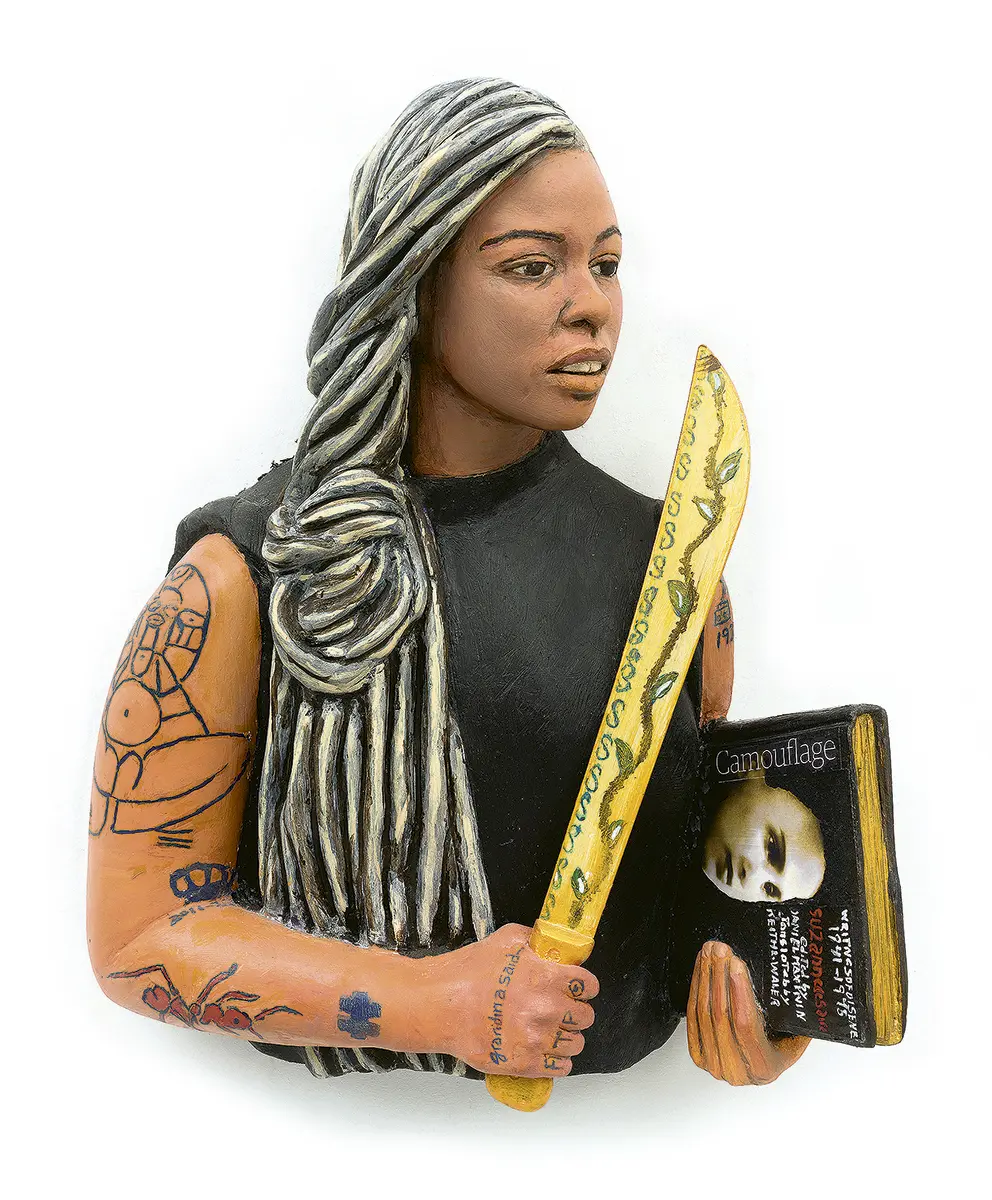
A very significant factor in the early stages of their work is the factory, C & R Statuary Corp., owned and managed by Torres’ uncle, Raúl Arce, in which Rigoberto learned to work with plaster. The catalogue is dedicated to this man, in recognition of that major contribution to their artistic work. These details were explained by the artists themselves on a guided tour of the retrospective that I attended at which they spoke at length on the pieces as well as the learning process at Rigoberto’s factory of plaster religious images. One of the best sculptures, Shorty, is a worker at the plaster statuary company in the process of making the details on a plaster saint, his darker skin and red bandana and working table make a strong contrast in comparison to the whiteness of the plaster in hand, another, titled Tiburón (Shark) portrays a man in the white clothes that designate him as being initiated in Santeria, he wears the ritual beaded necklaces that give protection, and holds a small Elegua (guardian deity of the crossroads) in his hands, his hieratic pose and gaze reminiscent of ancient Egyptian priests. The complexity of some group sculptures baffles the mind as to how it was possible to execute the plaster models and have the subjects break away without one getting into the others space, breaking the plaster; Julio, José y Juanito (Julio, José y Juanito) presents a trio of kids, the oldest standing with the two others sitting one on top of the other was actually featured in the video where the exit operation was seamlessly executed by the portrayed, but most amazing of all, and also documented in the video, was Raymond and Toby which is a composition that includes a young man and his big dog who stood perfectly still throughout the entire process of the plaster casting alongside his master.
This assimilation and transformation of the traditional elements and colors present a strong contrast with the gallery spaces that started adopting a sober, minimalist aesthetic in NY from the ‘50s onwards and is still the style which prevails today. At the Bronx Museum, Amy Rosenblum-Martín explains in the catalogue “galleries are transformed into elegant, cerulean blue spaces, featuring Neoclassical details found in local architecture and interior design, playfully combining exterior and interior references to architect/artist Giovanni Battista Piranesi.”
The experience of viewing the exhibition is above all an enlightening one, where the vibrant works by Torres and Ahearn make us see for the first time, in a museum and in a relevant context of community, the Latino population that is relegated to the obscurity of those ignored by the media and the art world within an aesthetic context that speaks their language and makes a proud statement of their resilience and strength.
ALBERTO BARRAL