Artist and researcher Javier Vanegas has been relying on photography for several years now. His explorations in the world of photography and the many possible ways to transfer an image to a medium that can “adopt” it, have led him to travel to even the most remote and inhospitable regions of Colombia. May this serve as a prelude to venture into his recent solo show, where two seemingly disconnected paths intertwine: AI and the indigenous Kogui people of Santa Marta’s Sierra Nevada.
It is not uncommon nowadays to talk about decolonialism, to build inclusive languages, and to shift borders, including gender ones. We also hear echoes of a posthumanism where AI and the vastness of what pertains to being human go beyond what we have been used to in our daily lives. Or at least it seems that way, and we should question rather than overlook this subject during our discussions with artists, anthropologists, sociologists, and philosophers, to name just a few fields interested in understanding the broad context of interconnections in today’s world. Hence, it’s worth paying attention to those two concepts that constantly stand out when contemplating the photographs in this exhibition and when reading “Time and Entropy,” the text that Vanegas carefully fine-tuned to accompany it.
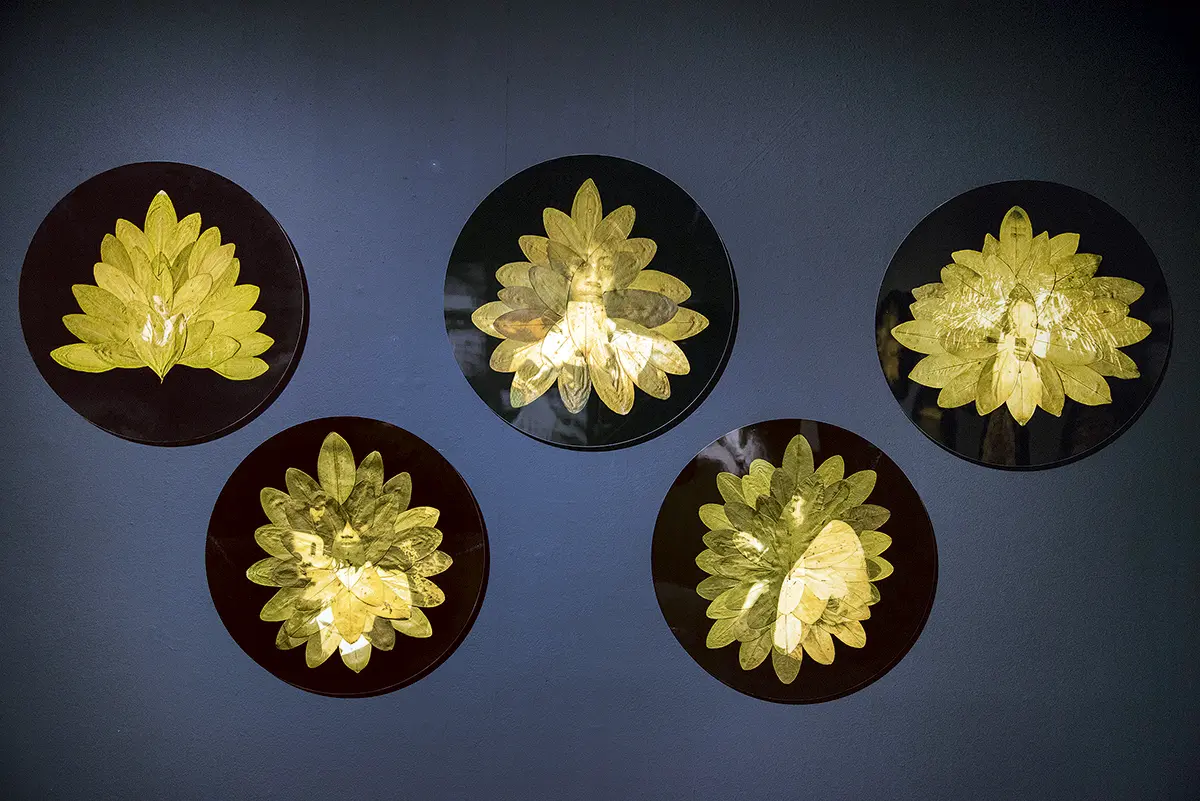
It may be crucial to examine how, in the West, we have constructed a type of progress whereby linear time allows us to see how we have moved away from a primitive existence to reach a world where we can access universal information through a cell phone. But what is progress? What times have we invented in order to drive a global machinery based on a supposed well-being? The images, like mandalas, question us about the difficulties we sometimes have in discerning temporalities that nowadays tend to dissolve like water in our hands. Kogui children, in their maloca (communal house), calmly consult their phones at night, while also exuding an uncorrupted human essence, an understanding of the circular time in which they live, and their absolute connection with the living beings that surround them. But where is the human being in all of this? What is “humanity” today? Where does the “self” fit in these discontinuous times that constantly clash with our Western way of grasping the days, the weeks, and the years? Vanegas’ work points to the fact that we are living in uncomfortable times because we fail to understand them. It may be easy to say that time in some communities around the world is circular, serpentine, or spiraling, but embracing it goes beyond a rhetorical problem. I mentioned seeing Kogui children, observing nature, and feeling time and spiritual essences. Capturing the spirit of someone living in different times is a challenging task. As Coetzee asked: “What has made it impossible for us to live in time, like fish in water, like birds in air, like children?"1 Surely, this sensitivity has been honed by Vanegas after endless visits to this indigenous community and many others in the country, including encounters with elders, and immersing himself in all sorts of rituals that seek to maintain communication with an “Other,” who is unknown and unclassifiable to us in the West, managing a strange sense of time, which, for all its complexities, is universal. A keyboard that turns on a light inside a maloca in the middle of the night in a remote place in northern Colombia where Aluna is the mother of everything, establishes the link between the different temporalities.
Aluna must be powerful since she has survived these overwhelming and colonizing times. And she did it before. Now it’s her turn. Precisely, Vanegas’s commitment to materializing this exhibition raises a question about entropy. When we talk about entropy, we think of surplus energy floating in the air, creating chaos, and then reaching equilibriums that dissipate again in eternal returns that keep moving this universe. While contemplating mandalas, coca leaves, and AI-generated images, a cycle is slowly being announced whereby the digital is transferred to the natural and then back to the digital again. With this in mind, let us conclude with a question haunting us during the exhibition’s route: aren’t the people of Sierra Nevada an entropic case in the course of nature and human history?
NOTE
1. J. M. Coetzee (1980) Waiting for the Barbarians, London: Penguin, p. 131.
ANDRÉS GAITÁN