Last July 14, Santiago’s the MAC inaugurated a series of exhibitions on the occasion of the 50th anniversary of the 1973 military coup. One standout among them was “La memoria en el cuerpo” (The Memory in the Body), a solo show by the Chilean artist Janet Toro (1963). Curated by Joselyne Contreras, the show’s five rooms presented video and photographic documentation, maps and texts of two series of performances and installations created by the artist between 1990 and 1999. In other words, the exhibition featured archival images reconstructing fragments of actions in the past, but recontextualized in the present, about a subject that remains raw and piercing in Chile.
According to Diana Taylor, the video record of a performance is not the performance as such, but a piece of the archive, and archival selection is always mediated by later interpretation (Taylor, 2015).1 This contrasts with the notion of the repertoire, which implies “bodily memory (…and) an ephemeral, non-reproducible knowledge,” with the performance’s idea of the here and now. Rather, the essential element resides in the presence and agency of the body in its dialog and participation with the audience, and in the transmission of a shared knowledge.
Given that the very context in which this archive was situated was the remembrance of a social trauma, the sequence of images of Janet Toro, unfolding through projectors and monitors, amplified her artistic discourse, giving its narrative of the female body a new meaning. In that sense, technology’s mediation in the recording of the performances must be taken into account, and, if possible, the experience of relationship between the audience and the artist’s body must be reinstituted through these images.
Only one photograph from the 1990 performance La sangre, el río y el cuerpo (The Blood, The River, and the Body) was included. It was relevant, however, to contextualize the ninety performance-installations that comprise El cuerpo de la memoria (The Body of Memory), made over the course of two months as part of II Bienal de Arte Joven en el Museo Nacional de Bellas Artes in Santiago. Toro performed her 1990 action independently and outside any institutional framework. On an islet in the Mapocho river (which traverses the city of Santiago), nude and in plain view of passers-by, she sunk a canvas into a receptacle filled with animal blood and wrapped it as a shroud around her body. Then, she laid down, parallel to the murky, dirty river, on another white canvas, fifteen meters long and 2 meters wide, and remained there for an indeterminate length of time.
The 1990 shroud, the blood in it already blackened, was reused in 1999 to connect the museum institution with other spaces in the city. The spaces identified were political detention and torture sites located in the urban grid, which Toro demarcated in her journey. Shoeless and covered in a white canvas, holding a fragment of a bloodstained fabric from the year 1990, she went from the Museo Nacional de Bellas Artes (MNBA) to the street and back. Unlike Toro’s encounters with unadvised passers-by, which exposed her in her fragility, the second set of performances took place at the MNBA in front of a diverse audience.
With the 1990 action at the Mapocho river, Janet Toro began to weave a narrative about the trauma of bodies subjected to disappearance and torture. That constructed narrative was amplified in the series of the ninety performances, as the experience of the remembrance of suffering was repeated through the reference to forms of torture. This makes the traces and elements found in the images of the first performance especially relevant.
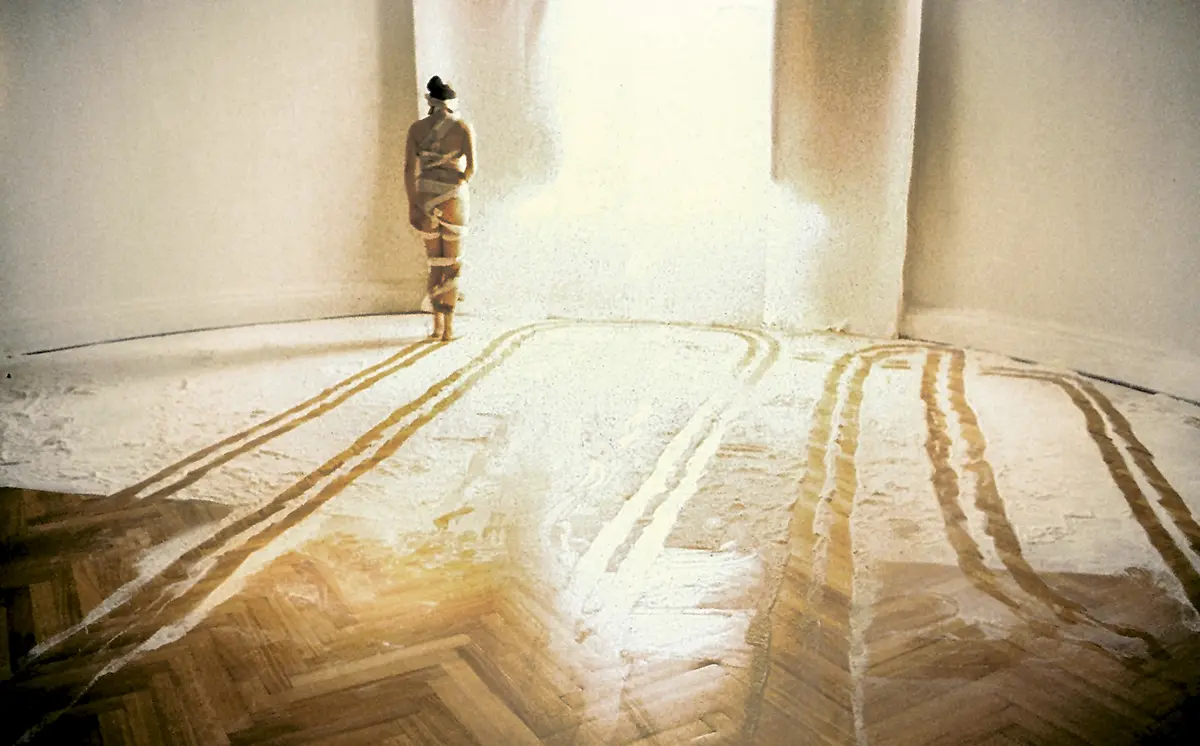
Toro used scant means for her performances at the Museo Nacional de Bellas Artes (MNBA). She exposed her nude body, ripped the blood-stained canvas into strips, and partially covered herself. We see her demarcate an interior trajectory with lines drawn by her feet on the white flour that carpets the floor, the bread-making material used here to register the trauma of a female body. In other videos, Toro’s approaches forms of torture in the simulation of actions.
Could a register that becomes archive, over a repertoire consisting in the repetition of performances, communicate the memory and remembrance of trauma by means of the gestures, movements, expressions of a body, turned into mere images that are temporarily consumed in a virtual or cinematographic space? A different kind of experience comes into play here, one mediated by images through technological devices and photography. What acquires value are the expression of that temporal set and the fragments retained as the pulse of a collective memory being reconstructed.
Janet Toro’s performances retain all their power as an experience. There is a body in transit through those spaces, drawing lines, and calling us to the action of not forgetting. It discloses the embodied memory of a collective trauma and transmits at the same time a knowledge of history by means of actions that, transformed into images, 50 years after the coup become choreographies of meaning (Taylor, 2015).
NOTE
1. Taylor, Diana (2015). El archivo y el repertorio (la memoria cultural performática en las Américas). Santiago de Chile: Ediciones Universidad Alberto Hurtado, pp. 55-56.
DERMIS LEÓN