The investigations carried forth by Jaime Gili (Caracas, 1973) push the tradition of abstract geometry towards the expansion of boundaries inside and outside the canvas. Gili’s exhibition OJO (EYE), at Caracas’ Sala Mendoza, showcases his most recent explorations of geometry in space and color. Featuring sixty artworks—small-, medium-, and large-format canvases; graphic works; and a monumental-scale mural—this show can be understood as mid-career overview covering the period between 2009 and 2023. It highlights the spectacular pride of place Gili has reserved for painting in urban formats and in integration into architecture, from a perspective that goes beyond abstract art’s formal contents and reaches towards social and political meaning, at an urban scale. The exhibition was curated by the artist, who set stations for the visitor’s itinerary three based on three axes of his work. The title, OJO (EYE), responds to an epiphany experienced by Gili with his ñawis (eyes) during a month-long residence at Kiosko, in Bolivia, and constitutes the third module. Each station was assigned to one of three different critics, who accompany the work with their texts. This decision contributed a variety of points of view, which enriches our reading of the art in the exhibition space.
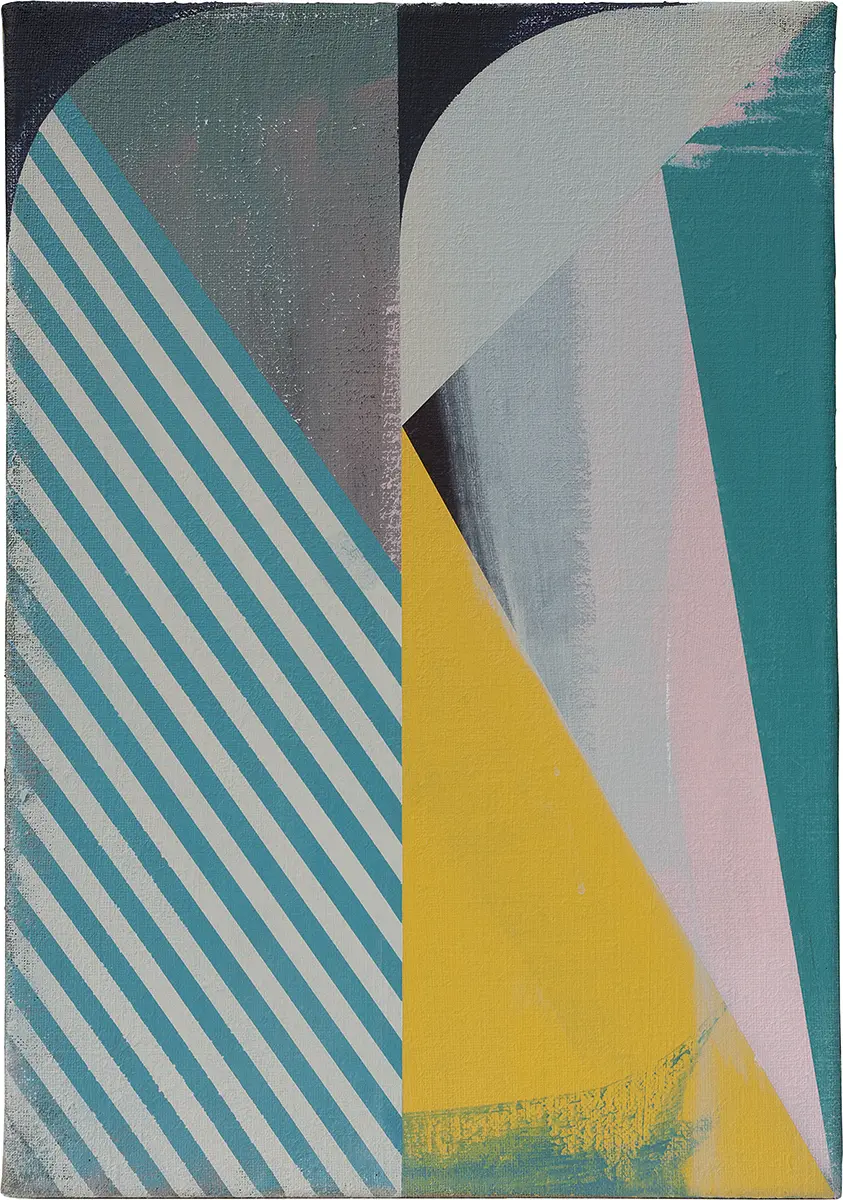
The first station focuses on the strictly pictorial character of Gili’s creative processes and was assigned to Juan Carlos Ledesma. Here, the viewer’s gaze is directed towards color, lines, geometry, and forms in space. The works, mostly acrylic on canvas, were created during the COVID-19 pandemic and come directly from the artist’s studio, as if intent on escaping from their locked down condition. In Millenial Mecánica (Millenial mechanics, 2017) and Republic Announcement (2019), the composition is structured by an interesting process of overlaps between normal repetitions and rhythms, generating lines shooting at different angles and in different directions. In Scarpa ascendente (Ascending Scarpa) and Scarpa descendente (Descending Scarpa), both from 2014, color gains unexpected force and seems to escape the canvas. The presence of repetitions, so widespread in abstract art, produces a unique effect that is not vibration, but multi-directionality, since these are not repetitions of the same line but of angles fracturing space.
The second station deals with the frame of the painting and expands into architectural intervention. It comprises an outsize mural covering an entire wall and glass intervened with magenta-hued serigraphy, which seems to interrupt the canvases. Gili takes advantage of the exhibition gallery’s double height to celebrate the blowing-up of space up by its angles. The installation also works as an allusion to his earlier urban interventions in working-class neighborhoods of Caracas. The text here was assigned to the architect Max Pedemonte, who reflects about the flexible relationship between habitable space and the qualities of urbanism. Although the volume is flat on the plane, that plane becomes a multicolor three-dimensional object and connects with the urban landscape.
The exhibition’s third station, from which it takes its title, is situated in a small side gallery holding small paintings sprayed on both sides. The text accompanying this section was written by Verónica Liprandi. The paintings, hanging from the ceiling and resembling weavings swaying in the wind, form a penetrable triangle. This series was created in 2022 during Gili’s artist’s residence in Bolivia, where he developed a significant connection with that Andean nation’s ancestral cultures. The experience prompted him to explore new styles. A textile museum established in the 1960s grabbed his attention, especially the diamond shape of the pieces. In the Bolivian Andes, that shape is called ñawi, which means “eye”. Gili understood that figure as a mystical pattern at the center of the design; he took its shape, its meaning, and its repetition not as a decorative motif, but as a study of diamond-shaped geometric designs (ñawis). He chose spray painting as a resource, which forces speed and immediacy when drawing on paper, and admits few variations. The final result makes one think of crossings between ancestral cultures and contemporary design. Works like Ñawi (2) and Ñawi (7), both from 2022, signal Gili’s continued reinvention of abstraction, transformed organically and pushed to unsuspected terrains. As a whole, this exhibition can be understood not only as a series of distinct works of art and stations, but as a unit in close exchange with the space that holds it, which gives it the characteristics of an installation where the different problems and scales of the privacy of the studio and the urban space flow together, and designs from different cultures are set to dialog.
In alliance with Henrique Faria Fine Art, New York.
NOTE
This exhibition was held in association with Hernirque Faria | Nueva York.
MARÍA LUZ CÁRDENAS