Form and meticulous order, seriality and accumulation are easily perceived when you enter the main room of Jac Leirner’s exhibition at the Swiss Institute in New York. With works that draw on diverse and eclectic aesthetics, such as Minimalism, Abstract, and Pop, to povera, the exhibition brings together a series of Leirner’s works from 1980 to the present. The archive, both personal and social, and the informational quest, are two articulating themes that run through the whole exhibition.
Created from everyday objects, the exhibited artworks use repetition as a recurring strategy to reveal the accumulation of a broad sort of objects with which we co-inhabit. Blue Phase (1992), a serpentine sculpture made of cruzeiro bills and polyurethane cord, is displayed at the center of the main room. Made of countless banknotes, accurately placed one after the other, this sculpture pictures a fundamental aspect of Leirner’s compositions: human and time traces. The cruzeiros banknotes, now a worthless and discontinued Brazilian currency, are clearly used, marked, and deteriorated by the passage of time. Arranged so that the identity of the bills cannot effectively be identified by the public, Blue Phase depicts part of the material support of that infinite and incalculable financial world in which we are immersed.
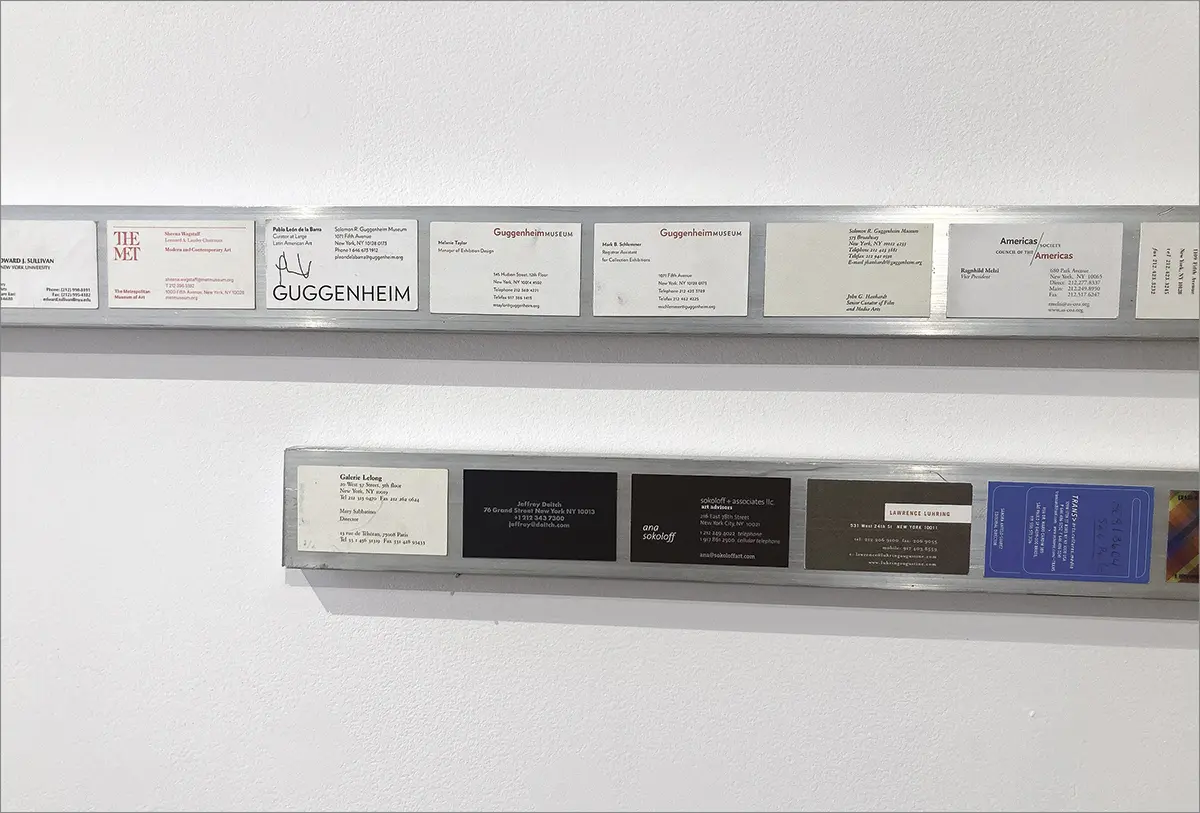
Behind the serpentine sculpture, we find Nice to meet you (NYC scene) (2023), a series of business cards framed in aluminum. Mostly from the art world, the cards are arranged one next to the other in horizontal lines displaying institutions and personal names, job positions and titles, addresses, phone numbers, email details. A whole series of cards that Jac Leirner has declared to have received herself.1 In this art piece, the world of art is entangled within its bureaucratic and networked features and Leirner’s personal trajectory, experience, and its material trace. Pulmão/Lung (Vegetal/Mineral) (Vegetable/Mineral, 1987), made from cigarette boxes smoked by the artist, and carefully preserved and manipulated to create the sculpture, also follows this impulse of connecting the personal with larger social structures. Pulmão/Lung is an organized pile, compacted and leaning slightly due to the shape of the unfolded boxes: a stack filed as a fragment of a personal archive.
Through the main room, other works, assembled also with everyday objects such as marker caps, pens, nail files, precision levels, Legos, and adhesive tapes, enhance this tension between the personal, accumulation, registration, and time and social processes.
A different composition, and decisively overwhelming, is used in the two large works that monopolize the room on the second floor: Village Inside II and Village Inside I (2023). The two panels are completely covered with different kinds of printed papers: menus and brochures from food restaurants and bars, movie advertisements, postcards, business cards, job offers, newspaper pages, yoga classes and beauty salons leaflets, napkins, among others. The printed materials were collected from the same neighborhood where the Swiss Institute is located, the East Village. In this turn in time and space, the artist anchors her work and her quest in our immediate surroundings. Village Inside II and Village Inside I depict an informational daily map, but, to the surprise of the digital era gaze, it is all there: printed.
What is fascinating about Jac Leirner’s proposals is that even if the pieces that she gathers and assembles are rather obsolete, discarded, or disposable objects and matters pointing to a moment or archive in time, they stand totally intertwined with the present context. Indeed, especially cruzeiros, personal business cards for its already perhaps obsolete details, and cigarette boxes, are more easily located in a precise past stage. However, the informational and consumer system to which they refer, its seriality, networking, accumulation, and over-information of data, undoubtedly resonates with today’s digital web. In fact, it triggers, in contradiction with the current informational world that boasts mostly of being intangible, the question about its material testimonies and vestiges.
NOTE
1. “Puzzles with No Boundaries. An Interview with Jac Leirner,” https://www.moma.org/magazine/articles/758
AGUSTINA BATEZZATI