The solo show We Metalize Our Memories, curated by Miguel López, encompasses two decades of Ishmael Randall-Weeks’ work, specifically the years he has been living in Peru after his long sojourn in the United States, where he went to high school and university. The large number of works gathered in the exhibition allowed the visitors to learn about the artist’s major thematic concerns, such as architecture, construction, pre-Columbian cultural heritage, extractive processes, and traditions of modernist sculpture. Moreover, it highlighted how the choice of materials and objects that he reworks constitutes not only a set of sculptural resources but also a means to address complex social processes.
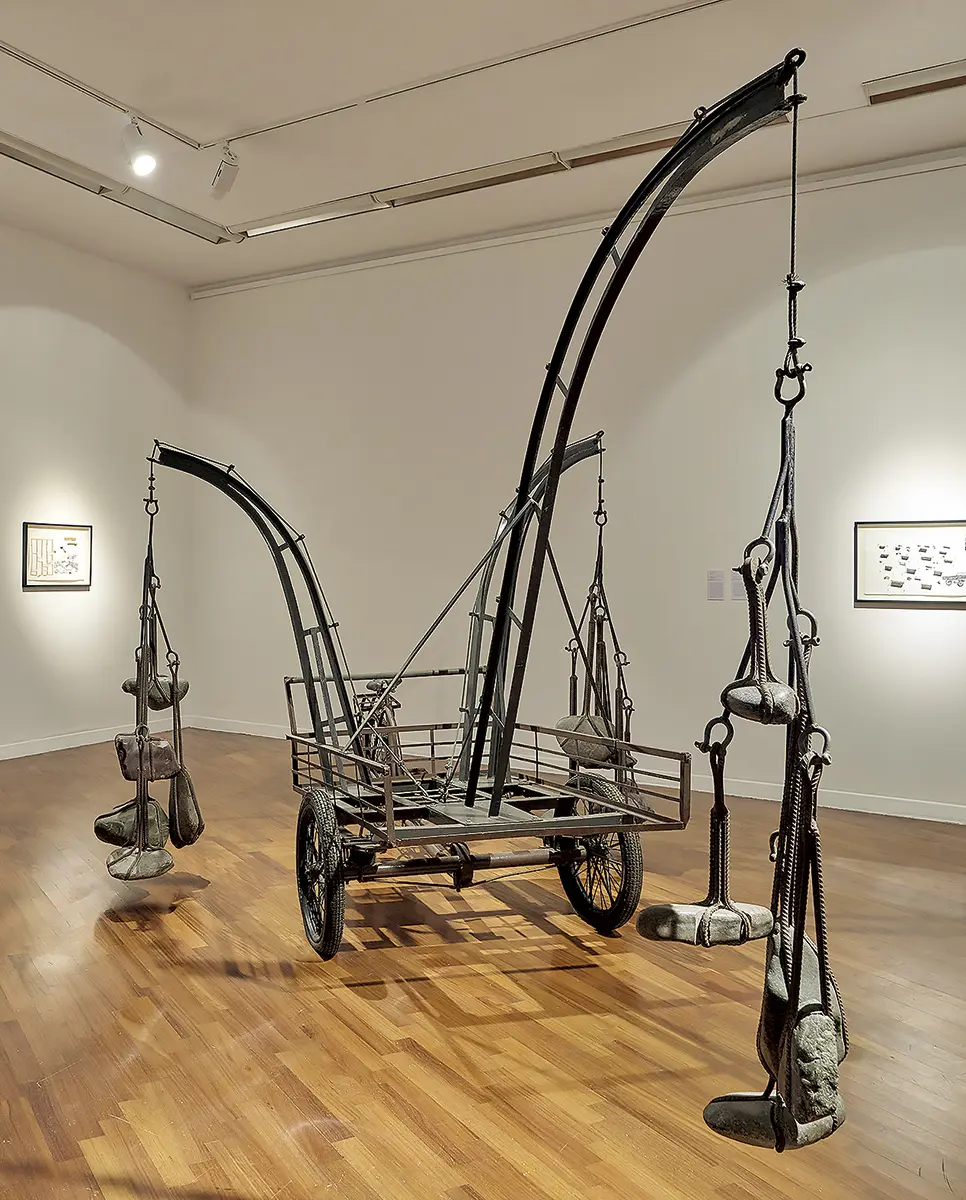
The cargo tricycle is an emblematic example of this approach. In the exhibition, it appears in three instances. For Balances/tensiones (Balances/Tensions, 2005-2006) it has been altered and fitted with three structures resembling cranes from which hang river stones held by construction irons wrapped around them like ropes. These river stones, taken from the Vilcanota River, allude to the Andean and pre-Columbian world (the river passes through the Valle sagrado de los Incas, a few kilometers from Machu Picchu). They also symbolize displacement, implicit in their relocation; an idea reinforced by the tricycle, which refers also to precariousness, as it is a tool used for street vending, a trade many migrants from the Andes engage in when they come to the capital city. Nómade (Nomad, 2007) is a tricycle transformed into a kind of mobile home made from recycled oil cans; complete with a sink, kitchen, and interior resting area. The silver structure of the piece (which shows the inner side of the cans) nods to the emblematic Airstream metal trailers from the 1930s, while the outer side (where we can see the oil brand imprinted on the cans) reveals the recycled and low-cost origin of this vehicle (something also evidenced by the rust), combining futuristic anticipations of early twentieth-century industrial design, utopias of mobility, poverty, and housing shortage. The video Aplanadora (Steamroller, 2010) shows a steamroller running over an old tricycle and crushing it. This evokes the clash between an idea of progress—whose emblem is heavy machinery—and the most vulnerable sectors of society, thrown into a subsistence economy.
Such frictions are a recurring theme in Randall-Weeks’ oeuvre. Pupitres (todas las tierras) [School Desk (Every Land), 2021], is a notable example of this. The traditional school desk is disassembled, as if it were an IKEA furniture piece, and mounted on the wall. The desk is made of different types of soil from various regions of Peru and inscribed with their proportions and names. These have not been merged, but rather amalgamated, preserving their specific features (color, texture) to allow us to distinguish them. Through this material process, the artist critiques the risks of cultural homogenization inherent in the country’s education system; an idea bolstered by the implicitly referenced novel Todas las sangres (Every Blood) by José María Arguedas, which addresses the challenges of modernization in a multiethnic and multicultural country like Peru.
Mercado (Market, 2008), made from crates covered in mirrors, juxtaposes an everyday object—such as rudimentary wooden boxes used to sell fruit in public markets—with an industrial material. In fact, the work references developments in Minimalism, since the mirrored crates bring to mind works like Robert Morris’ Mirrored Cubes (1965). But unlike Morris’ perfect and orderly cubes, Randall-Weeks’ stacked, uneven crates produce an almost psychedelic reflection on the walls, completely breaking away from minimalist aesthetic principles.
Another aspect of Randall-Weeks’ work highlighted in the exhibition is carving as a symbolically charged technique. In addition to the pieces for which he carves bricks—such as Wall (2012), where the bricks allude to construction and its heyday—his carved books point to an extraction process; carving points to the country’s extractivist economy. Ibeam (from 2023, with the first version dating back to 2013) takes the form of a construction beam, but is made of books. On one side, the titles are visible: The History of Corruption in Peru, Peruvian Drug Legislation, Justice of the Peace in Peru, A Proposal for the Reform of the Peruvian State, Extractivisms, and Economic Geography of Peru, among other volumes dealing with the country’s issues. On the other side, the books have been carved, and due to the differences between their covers and the shades of the pages, a sort of stratigraphy reminiscent of a geological profile has been created. Here, construction (the beam), discourses on local issues (the books), extractivism (the carving process), and geography (the cliff-like shape that emerges) converge.
Beyond identifying the thematic concerns that run through Ishmael Randall-Weeks’ work and correspond to his life’s trajectory, the exhibition’s journey throughout two decades of work allowed us to recognize the artist’s great formal and technical sophistication, which in turn enable him to critically articulate different places, cultures, and even times.
MAX HERNÁNDEZ CALVO