In general, the title of an art exhibition is charged with intentions and atmospheres that are negotiated between the artist and the curator, something akin to a convention, a treaty.
In a convention, one seeks some sort of juridical or legal order; in a convention, a prior agreement.
Let us see, then, what intentions guided the most recent presentation of Iole de Freitas’ works in São Paulo, a new initiative of the Instituto Tomie Ohtake.
It certainly explored a series of investigations derived from the eventful career of an artist who has literally traversed spaces with artworks that never fit into neatly defined categories, fields, or single artistic methodologies.
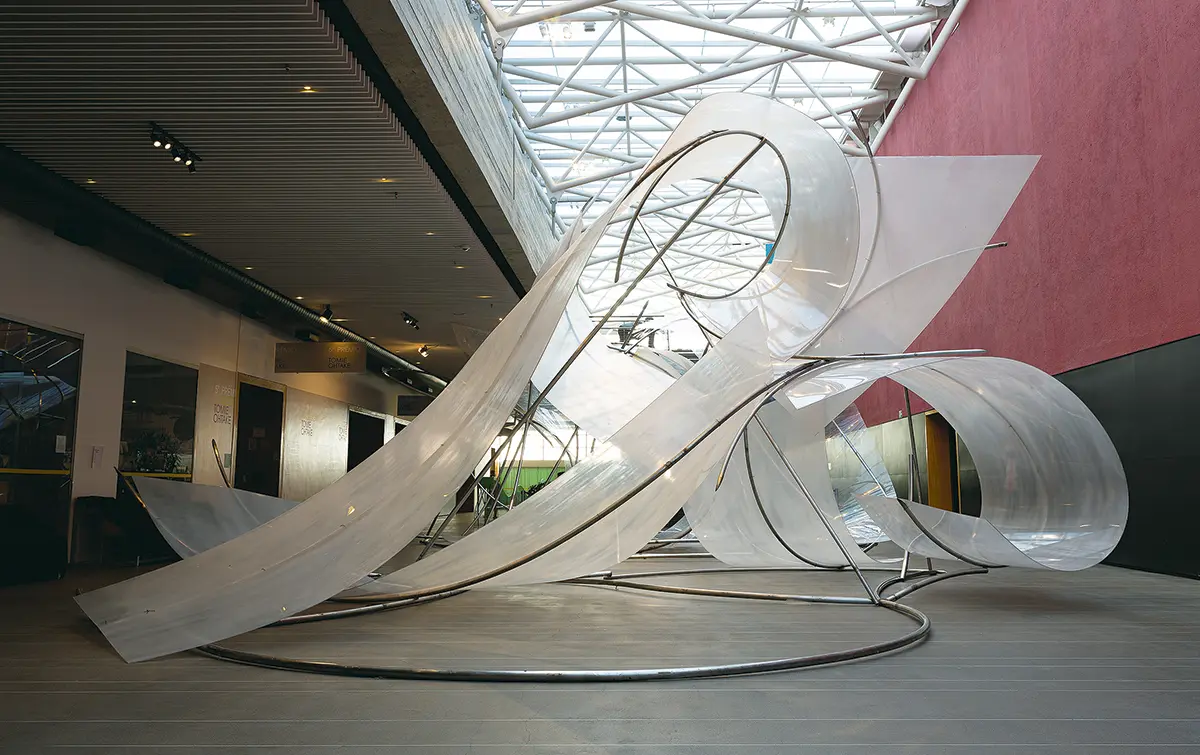
The exhibition, titled Iole de Freitas: colapsada, em pé... (Iole de Freitas, Collapsed, Standing…) built an environment of great visual impact, occupying the building’s vast central area with a monumental installation that also connected to the other two exhibition spaces. It presented a thesis about “free movement”, in the words of the curator, Paulo Miyada.
The building’s central hall was thus taken over by Iole de Freitas’ well-known visual maneuvers, with her stainless-steel and painted polycarbonate crystal structures, which invade a space and interrupt the flow of the viewer’s gaze in order to invent an unexpected downwards motion, inviting them to reconsider their own bodies.
The installation Colapsada em pé (Collapsed Standing, 6,30 x 9,40 x 16 meters), located in the first-floor circulation area and connected to the grand hall, concentrated the powers of an expanded creative gesture in a space that seemed to contain all the energies of a centripetal and centrifugal dialog.
Monumental in its dimensions, this work explored the very notion of expanded scale by traversing the first floor and reaching the base of the second floor, its volume dominated by the apparent lightness of structures that, with the hollowed-out, translucent recourse of its parts, rose into a kind of manual trace designed in stainless steel.
Each metallic set of this tracing—projected in blocks and organized by the artist in her studio, for its later setup as an exhibit—between polycarbonate pieces possessed an organic form of motion that naturally overflowed from the exhibition area, like a living body.
As is known, Iole de Freitas has modeled her intervention in the contemporary scene and built a particular signature in the history of Brazilian art.
Starting with her experiments in sculpture, in particular her production of the late 1980s, with plastic pieces in plastic, copper, fabric, and brass, the artist has sustained an intense relationship with the materiality of every space she has occupied, with their fronts of creation.
For her show at the Instituto Tomie Ohtake, the coherence of a common axis between the installation and two galleries with three-dimensional and video works represented one possibility of spatial occupation, conceived by the artist as a reminder of our bodily awareness.
In the narrow first gallery, to the right as visitors entered it, Escada (Staircase, 2023), in stainless steel, carbonate steel stilts, and silicone-paper volumes, dominated the space with its 4 x 2,86 x 19 m, sharing our attention with the video performance Dança (Dance), an encounter between de Freitas and the dancer Bento Dias based on Rodin’s Les Bourgeois de Calais (The Burghers of Calais).
The projection of the performance in two opposite planes, in 6’ videos, guided visitors toward a visual read of the choreographic occupation created by Iole de Freitas. It showcased the clash of the bodies in contact with the sculpture, in concentrated movements between the staircase steps, its angles, its openings, and in direct contact with the walls.
Special mention must be made of the outstanding use of the resource of self-description that accompanied Escada (Stairs).
The well-known choreographic element that infuses the artist’s work since her formative period—she studied and assimilated modern dance from an early age—has been in evidence often through the bodily experiences dotting her visual-arts production.
Back in the space of the great central installation, as they walked around the volume of the show’s main work, visitors reached yet another exhibition space and encountered.
The motion present in the cuts and the editing of the videos was riveting and thought-provoking. It brought forth the bodily interactions between Iole de Freitas and Bento Dias, in contact with the works that preceded the definitive setup of the installation in the Institute’s Grand Hall.
This space also showcases the notion of ruins, in Cilindros de Kassel (Kassel Cylinders, 2007-2023), which literally salvaged cylindrical blocks taken from the wall of the Fridericianum building, the same cylinders that held the steel cables in the artwork created for documenta .
In fact, the installation Colapsada, em pé (Collapsed, Standing) and the entire exhibition project built on the basis of an aesthetic dialog between artworks and video performances, synthesized the inquiries and investigations that give shape to the thoughtful production of an artist who has asserted her spatial convictions through the decades.
Her volumes sustain the perspective of a sculptural-architectural ascent, which interprets many of the concerns associated with a process-focused understanding of rational space.
Iole de Freitas was always able to fulfill the destiny of each three-dimensional project, be it thought the opacity of light or through the impact of her intersection of the architecture of the spaces being occupied at various institutions. Consolidating her inventiveness at a monumental scale, interested in corporeality, she reaffirms the place occupied by the production of women artists in the contemporary scene.
CLAUDIA FAZZOLARI