Let us start the review of Vaudeville, Ilê Sartuzi’s first solo show in Portugal and his debut in Lisbon and soon to be Madrid-based Galeria Pedro Cera with the acknowledgment of the importance curtains have gained over the years in contemporary art. Curtains have the uncanny ability to be both a tool and a rhetorical device: they hide and they reveal, they set the tone and create a rhythm, they conjure the magic of the stage and aliveness, as well as that of moving image from days long gone, when projected light was a technological marvel. They elicit a shared space, a sense of communal viewing and belonging. They trace a border between fact and fiction, or they try to, if that binary still holds any value today. They partition a space, allow for privacy, and set the imagination off. No wonder artists have been drawn to the endless possibilities that a hanging piece of fabric, velvet preferably, allows. It comes as no surprise then, that a show titled Vaudeville, is ripe with as many iterations of the velvet curtain as one can imagine.
But let’s make a quick intermission in our reasoning and think about Vaudeville, the theatrical genre of variety entertainment, not the exhibition being reviewed, for a second: it developed in 19th century France and was originally a comedy without psychological or moral intentions, based on a comical situation - a dramatic composition or light poetry, interspersed with songs or ballets. It wasn’t meant to make you think. Instead, it provided an escape from daily life, from the harshness of Industrial era Europe. It was meant to make you laugh. Humor was key in vaudeville theater.
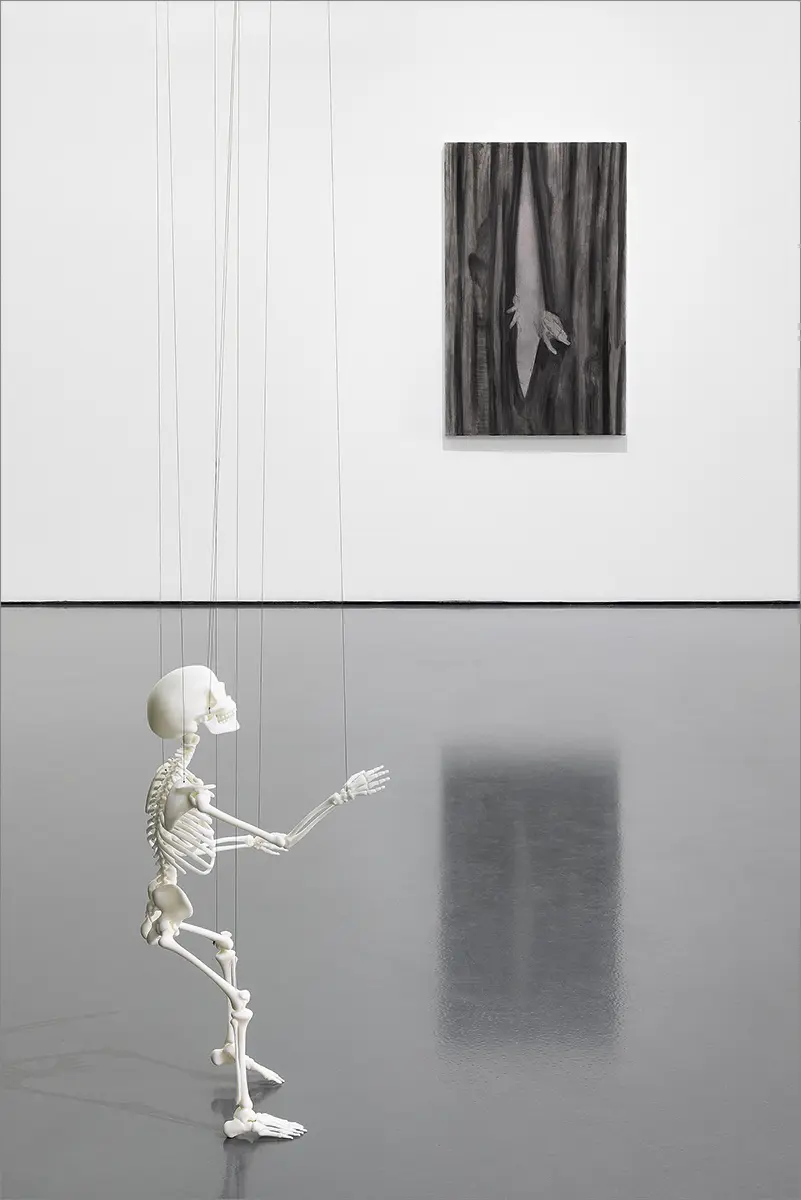
While Sartuzi’s exhibition goal is not to make you laugh, humor is also a central premise. When entering the exhibition the visitor encounters a series of pieces which are better understood as if they were thought of as a set of separate, unrelated acts grouped together on a common bill, like in any good old vaudevillian presentation. For instance if you look slightly to your left you will encounter Four Curtains (2023), a sculpture in which four small velvet sculptures open and close, automatically, showing or hiding a small space that they define. That space is empty but the anticipation of viewing what lies inside creates a tangible yet somewhat irrelevant tension which only gets resolved by the anticlimactic reveal of... nothingness, and the apparent waste of our time. Behind it lies Skeleton Dance (2023), a 3D-printed, dancing skeleton sculpture, which borrows its name from the eponymous Disney animation from 1929. In Sartuzi’s sculpture, the original soundtrack comes out of a speaker placed in the automated marionette-like wooden structure holding the figure. The interspersed rhythm of the sound and the squeaking noise of the motor and the strings holding its bones generates a sort of chaotic, anxiety ridden energy that fills the exhibition space, creating another tense moment, which is regularly broken by several absurd monologues we can only assume are meant to be the skeleton’s own discombobulated musings.
The last act in the show, the closing of the curtain if you will, is presented by a pairing of two pieces. Laughing Chair (2023) is exactly what its title suggests, a laughing chair. Sartuzi turned an old cinema chair into a well-humored object by training an AI to produce a sound that resembles human laughter. The chair’s status within the exhibition space is intentionally ambiguous, another tense moment: shall we sit on it and watch Ghostbuster (2023), the film being projected in front of it. In the film something strangely appealing is happening on the flat TV screen: a haunting, mesmerizing presence dances before our eyes and in front of curtains that never open. There is no behind the curtains, what we see is what we get: a spectral entity, a ghost that attempts to entertain us. Or the old cinema chair. Most likely the latter as it keeps on laughing at the dancing ghost’s act. Then we realize: we are just bystanders of this Vaudeville show. The audience is the show itself, it watches itself as it performs in a sort of tautological device. We are not needed, nor required. There is no tension, actually, we are just not the target audience of this spectacle. The show, as the world in the near future, will most likely go on without us.
LUÍS SILVA