The title of Gala Porras-Kim’s exhibition is paradoxical. It refers to time intervals in terms of narrative, but describes them as the durations of versions, reformulations, and updatings of tales that survive between moments, speculating about their possible transitions, and ultimately expressing or filling in these possible gaps in the interest of something that can be described as an original compensation. There is, from the start, a political vocation that claims for the immemorial rights that can be attributed to things, in themselves or as the remnants of what they were or of that of which they made part. But she does this not only as follow-up and continuation of a protest that insists on demanding restitution for the pillage systematically orchestrated by colonialisms and postcolonialisms, but also for the sake of a fulfilment of place and time in the order of the transcendental. The inherent humanity of things remote from us in time and the respect they must be granted. In her quest to take remains and objects back to their places of origin, Gala Porras-Kim has sought to return them to a first nature as instruments and mediators of a ritual practice. She seeks to conjure, in the realm of the political, but also in the realm of the magical, the meaning of place in time, its transits and its sense of belonging, as an object, in the face of the vicissitudes of the world. Her update emulates and sets in contrast those contents through devices that break, condense, and take them into account within the museographic space, as manifestations of the spatio-temporal transpositions and entanglements that give continuity to these back-and-forth motions, which—whether already happened or yet to happen—are brought into and presented for display here. The exhibition serves as the actual vortex of its substitutes—as collections or repositories—, imitating them in their function, using the ritual element to redeem the dignity of the ancestral on the basis of the ineffable.
Thus, with permission from the National Anthropology Institute, she exhibits the polyurethane-and-acrylic reproductions of two monoliths salvaged in the last decade from the Teotihuacan archeological site, their original use and purpose still undetermined. These are at the same time figures of substitution, and not only as imitations indicating an actuality and a physical presence that, despite the evidence, can only be there in a figurative sense. Inas much as they appear, they denounce a state of affairs, arranged here as they are with the intention of being in a different place, of having been a different place, and to have had there a purpose and a meaning that lives in the present. The transference is symbolic, but the intention of actually performing it is not entirely absent, as revealed by a letter addressed the national coordinator of museums and exhibitions of the Instituto Nacional de Antropología, requesting that these reproductions be used in place of the originals as a first step “towards the recognition of the possible disruption of the ritual provoked by their extraction.”
The remaining body of work featured in this exhibition functions in the same way, albeit based on different places, dynamics, and mechanisms. It speaks of long-ago things through the actuality of their contemporary remainders and traces, which it salvages for their ultimate materiality to constitute a condensation of what they were, as physical representations, projections, and sublimations imbued with a social and political relevance well beyond the notion of a national legacy.
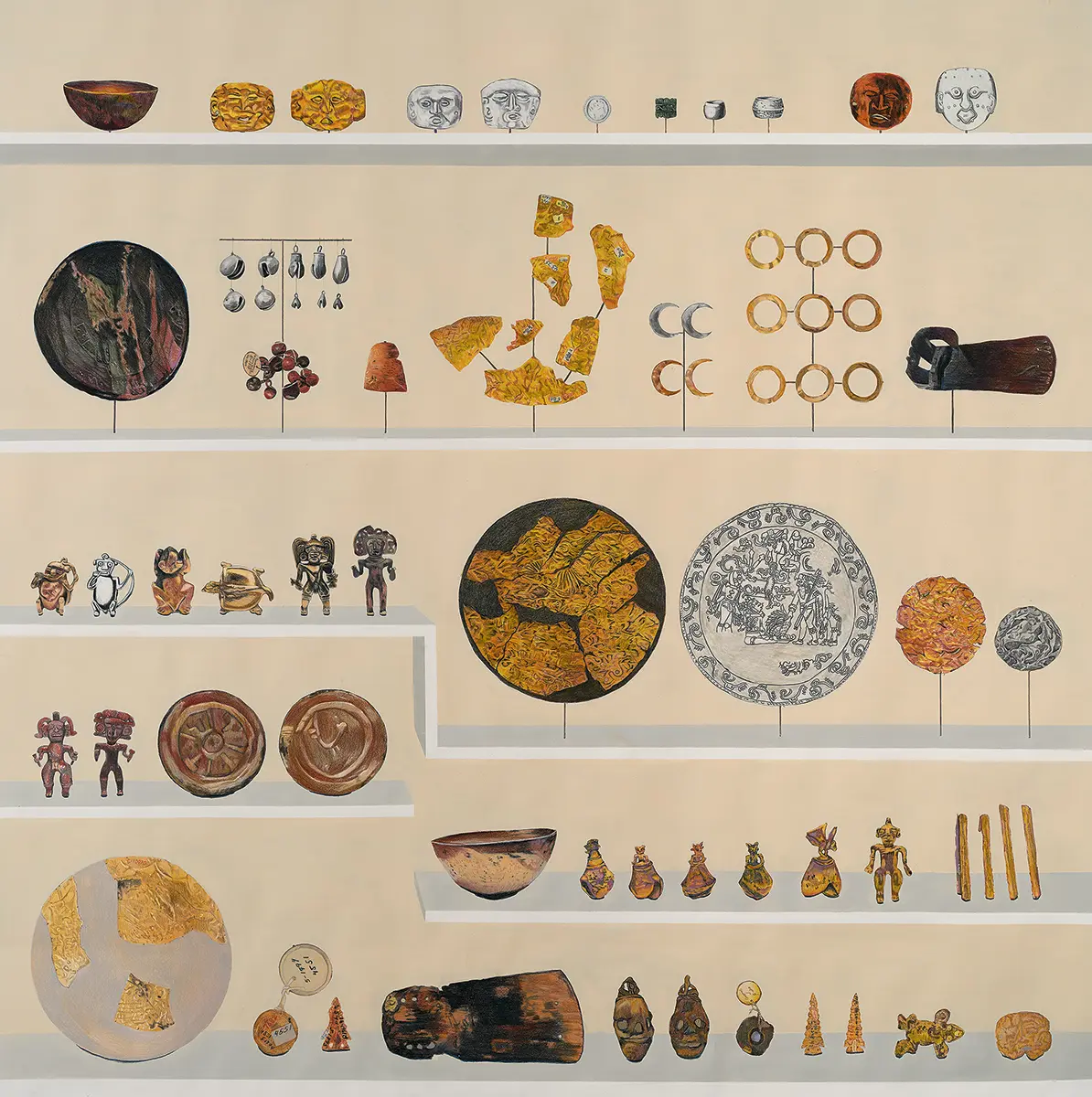
Using color pencils and acrylic, Gala Porras-Kim painstakingly captures and reorganizes the collection of rainmaking offerings at Harvard’s Peabody Museum of Archaeology and Ethnology, objects in gold, jade, and copper, as well as remains of textiles and wooden weaponry taken there by the American consul Edward Thompson, an amateur archeologist who, after gaining ownership of the land holdings that encompassed the sacred cenote of Chichén-Itzá, decided to dredge its contents. With devoted care and attention, Gala Porras-Kim brings and arranges these items for us, producing a symbolic catalog as she represents them. Her gesture emulates the continuous process of bringing forth the distant past and recompensing for it in terms determined by the emotional and the ritualistic: it no longer is, but nevertheless, it is stated here, it comes into our presence.
Similarly, in what she describes as an asymptote, twelve drawings—made by Gala Porras-Kim in consultation with Harvard astrophysicists—contrast the distant skies of the Neolithic with the different moments of the day in which she captured the extant ruins of the oldest temple for which we have any evidence, erected some 12,000 years ago temple and uncovered in Turkey in the 1960s. Or she compacts dust collected from the 2021 remodeling and renovation of the MET’s Rockefeller wing, which holds ancient art from the Americas, Africa, and Australia, into a cube of debris that contains and emulates these archives of kidnapped objects with the promise of returning them to, and expressing them into, the place where they belong. The same can be said of her culture of mold collected from the British Museum’s warehouses: that which destroys the past, also expresses it in its current presence. Gala Porras-Kim comes to dignify—to lay down connections with—a repository dehumanized by the norms and restrictions imposed by Capital’s museum catalogs.
RICARDO POHLENZ