
There is an elusive quality to play, which emerges, much like language—beyond its rules and conventions—from rudiments appearing as “emergences” in a sense that appeals to the ontological, and codes for which words serve as alliterations or onomatopoeias accompanying rituals and gestures inherent to a mise-en-scène: singing in a circle around “Lady Blanca” or the “Snake of the Sea”, or surrendering to an unnamable condition lying somewhere between illness and enchantment. Constructions and derivations, abstractions and similarities, rituals that transgress reality in order to bound it, to inhabit it. Games constitute the interweaving of the simultaneous and the virtual, based on the doing-as-if, which is defined as a place in the world and a door to converge, if you will, into that ritual otherness involving the apparent banality of its process.
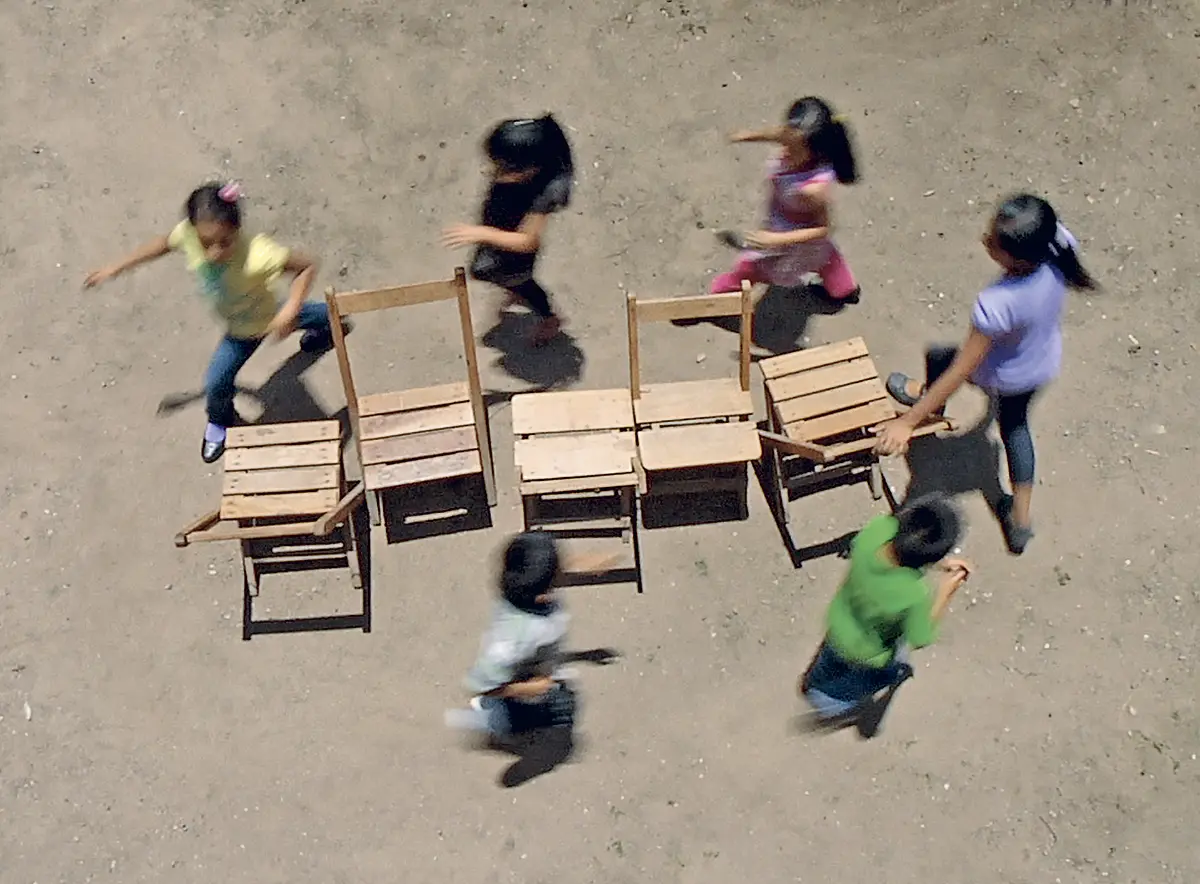
Since 1999, Francis Alÿs began filming children’s games throughout his travels around the world. Assisted on location by filmmakers Julien Devaux and Rafael Ortega, sound artist Félix Blume, documentarian Elena Pardo, sign painter Emilio Rivera, and curator Alejandro Morales, among others, Francis Alÿs has assembled a video series that both disengages and unfolds from his work, and which can be described as a landscape made of actions, mechanisms, and representations marking his journeys across the global village. A promise that survives as an extension of the modern, deceived in its own reaches and seeking, from its very edges, to conjure our colonial appetite for the new and for what lies beyond our present state.
At the outset, it feels unjust to describe or enumerate only some of the documented video games displayed in the museum. Depending, I suppose, on personal obsessions and references, I was lured in situ by some games more than others. Be it, for example, the video made in 1999, which served as the starting point for this series—a boy kicking a bottle uphill in a deprived neighborhood in Mexico City—or the most recent one, for now, made in 2022 in Denmark, where pairs of children hold oranges between their foreheads, hoping not to drop them.
One can appreciate, of course, the formal hinges in the work of Francis Alÿs: the deployment of artifacts that, once transformed, declare and establish a territory of signifiers only surpassed by certain actions and devices, which compose the mechanisms of meaning that constitute his oeuvre. Supported by his production team, he has ventured into new mechanisms, related to the previous ones, where play and creation converge, but with their own poetics, bringing together these exceptional moments in an emotional, vibrant, and colorful repertoire full of formal tensions whose significance lies somewhere between what he declares them to be and what just is.
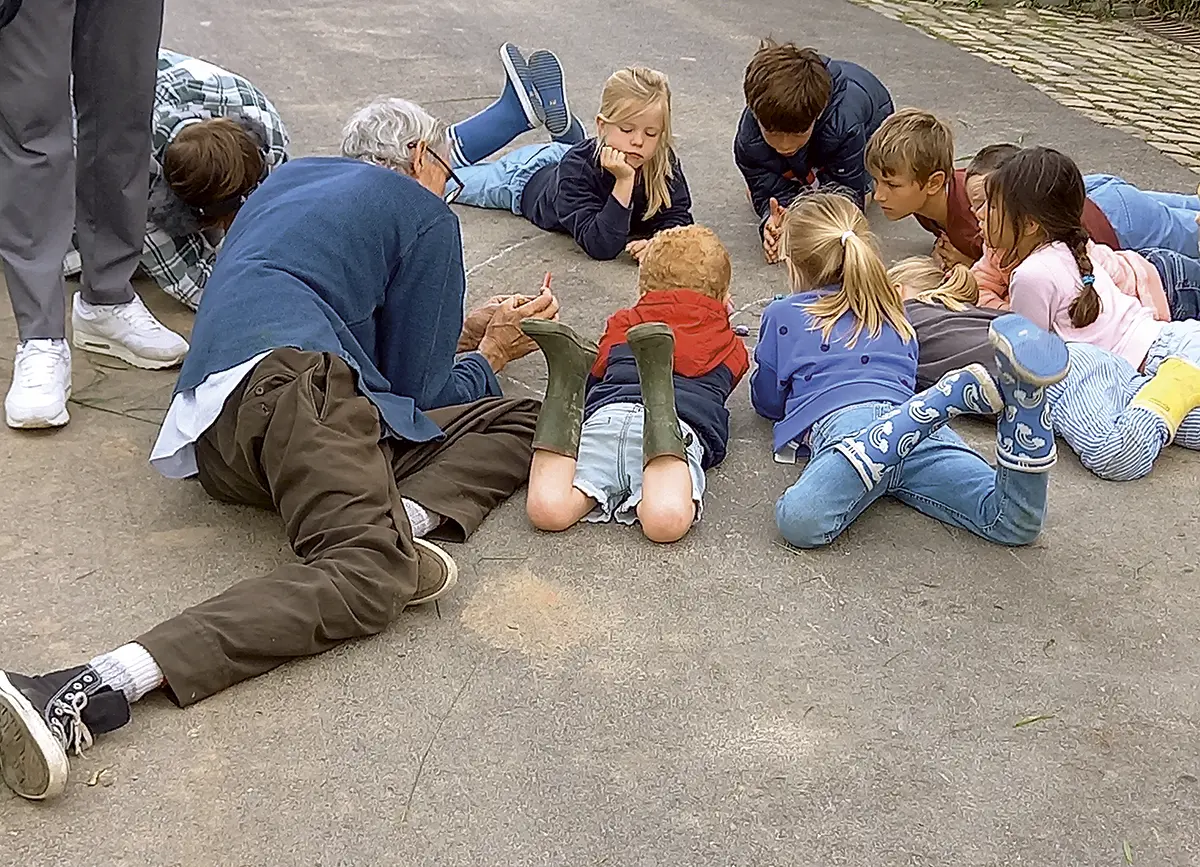
The title of the exhibition succinctly defines the contents of this collection: children playing, absorbed by the rules and restrictions posed by their games. Every competition eventually turns into a personal performance, a private space where a separate world is established through agreed-upon rituals. This is precisely what the lens captures. The children are so engrossed in their roles and objectives that they pay no attention to the camera following them and offering a glimpse into an intimacy that, as a magical space, imposes and conjures the atrocious realities surrounding them.
The videos were projected on screens distributed throughout the space, creating a polychromatic expanse of windows, which was as overpowering as it was moving. This choral experience was enforced on the viewer as a totality; a meticulous selection evoking (as the exhibition’s curator, Cuauhtémoc Medina, and other friends pointed out to Francis Alÿs) Pieter Bruegel the Elder’s Les Jeux d’enfants (Children’s Games, 1560). According to Medina, this connection with Bruegel served as a Proustian madeleine that led the artist to recall the Flemish artist’s retrospective exhibition he visited in Brussels when he was eight years old.
This was also the reference point from which the magnificent display was constructed. The connections become evident in juxtaposition: a counterpoint that revisits and updates a catalogue of appearances whereby the pictorial citation is transcended through mechanisms that are, and are not, the same. The spirit of exhaustion is replaced by tools that beckon other catalogues from the global repertoire. The formal list of references in Bruegel’s painting becomes an experience that seeks to conjure the means that enable its feasibility.
On the wall at one end of the exhibition space, as a sort of culmination, hung three small-format oil paintings that appealed to this last substrate: the pictorial object that provides the means for the rest of this adventure. The exhibition was accompanied by a series of texts by Lorna Scott Fox describing the actions recorded in the videos and functioning as literary extensions.
* Courtesy of the artist.
RICARDO POHLENZ