Última arquitectura (Final Architecture), by Florencia Levy (Buenos Aires, 1979), was the inaugural exhibition for Arthaus’ new galleries. Arthaus is a space for contemporary art established by the collector Andrés Buhar and headed by María Teresa Constantin, intended also as a concert room, stage-arts laboratory, and cultural center.
In the lower level, the video installation Lugar fósil (Fossil Place, 2019-2023), winner of the Premio Trabucco in 2019, brought forth—in a new exhibition model—environmental and economic testimonies from different Chinese cities, starting from the 1980s. Acid rain, oil spills in the ocean, contaminated waterways, buildings rendered invisible by smog, and other dystopian environmental phenomena served as a record of the damage wrought by human beings upon the planet.
Also in the lower level, visitors encountered Tierra de ciervos (Land of Deer, 2017), a photograph attesting to Levy’s travels and travails in China, where she was detained for her attempts to record images of one of the world’s most heavily contaminated areas: the city of Baotou, in Inner Mongolia.
The Baotou region is rich in the group of minerals known as “rare earths”, key to the manufacture of electronics such as mobile phones. It is also home to an artificial lake, 36 square kilometers in size, made of the toxic and radioactive residual sludge that results from daily dumps of mining by products. Having survived the city’s authorities attempt to destroy Levy’s material by reformatting her camera’s memory card, the photograph on display sheds light on the extent of the catastrophe.
After scanning with the cellphones the QR code placed under the photograph, visitors were shown a video of the precise moment of Levy’s arrest. In that way, she underscores our deep enmeshment in a system that encourages extractives policies, with no regard for their consequences.
In Toda virtualidad is geológica y política (The Virtual Is Geological and Political), his essay for the exhibition, the philosopher Michel Nieva writes that we all carry a piece of China in our pockets, since a large percentage of the minerals used in digital technologies have their origin in the Baotou mining complex.
This situation is also highlighted in Herencia de un gesto (Legacy of a Gesture), a series of enameled ceramic works modeled by Levy that include in their elaboration materials such as gold copper, and aluminum. Each represents a cellphone model (14 pro max, Z Flip 4, SE First Generation, and others) marked with fingerprints, again expressing how entangled we all are in those extractives policies.
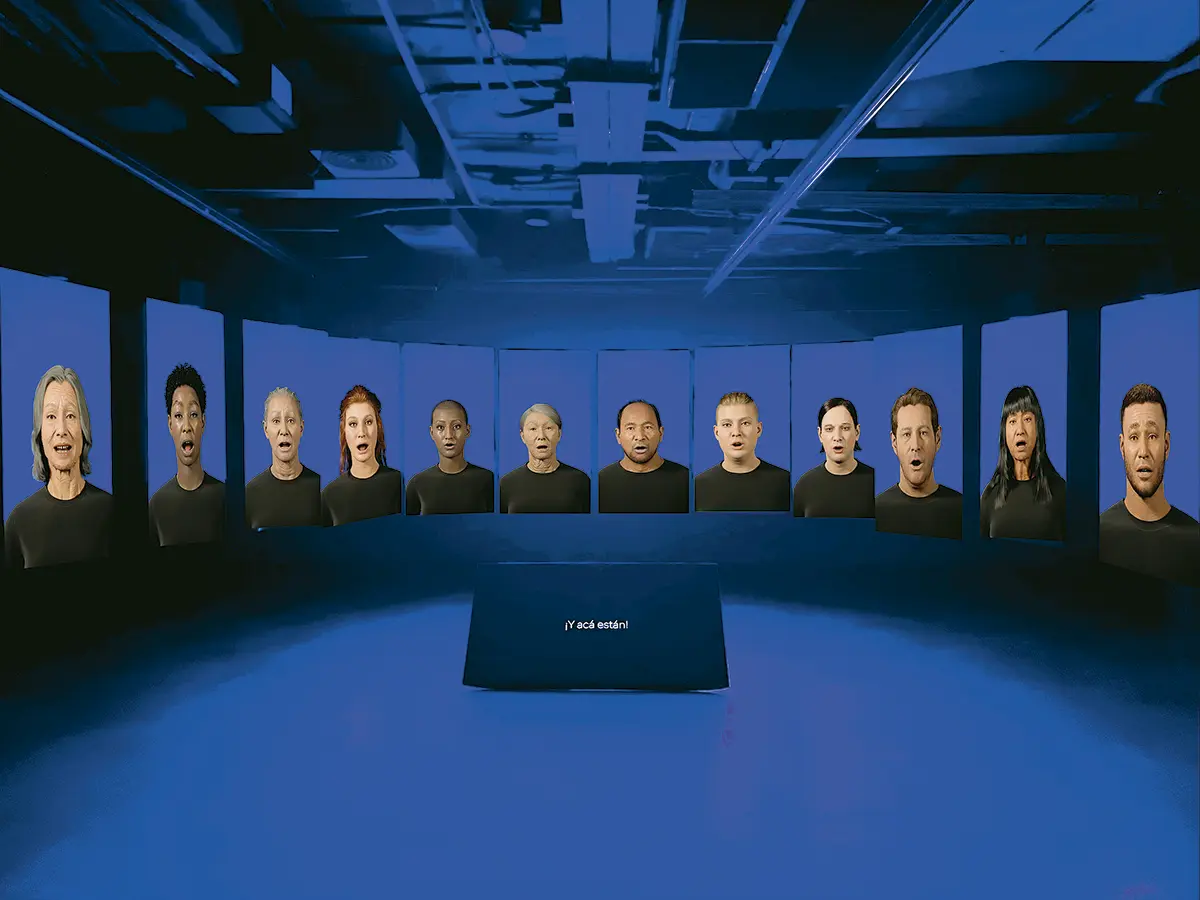
In the first-floor gallery, visitors found a striking audiovisual installation titled Cientos de millones de años para estas formas (Hundreds of Millions of Years for These Forms, 2023), where twelve figures placed in a semi-circle sang in unison (bringing to mind an Ancient Greek chorus). The human-like figures were created and 3D-modeled by artificial intelligence, with recordings of actual singers. In front of them, a screen transcribed the lyrics of the song written by the artist to musician Santiago Verea’s score, featuring attention-grabbing phrases like “The echo of the minerals asleep on the surface…”. Will we see something worse? We will see something worse! How far away in the distance? Which war is this?
Across from this installation, and exhibited under the title Última arquitectura (Final Architecture), was a collage-like assortment of items that included watercolors, clipped photographs, prints on vinyl, and engraved steel sheets. Among the images that stood out were architectural details of bank buildings from Buenos Aires’ financial district, set in contrast to images of the ocean floor and fragments of the Convention on the Law of the Sea to signal the role played by the economy in the destruction of the environment.
The show was brought to a close by an installation titled Los océanos oscuros fueron el útero de la vida: de su protección, la existencia emergió. Todavía llevamos en nuestros cuerpos-en nuestra sangre, en la amargura salada de nuestras lágrimas-las marcas de este pasado remoto (The dark oceans were life’s womb: existence emerged in their sheltering. We still carry in our bodies—in our blood, in the salty bitterness of our tears—the marks of that remote past). The title cites Arvid Pardo’s speech to the UN’s Convention on the Law of the Sea, where the sea and ocean floors, with their underground resources, were declared the common heritage of mankind.
This installation featured 3D-printed polymetallic nodules submerged in water-filled fish tanks. Polymetallic nodules are spherical accretions of large amounts of metals, up to twenty centimeters in size, found in the ocean floor. They are of great interest to the energy industry and are used in the development of sustainable energy systems.
Levy creates an intimate atmosphere for thinking and reflection in the Anthropocene era. Her works highlight the devastation of the environment not only in China, but across the world, and raise an alarm about the contamination and destruction of habitats at the hand of humanity.
In an era of technological revolutions and irrepressible consumerism, is transformative change still possible? Are we still able to reinvent ourselves and start afresh? Is Última arquitectura (Final Architecture) a lament for the end or a clarion call for a new beginning?
EMILIA VAN RAAP