The exhibition “Federico Herrero: Mutating the Topographic Memory” was on display from May 17 through June 17, 2003 at the Walker Street location of the James Cohan gallery, in New York City’s Tribeca neighborhood. A critical inquiry into the meaning of the landscape in the Anthropocene era that uses the aesthetic language of formalism, Herrero’s work challenges the well-worn divide between form and content, or between politics and aesthetics, that has informed discussions of modern and contemporary art since the early twentieth century. On that perspective, form, in the Kantian sense, does not exist as an aesthetic mode in isolation from the social content of the world, or, in the case of Herrero, the content of ecology and an eco-critical method. In the nine paintings arranged in the gallery’s ample space, Herrero reminds us of the tensions that define urban environments, where the unstoppable drive of late capitalism assails nature ceaselessly, while nature insists on resisting its extermination. In that sense, Herrero’s paintings invite us to consider not only the ecological disaster produced by the neoliberal era, but also the ability of form—this is to say, of lines, curves, colors, and compositions—to resist the Anthropocene debacle by means of aesthetic discourses and narratives.
Federico Herrero was born in San José (Costa Rica) in 1978 and studied painting at the Pratt Institute in New York City in the late 1990s. In the same way that form and content coexist in his work, his painting is neither mimetic nor abstract and can’t be assimilated to existing Latin American art styles or schools, such as Conceptualism or Geometric Abstraction. The imagination informing his works, with the artist’s own memory—his stories, his geographies, his remembrances, his boundaries—as its main repository, creates referents that the viewer can recognize, but only by means of such Barthesian “anchors” as the one provided in this instance by the title. In Pan de Azúcar (Sugarloaf, 2014), now part of the Guggenheim Museum collection, for example, Herrero places at the center of the painting the famous dome found at the mouth of Rio de Janeiro’s Guanabara Bay, with black outlines and against a black ground. Above it, in a grey mass, we see the air, the sky, and the mountains. Under it, the city in green; in the bottom section, the green becomes gray. Using a strategy of repetition (albeit with small variations), Herrero generates a formalist language that recognizes and celebrates a topographic, regional icon, the soul of the mountain, Pão de Azúcar.
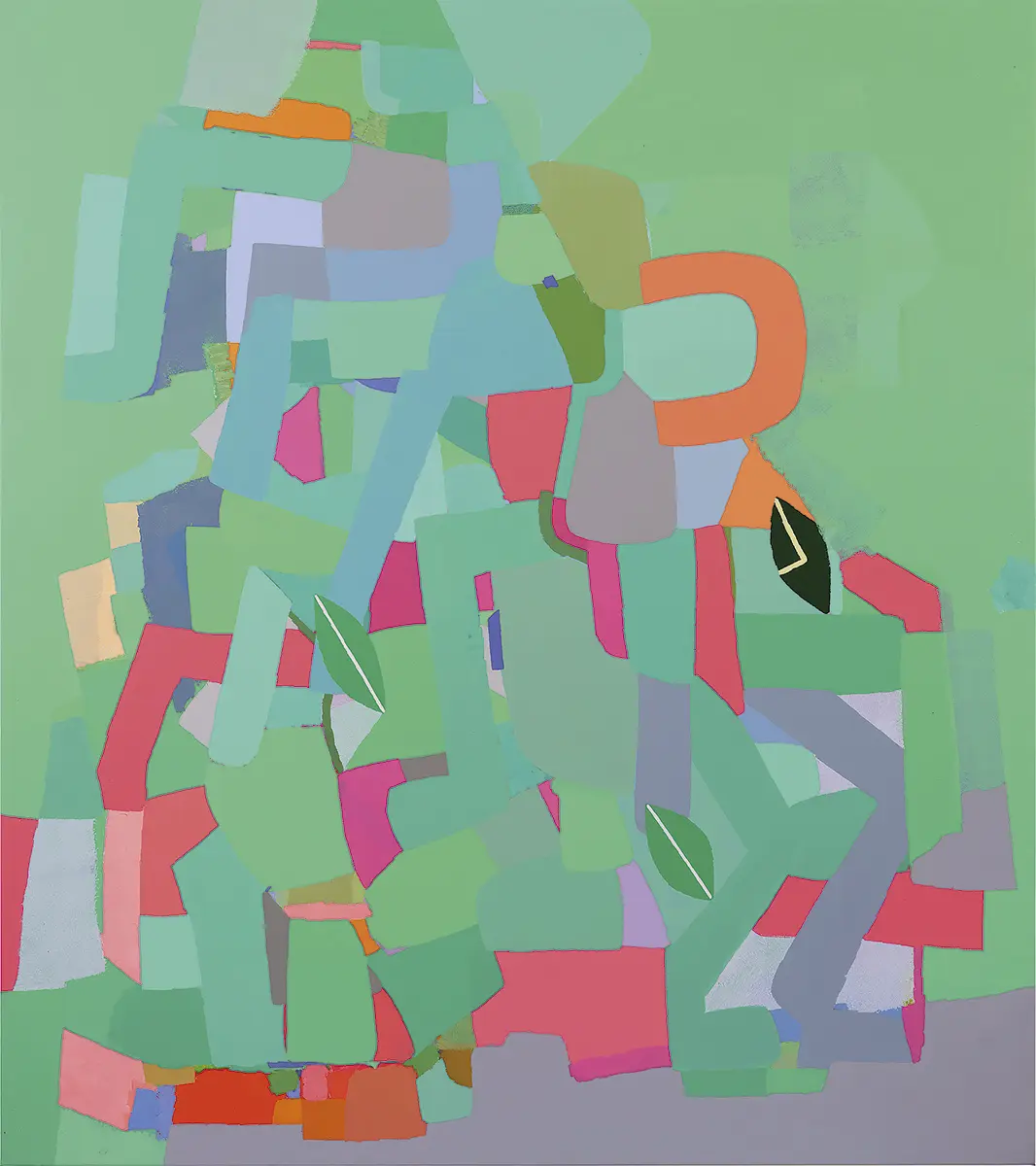
In his exhibition at James Cohan, Herrero, who resides in Costa Rica, continues the practice of underscoring the forms of his works with more or less synthetic titles that always refer to the geologic movements, situations, and times of a specific geography, as in the case of Pan de Azúcar (Sugarloaf). In that sense, the series becomes more global and more personal at the same time, adding a further element to the dichotomies already present. In fact, the very title of the exhibition invokes the images and their meanings, all together, inviting visitors to contemplate a series of topographies in connection with their potential for mutability. Some of the formats are very large, up to 270 x 240 cm in the case of Time (2023). Here, topography imagines time as a weaving, as a knot that overflows the boundaries of the painting or those of the Earth. Two semicircular orange shapes mirror one another and contract in the upper section of the painting, existing over and behind blue fragments that are like segments of water, of grass, or of a hill that does not end at the far right or left edge of the canvas. But this voluminous knot that dislodges itself from the two-dimensionality of the painting is also covered in the artificiality of neon colors. The time of the Anthropocene follows a linearity of destruction, but the time of that water, that grass, and that hill resists in a knot that hangs on tightly, refusing to let itself disappear.
In other examples in smaller formats, such as Montaña de agua (Water Mountain) (198,1 x 181,9 cm), also from 2023, Herrero presents us with a shape that brings to mind Pan de Azúcar, his painting of Brazil’s iconic topography from more than decade ago. Yes, Herrero’s archive has to do not only with what he sees and remembers, or with memories of his travels, his experiences and his knowledge of landscapes, but also with his own creations, of better yet, with the shapes that fill his imaginative repertoire. In this case, the mountain, as the title informs us, is no longer a granite and quartz monolith, but water. Water solidifies, it dries out perhaps, in a critique of centuries of capitalism and the accelerated the pace of the destruction it wreaks today on the environment, on the water with its living being, on life itself. At the same time, by titling his work first in Spanish and then, in parenthesis, in English, Herrero situates his identity in Hispanic Latin America, along with the origin of his memories and, in consequence, of his mutating topologies. We can conclude that Herrero critiques the Anthropocene catastrophe from Costa Rica in relationship with the world, and vice versa, all the while imagining a future of greater ecological justice, bringing together content and form in his painting, and joining eco-critique with aesthetics.
FLORENCIA SAN MARTÍN