The being there of what is not there. These are the presences that Doris Salcedo drags from the other side, from the unknown and the unfathomable, from death, in order to make them appear before us; we who stand before these sculptural installations. They’re like a spell, like the stuff of magic. In reality, they’re the stuff of art. The most painstaking, endured, and nurtured art of our time.
Eight installations were gathered here from May 21 to September 17—Untitled (1989-2014); A flor de piel (2012), Plegaria muda (Silent Prayer, 2008-2010), Atrabiliarios (Atrabilious, 1992-2004), Untitled (1989-2016), Disremembered (2020-2021), Palimpsest (2013-2017), and Unland: The Orphan’s Tunic (1997)—in the very special Fondation Beyeler (Basel, Switzerland), which last year hosted the largest ever retrospective of Goya, and has also exhibited the works of many great artists, such as Picasso and Matisse. Now, with Doris Salcedo, a woman has been added to this list. And not a woman from the North, but one from the global South. I traveled there to experience this event and to trace once again the thread that connects works that have been engendered in impossible images. In Derrida’s words, they are the images of the aporias of the human: “the possibility of an impossibility.”
Salcedo’s creative process thus begins from an impossible image. After a long period spent reading (at least two books a month) works by her poet friends, philosophers, or cultural theorists, she builds the concepts that will guide her exploration of each victim’s singular experience, which Salcedo lives in her own consciousness. She engages in lengthy dialogues with the victims, establishing connections through constant visits and encounters with survivors of specific events related to the political violence and colonialism of our times, most of them occurring in Colombia. Her motivation is to make the missing persons appear, to call the absent and capture the void left by absence; to include those that have been displaced, to dignify those that have been raped, to mourn the unburied, to make visible the psychic and physical pain, to reveal the invisible shroud borne by those who endure the eternal pain of surviving barbarity, to shed light on how impossible it is to fathom the countless victims and the massive crime, to suffer the radical solitude of those who dwell in life’s peripheries.
Doris Salcedo’s studio is a site of collaboration and research, where nothing is foreign: gardening techniques, hydraulics, mechanics, carpentry, metallurgy, mummification procedures and where every science belongs: physics, chemistry, biology. Whatever is required, until they find the formula to make materials behave as they exist in her imagination: transfigured. Then she works with wood, metals, dead trees, concrete, flowers, plaster, gauze, human hair, pig viscera, surgical thread, found clothing and furniture, fabrics, ashes, water; she forges, she digs, she carves, she molds, she mummifies or weaves them. Often, her sculpted objects are so unreal that they resemble drawings brought to light by a powerful lamp.
They are works of fragile appearance, as demanding in their display—carefully curated by Sam Keller and Fiona Hesse for this occasion—as they were in their creation. I walk through one of the rooms with Doris Salcedo and I ask her, more out of astonishment than expecting an answer: “Are these works not fragile? They have traveled the world for decades and are in perfect form!” Squinting her eyes as if looking from afar, and with a touch of faith in her voice, she responds: “They endure.”
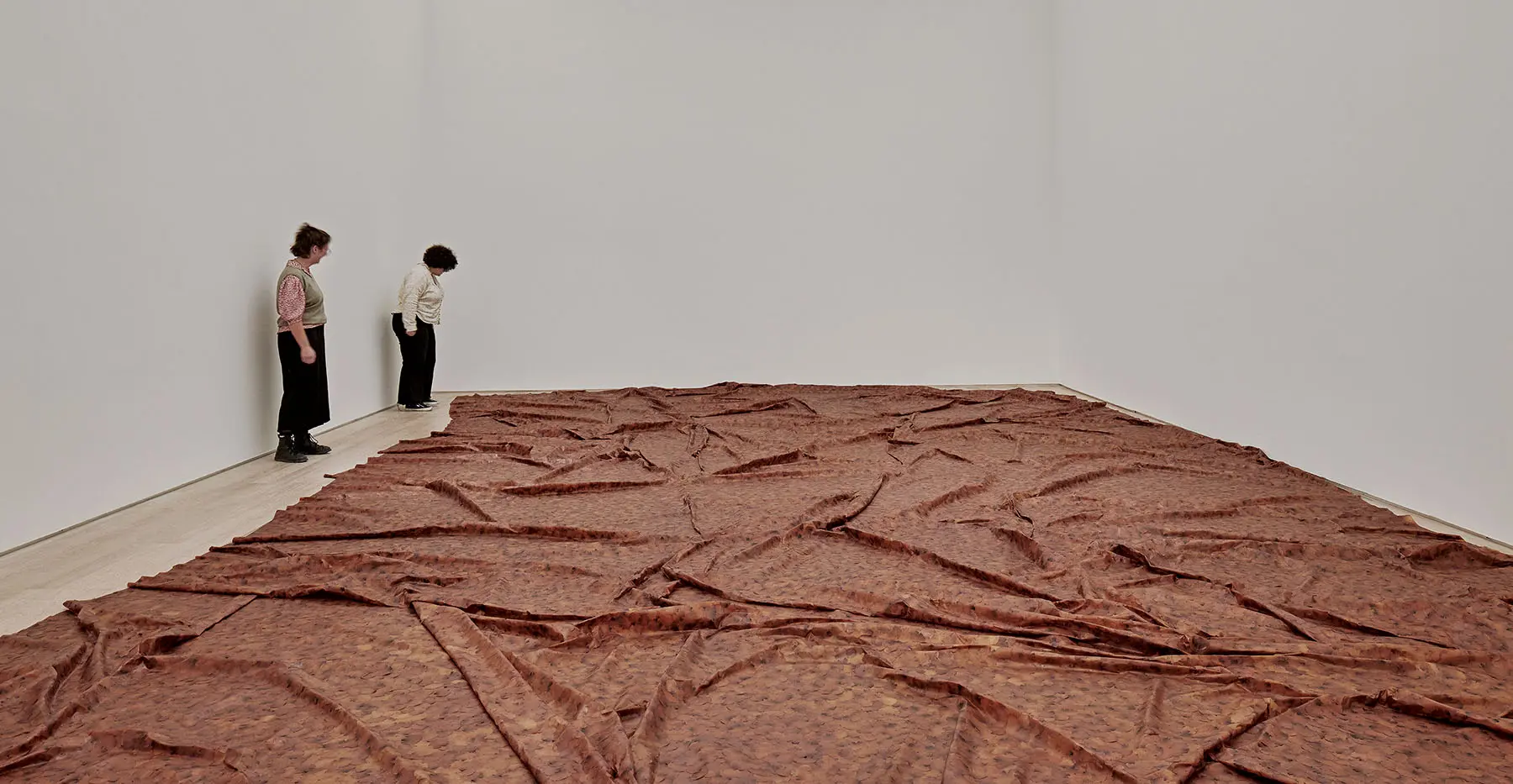
When facing them, answers to the questions that the viewer is asking are rooted in silence. How do these roses survive? Alive yet dead, with dried red blood; petals pierced by the relentless needle that has woven them with surgical thread; united in a shroud covering the floor of an entire room. How does this shroud, seemingly impossible to touch, glide before my eyes like a Baroque painting, with folds that sink into the excruciating consciousness of pain when some monster tore off all the bloodied skin of a nurse in a distant war hospital? I’m referring to A flor de piel (2012), a work that pays tribute to a Colombian nurse who was tortured to death.
How can hundreds of tombstones cry beneath our feet, on a path created by the names of numerous people from Africa, Egypt, Syria, and Kurdistan emerging in water? Those tears should also be our tears. On October 2022 (six months before the show’s opening), the Fondation Beyeler installed Palimpsest, the first work in which Salcedo reveals the names of forcibly drowned migrants by the thousands in the Mediterranean Sea, on a floor of rectangular stone slabs that temporarily and intermittently appear in water taking the form of tears.
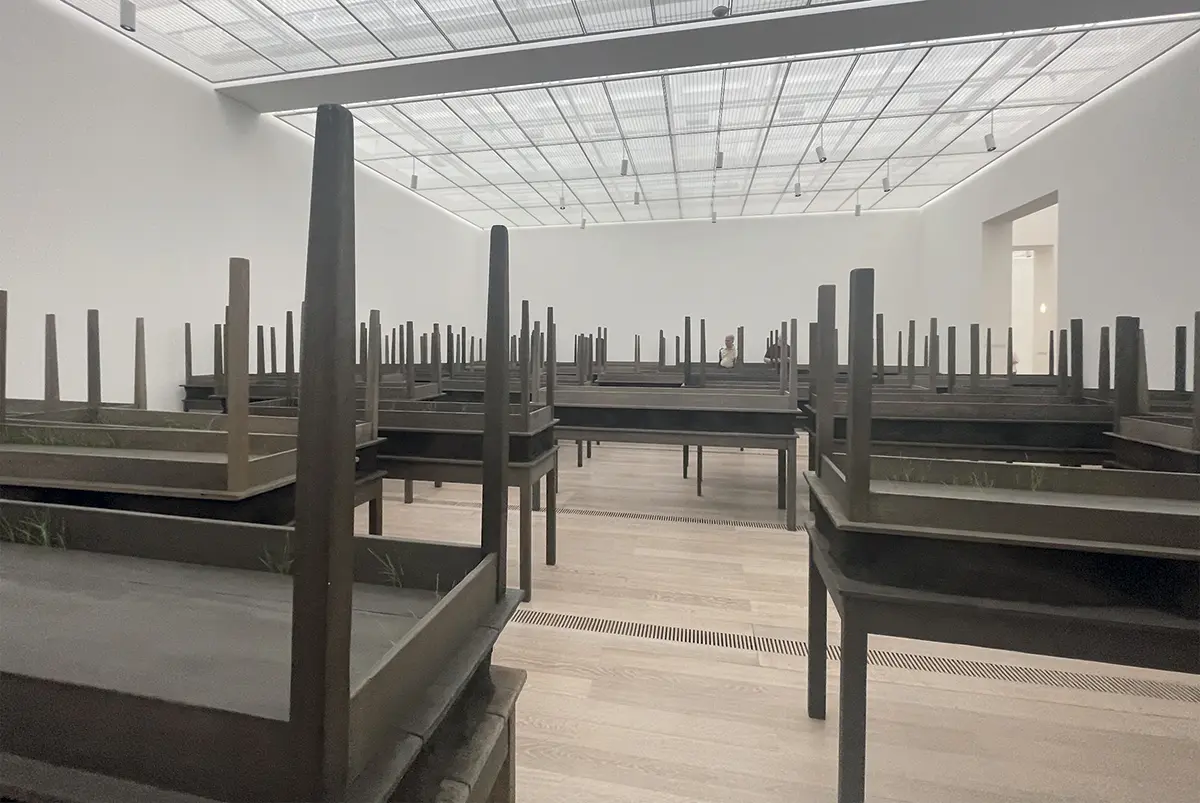
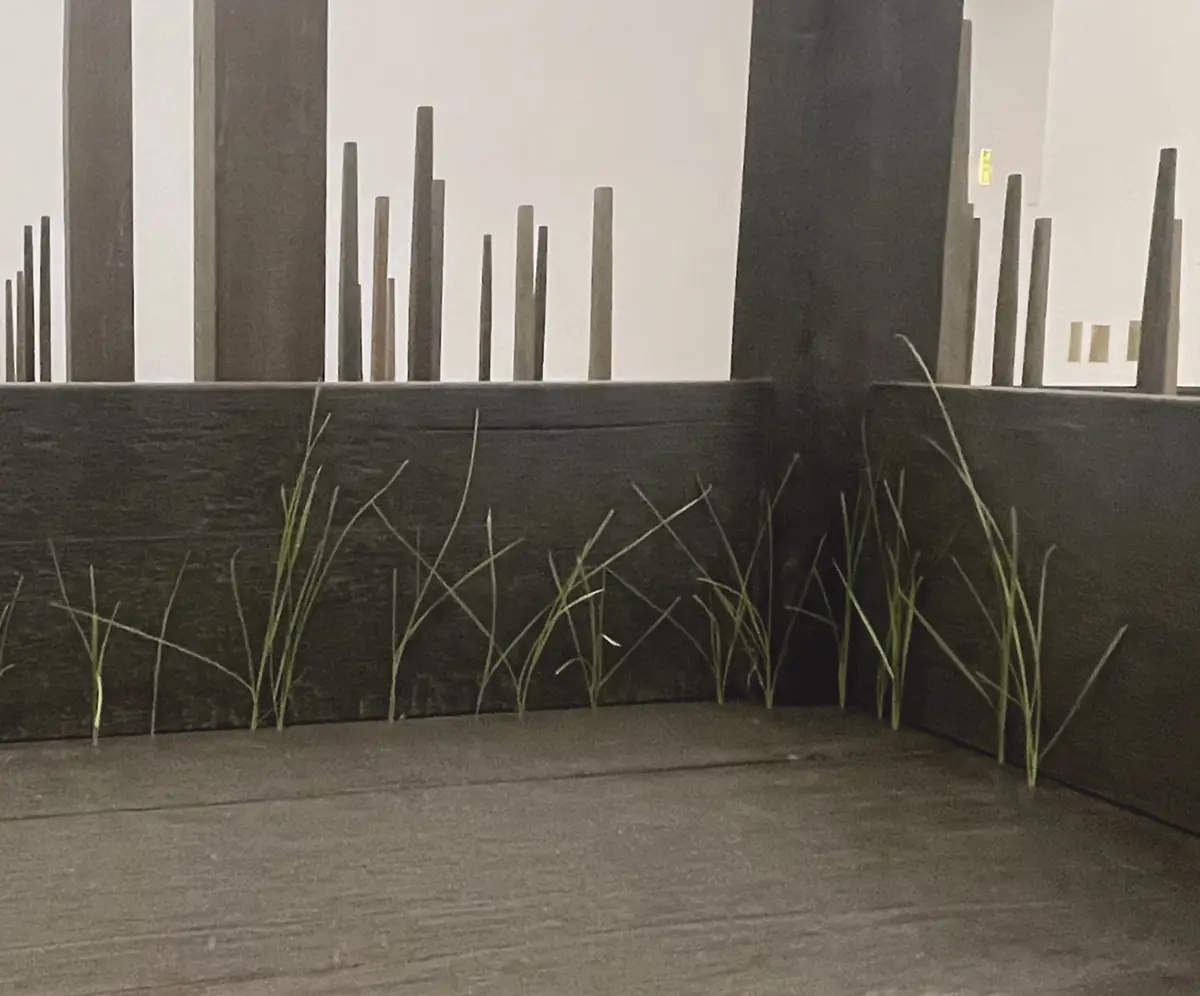
Plegaria muda (Silent Prayer, 2008-2010) is an installation commemorating the murder of innocent peasants made to appear as guerrillas killed in combat by the Colombian Army: 120 pairs of tables stacked one on top of another and joined with concrete slabs from which grass is sprouting, were arranged as a labyrinth. Poetically, it constructs a cemetery or mass graves that request the visitor not to be indifferent. In Untitled (1989-2014), she deals with families shattered by political violence; domestic spaces that will never be used again. This work presents furniture whose negative spaces were replaced with concrete: wardrobes, beds, tables, and chairs that no longer serve their purpose. Disremembered (2020-2021) consists of four translucent blouses hanging on the wall, made of silk thread that was sewn without tensioning the stitches and thousands of needles inserted into the fabric. How can blouses exist in a noble transparency woven with needles and raw silk threads as their only pattern?
In front of Unland: The Orphan’s Tunic (1997), whose title derives from a poem by Paul Celan, one wonders how can two precarious tables, found after dispossession, subsist united in two sections fitted together by a micro-seam of human hairs? How can its surface be crisscrossed throughout by those hairs? What needle can sew into wood?
In the anthology edited by the curators, you will be able to read poems, selected by Salcedo, by the young Vietnamese-American Ocean Vuong, and you’ll find an essay by the French-Algerian philosopher Seloua Luste Boulbina, titled Unsubmissive Phantology, which examines the persistent return of our social past.
I stumble over my shadow, when I sense an angel following me as I go out the door.
MARÍA BELÉN SÁEZ DE IBARRA