
The darkened rooms of the Museo de Arte Contemporáneo (MAC) evoked the magical feeling of theaters and their luminous projections. A variety of movie screens and monitors placed in open spaces, on the walls, and on the floor, showed the rhythmic and enigmatic movement of everyday things such as cobblestone bricks, bottles, plastic caps, coins, and even mangoes. Those objects play the leading roles in eighteen exceptional videos created by artists Donna Conlon (USA, 1966) and Jonathan Harker (Ecuador, 1975) in their work together over seventeen years.
This “seriously playful retrospective,” as the title announces, invited the viewer to explore videos that reveal a skillful combination of mischievous spirit with profound themes and outstanding technique. Organized by guest curator Sandino Scheidegger and MAC chief curator Juan Canela, the exhibition was co-produced by the MAC and the Fundación Casa Santa Ana. In addition to the exhibition, the foundation will be publishing a book, with texts by Paula Kupfer and Scheidegger, that will document this exceptional duo’s joint career.
The exhibition begins with seven invented (Video) games (2008-2009) that are played with objets trouvées such as broken bricks and mosaics, which the artists found through what they describe as urban archeology. We see only the hands of the two players in the (Video) games, which move the game pieces, following an unknown logic. They resemble the board games that are part of many traditions, which in this case work as symbols of weighty sociocultural subjects such as collaboration, political identity, and the interactions of power and gender. There was even a table with the live projection of a game board on which two visitors could play an invented “real” game of their own.
Instead of showing each video in its own black cube, this exhibition’s set was freer, which made it inevitable for the sound of each of the multiple works to affect the others—to a greater or lesser extent. The curators managed to create a successful flow to the exhibition: the product of careful forethought, considering the importance of sound in video art. The most impressive room was on the upper floor, where three huge screens set up in the shape of an open triangle projected Domino Effect (2013), Tropical Zincphony (2013) and The Voice Adrift (2017). All three of these videos give a life of their own to inanimate objects, which appear in continuous motion. It is a considerable achievement that the sound of the bricks falling one after another in the first video did not wage a sonic war with the mangoes rolling on zinc roofs in the one behind it, nor these with the plastic bottle flowing in water that rushes through city streets during a downpour in the video at the far end.
By comparison, the setup of a small dark room in which four videos were projected individually on each of the walls, seemed less interesting, at least initially. One’s curiosity was sparked by the fact that each video started just when one of the others ended, in a seemingly random fashion that held the audience’s attention. Visitors who stayed to watch all four videos, or who returned to that room, were richly rewarded in aesthetic pleasure, an element of surprise, and a rich sense of humor, as well as the sociopolitical messages these artworks convey. The room included Drinking Song (2011), Capapults (2012), Invisible Hands (2014), and Under the Rug (2015), videos that are linked by their narrative character and highly symbolic stories, in addition to the artists’ typical sense of humor and irony. In each video, Conlon and Harker (often represented only by their hands) appear to be “playing” with everyday objects, such as beer bottles, plastic caps, coins, brooms, and garbage, which they use to communicate messages about major issues such as corruption, money laundering, neocolonial situations, and the pollution of the natural world.
There was an intermediate stop in the exhibition to see Lottery (2017), an unusual, dreamlike, black-and-white video in a noticeably different cinematic style, evocative of the film noir of the 1940s. Later, in another transitional area, one could see Dry Season (2006) and Summer Breeze (2007), Conlon and Harker’s first two videos, on screens that created a triangle on the floor. In the former, the artists throw empty bottles on mounds of recycled glass, against a backdrop of natural mountains. According to Conlon, this piece combined—from that very first instance—her “concerns regarding the conflicts between the natural and the artificial” with Harker’s “sarcasm and penchant for the absurd.” The weather and excessive garbage are also part of Summer Breeze, where the wind creates a collage of colorful debris on a cyclone fence.
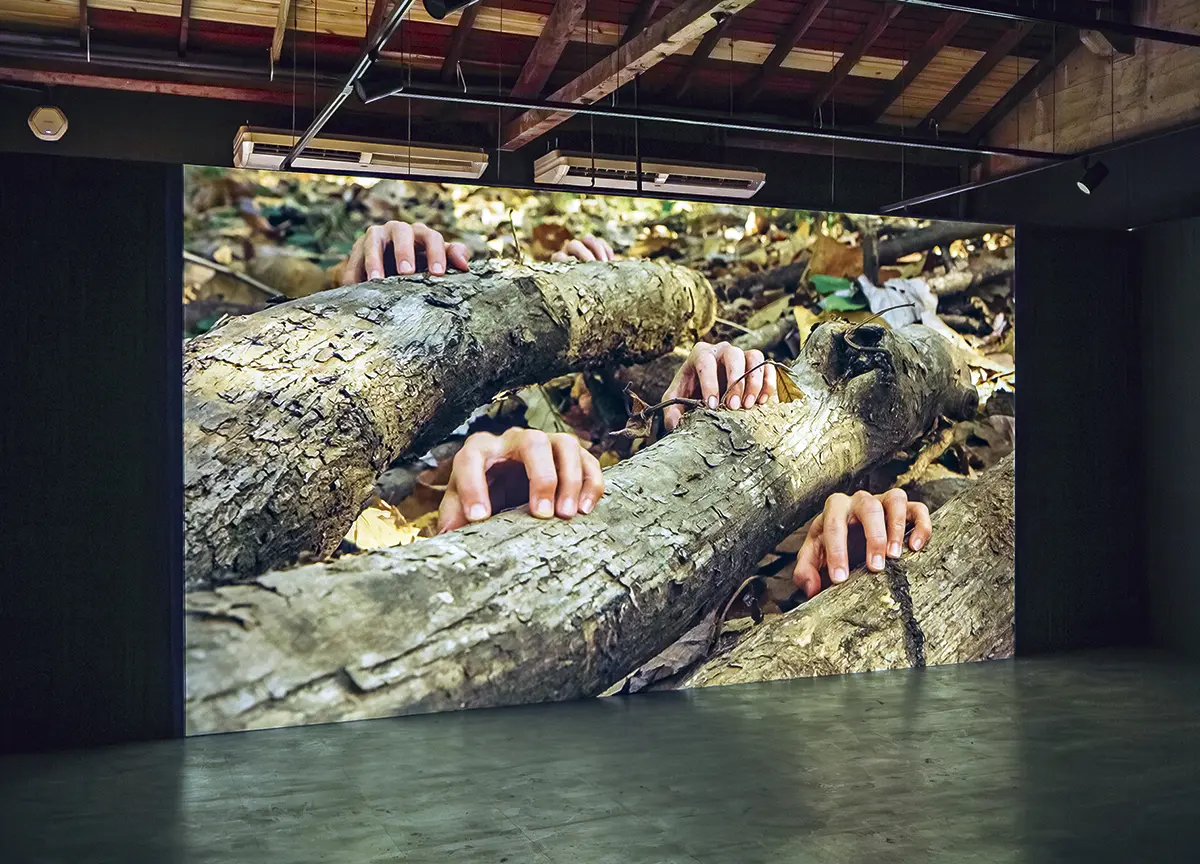
The exhibition concluded in a final exhibition space where the artists’ newest joint video entitled Handlings (2021) was projected on a large screen. As in a work of science fiction, strange and somewhat monstruous disembodied human hands move among the trees in an artificial teak forest, where they seem to be playing, hiding, and even coming together to mate. As in all of Conlon and Harker’s videos, it offers ample incentive for the imagination, as well as the opportunity to enjoy oneself, while being encouraged to think about the ironies in life and history, about social and political injustices, and about the relationship of human beings to their world, both natural and constructed.
MÓNICA E. KUPFER