This exhibition by Daniel Guzmán continues the explorations he has conducted since 2015, now with works dated from 2018 on, and expands them onto three-dimensional supports, where artworks and elements in differentiated scales and with distinct communicative processes are combined.
Displayed on the surrounding wall are various pictorial works that one can connect with four structures located at the center of the exhibition space. Guzmán refers to this group as “modes of reading and finding a way home”. This site will be a recurrent visual motif in several works as a symbol sown on surfaces of no place, or as a furious, overthrown being, or as part of a body with its organs spilling outwards, or as one being menaced by a giant, gesticulating character.
In each system, Guzmán engages the themes of Matando al padre, Matando a los hijos, Enterrando a los muertos, y Señales de vida (Killing the Father, Killing the Children, Burying the Dead, and Life Signals) in order to trigger more and more questions through the association of materials. Some of the elements are:
Matando al padre (Killing the Father) contrasts the tracing of an infinite symbol with the dualities of object/cosmos and subject/chaos, alluding to defecation, to mass graves that ineluctably put us in mind of the forced disappearance of people in Mexico.
Matando a los hijos (Killing the Children) gestures in the direction of Marxism as a social theory in an inscription in which the act named by the theme’s descriptor is understood as primitive communism, and there is a scene in which a military character brings down a smaller one: State/individual, father/son?
Enterrando a los muertos (Burying the Dead) combines the rereading of biblical narratives, a guitar that may bring to the fore the presence of music in death-related festivities, the infinite symbol with the dualities of object/cosmos, subject/chaos again, but this time with reflections about longevity.
Señales de vida (Life Signals) features a video projected from a cellphone behind an acrylic skull, with a legend about impermanence. Perhaps it symbolizes the incessant, loquacious work of the mind, and is accompanied by a text about a mother’s advice to set down and organize one’s thoughts in writing. The audiovisual displays names expelled from a future and a past, agents integrated into information about an expedition to a planet and the exploration of ruins found there, with paraphrases or quotations from Borges about “kissing pages savagely” without knowing “how to decipher a single letter”—perhaps with the artist himself observantly filming some works while not working in his studio, and there are shots of objects piling up.
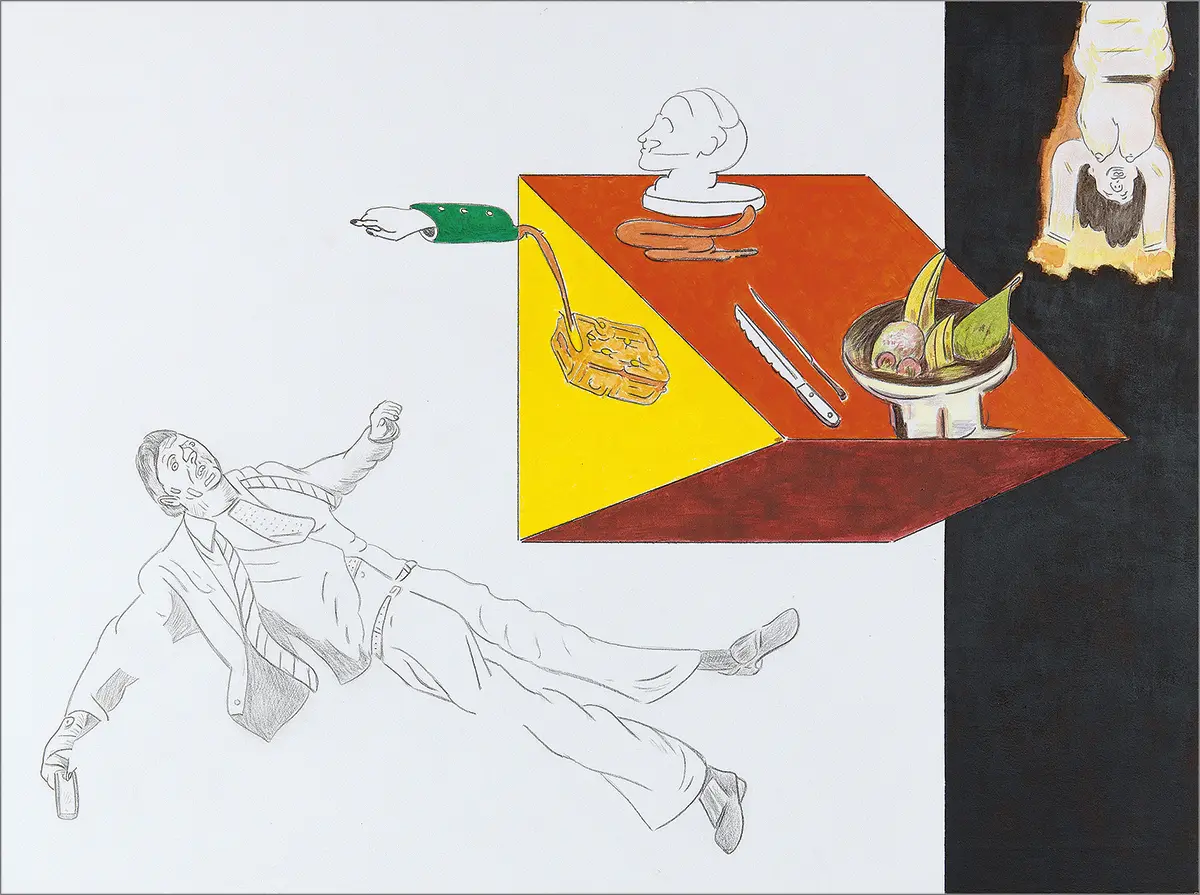
The outside of each of these thematic sets describes them as Ensayos de campo de concentración de narrativa temporal (Essays for a Concentration Camp of Temporal Narrative). On these panels, Guzmán expands motives and combines contrasting colors, superimposing, at times, versions of pictorial works at the sketch or work-in-progress stage delineated against a white ground, of which we find more finished instances further down the line.
Both in the paintings around the perimeter and in the elements of the central configuration, perception is informed by the connecting thread of densities of irradiating, simultaneous yet differentiated meanings.
There are references to indigenous traditions and representations (descending or standing deities, flayings, fretwork or trimmings); critical approaches to subjects like the family and religion; allusions to agents of violence in what could be military characters, helmets, explorer’s hats, torture scenes; corporealities, genders, and sexualities both female and male exhibited in their scatology; emerging from some of the latter, possible viscera that attach to planes or walls, while other bodies are pierced or penetrated by objects; architectural environments saturated by contrasting colors or planes, impossible in reality but convincing to our gaze as inhabited sites.
The diversity of supports offers opportunities for expressiveness: Kraft and bond paper, notebook pages, grid paper, framed drawings, boards, canvases, wooden structures raw in their reverse, and on them, some carved figures (rays, hands, bones).
The different degrees of finish (or not) in each element feature lines that refer to various visual functions: artwork, illustration, comic, gesture, and painstaking of hasty applications of color, unfinished areas or areas of sudden expressiveness, minimal delineations, supports with their textures in full, unvarnished display.
The above are some of the general characteristics of the journey that Daniel Guzmán plots for us, which he intervenes transversally with reminiscences of other creators in literature, music, and other cultural practices of prediction or interpretation of situations.
We can choose to follow the path suggested by the spatial arrangement of the works and the technical cards at kurimanzutto, and also to engage in explorations of our own design. On the walls, we may encounter dialogs about the mixed distribution of different axes of Guzmán’s pictorial production: rereadings of the still-life genre with skeletons and human remains and everyday object-emblems that perhaps suggest Mexicanness or rurality, offerings, or remains of animal meals; representations of tenants or card games, unencumbered corporealities engaged in inhabiting or playing. At times, the treatment of certain colors repeats in different areas.
Daniel Guzmán lives and works in Guadalajara (Mexico). He was a resident at the International Studio & Curatorial Program (ISCP), in New York. A First Prize winner in the Concurso de instalación en Ex Teresa Arte actual, he is a member of the Sistema Nacional de Creadores (National Artist’s System) and a former Jóvenes Creadores de la Secretaría de Cultura from México.
EUGENIA MACÍAS