A group of twenty-one works by Argentinean artist Daniel Fiorda (Buenos Aires, 1963) was on exhibit from May 6 through June 3 in the spaces of Edge Zones. It was the culmination of Fiorda’s year-long artist’s residence at the center’s facilities, won in competition in 2022.
In recent years, Fiorda’s practice has focused on the creation of works that emulate the archeological vestiges of modernity and the contemporary era. He uses found objects, taken apart and embedded into cement plaques or blocks, to create artworks that resemble the remains of a future catastrophe. Indebted to the povera aesthetic, Fiorda’s resources underscore the ruin-like character of his creations and their connection to current existential perspectives.
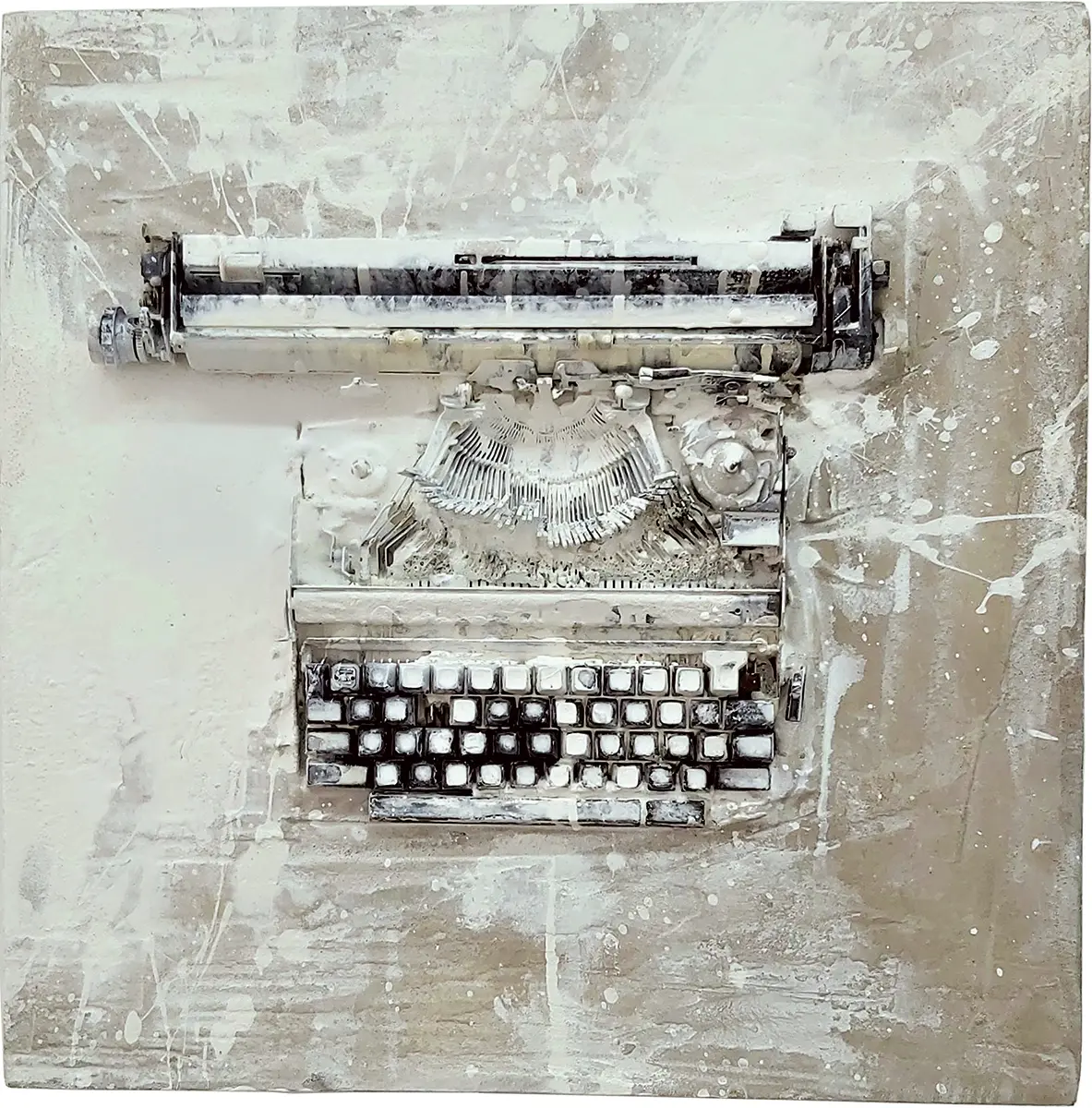
In a certain sense, the kinds of objects collected by Fiorda define a techno-temporal field within our culture. One such object is the typewriter, which he has incorporated into his works for years and has become one of his emblematic gestures. The exhibition under review included several items from the Typewriter series, comprised of cement plaques onto which the keyboard of an old typewriter has been embedded. Fiorda titles each one these works as a Finding, signaling the fact that they are based on found objects, and also suggesting their character as archeological finds from a dystopian future. The typewriter is also present in works like Tinta con sangre (Ink with Blood), a small plaque holding one of those two-tone red and black ribbons used by typists in the past and now almost forgotten, or In search of a lost time #3, where it becomes part of the foundation of an architectural section in concrete.
Evidently, cement is a key component of Fiorda’s grammar. As a defining item of twentieth- and twenty-first century architecture, the era’s the most widespread construction material, its creative use opens the door to innumerable relationships and connotations. Its aesthetic and visual qualities not only facilitate an enrichment of the works’ textures and their distinctive finishes, but also provide opportunities for inlaying, marking, formwork, modeling, dilution and splashing, etc. Similarly, the durability of the material has driven the artist to experiment with the random qualities that outdoors conditions can bring into his art. In this way, time enters the work not just by leaving traces of wearing, tearing, and decay, but also by allowing something of the reality of the vestigial to be part of what is being created. This is the case in In search of a lost time #4, comprised of found architectural fragments that Fiorda assembled together in precarious balance.
Paintings with concrete is the title of a series of works that also have cement as their protagonist. In one of them, Fiorda framed a high relief of interconnected cubic segments; in USB & #1, he used one of the factory-provided plastic casings used for the commercialization of the title’s ubiquitous device as a mold, casting a bas-relief of its readily identifiable shape.
Other objects deployed by Fiorda are equally characteristic of their technological era: old telephones (wired, wireless, and cellular), acetate discs, outdated electronics. His most recent series, A-i artificial intelligence, uses tiny nanotechnology components. The installation that welcomes visitors to the show, A-i artificial intelligence, City’s, features a grid with 42 concrete plaques encrusted with those small items. The title indicates the work’s similarity with a cartographic representation, while at the same time prompting a consideration of the role that artificial intelligence may ultimately play in our physical and mental landscapes.
A self-taught artist, Fiorda has spent his career mostly in the United States, where his work has been seen in numerous exhibitions. He has been the recipient of several honors, among them being selected by The City of Orlando Public Art Program, in Florida, for the year-long public installation of two of his works in 2002, and a prize at the 7th Annual Sculpture Competition organized by Washburn University in Topeka, Kansas, in 2003. His work is included in the collections of The Highland Museum of the Arts in Sebring (Florida) and the Museum of Latin American Art (MOLAA) in Los Angeles (California).
KATHERINE CHACÓN