The idea of the borderland brings forth notions of transit and portability, states of matter and uncertainties, essentialities and translations. Throughout her work, Chantal Peñalosa Fong uses her own experience of the borderland and what it represents as a platform for reflection. A native of Tecate, in the Mexican state of Baja California, and a descendant of Chinese immigrants, she visualizes and transposes linkages and memories in order to shift their place, to enunciate them with the radiance and the subtlety of what wears away. What remains for us are not experiences as such, but vestiges that invoke them with the frayed enchantment of their appearance.
It is tempting to compare Chantal Peñalosa Fong’s exhibitions to open books, involving as they do a certain portability, a collection of posters, notes, texts, and images that serve as the basis for building a narrative. But it is also possible to compare them—and to do it on the same terms—to Disney-like carnival or amusement park attractions, which would serve as extensions of that narrative. I have in mind, for instance, Atlas Western, a 2021 exhibition at MUAC curated by Amanda de la Garza, where Peñalosa recreated and documented Cine Pueblo, a Western-film soundstage built outside Tecate in an attempt to lure Hollywood productions at a time when the genre beginning its decline, and which survives with the spectral splendor of what never was. I’m also thinking of the catalog of essences that define both sides of the border, between what is lived and what is evoked, which was included in Peñalosa Fong’s Unfinished Business Garage, presented at Proyectos Monclova in 2019.
It could be that Peñalosa Fong uses both essences—that which takes into account, evokes, or reduces an experience—and shifts—be it real or imagined—in an attempt to extrapolate between real and figurative meanings that can construe a decayed Western soundstage as the enclave of an emotional archaeology. The ghostly nature of her new exhibition at Proyectos Monclova arises from that experience and that place. It is there in its very title, which quotes a particular genre of Chinese narrative. In it we can intuit, in the general perspective of her career trajectory, the braiding of narratives that, while dependent on stratum and device, converge into what is ultimately becoming a catalog of the immaterial.
The Chinese genre of Zhiguai xiaoshuo can be translated as “tales of the uncanny” or “register of the anomalous,” says Adriana Melchor Betancourt in her gallery text, following the connecting threads through which Chantal Peñalosa braids historical events and her own family story, invokes (or inhabits) real and invented places, and accounts for various levels of reality and figuration by means of equally various representation devices.
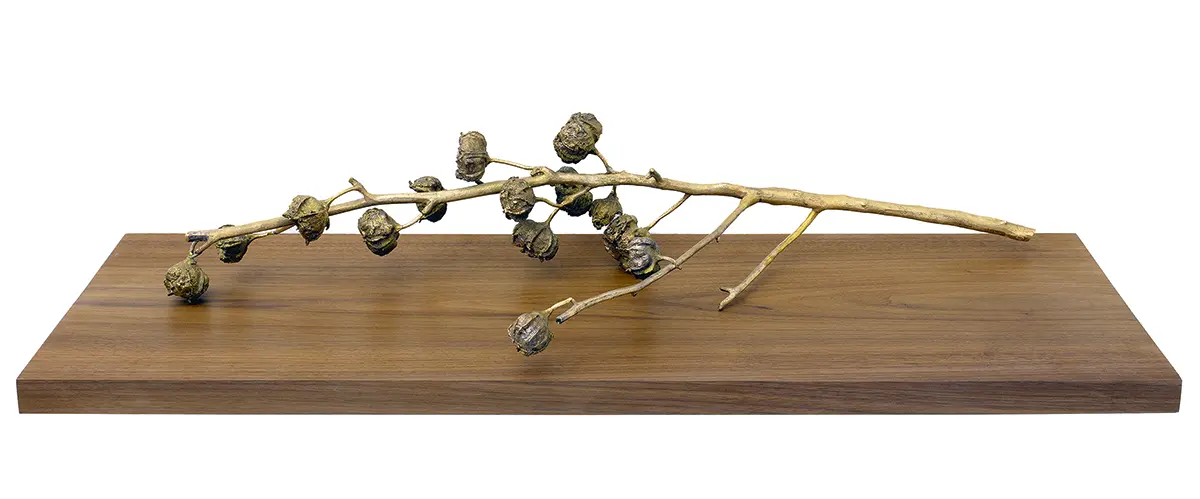
Peñalosa uses an artificial intelligence device to transfer into images her grandmother’s descriptions of her remembrances of China; then, she intervenes those images with watercolor to emulate the blue-green landscape figuration of Chinese shan shui. Or she makes a video recording in San Francisco’s Chinatown, becoming the narrative voice of the stories told by the women in her family about the Fong men’s flight there during the anti-Chinese persecution in 1930’s Baja California. Or she makes silkscreens based on a photo archive found in the city of Mexicali, documenting Chinese migration to Baja California (matched by a similar archive in San Diego); the resulting blotches evoke the ghostly nature that survives the images of ships. Or she produces a symbolic materialization of those linkages, transits, exploitations, and survivals in bronze sculptures of cotton flowers, related to the area of employment of Chinese laborers on both sides of the border.
The narrative material becomes essential for the representation of a family story that plays with evocation and invocation. Emulating the title she gave to her show, Peñalosa appeals to the Zhiguai xiaoshuo’s catalog of the supernatural as the last possible tableaux between the personal and the historical: versions that respond to different emotions and needs. Chantal Peñalosa Fong’s intention is not to tell the story of a social and political situation that extends into the present, as much as it is to invoke the vestiges that could constitute the core of such a story, which fades and disappears as those who can attest to it pass away. Her recourse to technology, evoking and updating the photocopy as a mode of transcription—medium or intermediary—takes the narrative to its ultimate materialization, insisting on the paradoxical distance between us and the object of our emotional attachment. She reconstructs it by artificial means in order to highlight it, and also to make our connectedness possible, on the basis of that which it tells us as voice, but also as a memory of that voice.
RICARDO POHLENZ